Cambridge professor Jason Arday faces plagiarism row ahead of memoir release
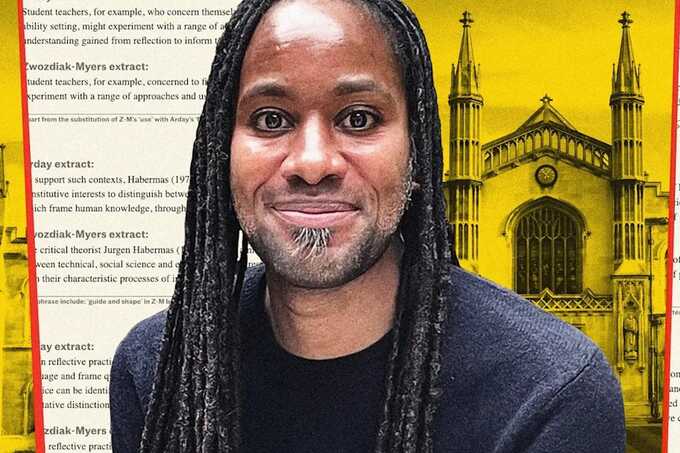
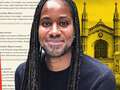
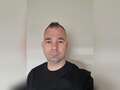
When Jason Arday became a Cambridge professor at the age of 37, he was lionised by the academic world and became a poster boy for the university’s diversity drive.
He had beaten almost impossible odds to get there. Diagnosed with autism, and non-verbal until the age of 11, he had only learnt to read and write at 18 but obtained a degree and a doctorate before forging a career in teaching.
Now, on the eve of the publication of his autobiography, the University of Cambridge’s professor of sociology of education has become the subject of a bitter row over plagiarism that has pitted his peers against each other.
On one side of the argument are professors at other universities who believe Prof Arday’s published works, including his PhD thesis, contain passages that are remarkably similar – and in some cases identical – to other academic papers, without proper attribution.
On the other side of the argument are friends and close colleagues of Prof Arday, the youngest black professor in the university’s history, who believe he is the victim of a racist smear campaign and have tried to make it an issue for the Government.
What started as a row between academics is now lapping at the shore of politics.
Both Cambridge and Liverpool John Moores University – which awarded Prof Arday his PhD – are on his side, insisting that he has done nothing wrong and the allegations are unfounded smears.
Cambridge said he had been the victim of a “vile campaign to undermine his credibility”.

The stakes could hardly be higher, as accusations of plagiarism can be career-ending for academics, and accusations that later prove to be false can be equally damaging to those who make them.
Until now, the row had been happening away from public view – but the publication of a blog this week, which features a side-by-side comparison of Prof Arday’s thesis with that of another student, has brought it out into the open.
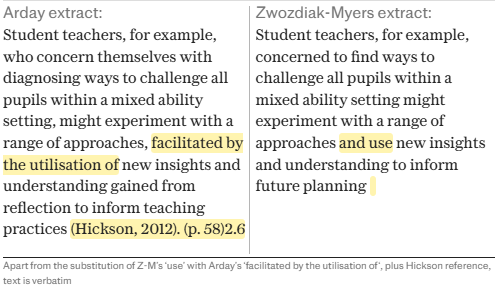
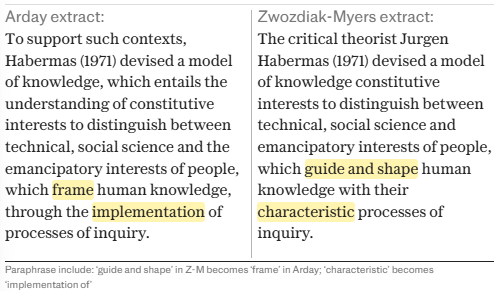
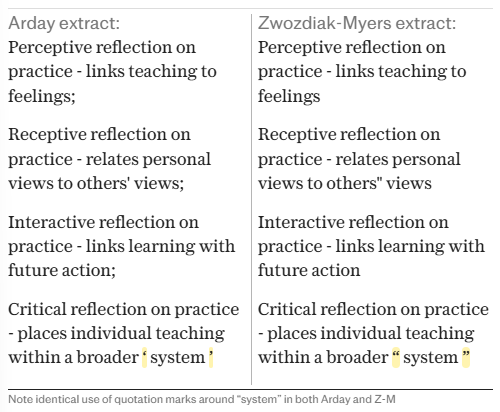
An analysis of Prof Arday’s PhD thesis for The Telegraph identified more than 100 passages that are identical or nearly identical to a 2009 PhD thesis by Paula Zwozdiak-Myers, a Brunel University student.
Prof Arday’s 401-page thesis, titled “An exploration of peer-monitoring among student teachers’ [sic] to inform reflective practice within the context of action research”, mentions Ms Zwozdiak-Myers 17 times.
The row between his supporters and his critics centres on whether he should have explicitly credited her on every occasion he paraphrased or quoted from her work, which is titled “An analysis of the concept reflective practice and an investigation into the development of student teachers’ reflective practice within the context of action research”.
Three examples of the work are:
Notwithstanding the two universities’ insistence that Prof Arday’s work has been checked and cleared, several respected academics have urged them to look again, arguing that computer programs designed to detect copying might have missed instances in which a few words have been changed or a sentence has been paraphrased.
Prof Arday made international headlines in 2023, when he became the youngest black professor in Cambridge’s history at the age of 37. His rise to the top of his profession was remarkable in the light of his autism, diagnosed as a child, which meant he did not speak his first word until he was 11 and left school with just two GCSEs.
He studied education at undergraduate and postgraduate level, completing his PhD at Liverpool John Moores University, and went on to hold academic posts at the University of Roehampton, Durham University and the University of Glasgow, where he became professor of sociology of education in 2021 before taking up a similar post at Cambridge three years ago.
He has now written a memoir, Great and Unfortunate Things, which is set to be published next month, in which he details his “improbable triumphs and heart-breaking setbacks”, according to publicity material for the book.
As well as his impressive academic achievements, Prof Arday attracted media coverage for multiple feats of ultra-endurance running to raise money for charity, which led to his selection as a torch-bearer for the London 2012 Olympic Games.
Scrutiny has also fallen on some of Prof Arday’s listed achievements, some of which have been amended or deleted from biographies in recent months.
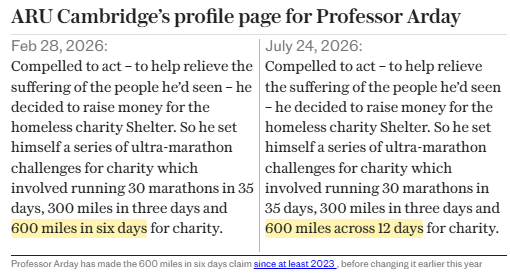
In 2010, the professor ran 30 marathons in 35 days to raise money for Shelter and the Shooting Star Children’s Hospice, and he has spoken about running 300 miles in three days and 600 miles in six days, only 50 miles short of the world record for ultra-distance running over six days.
Earlier this year, Southampton Solent University, which awarded Prof Arday an honorary degree in 2023, removed the references to running 300 miles and 600 miles from his citation on its website.
Anglia Ruskin University, which awarded him an honorary doctorate, recently changed the reference to 600 miles in six days to 600 miles in 12 days.
In total, Prof Arday says he has raised £5.5m for more than 70 charities.
Fellow academics began to raise concerns about the legitimacy of his published work when they carried out due diligence before inviting him to contribute to other academic papers.
Dave Harris, emeritus professor at Plymouth Marjon University, alerted Cambridge and Liverpool John Moores Universities to his concerns about plagiarism in 2023.
He said: “In my opinion, important sections of the work of Professor Jason Arday, both his PhD thesis and some subsequent published articles, solo and jointly written, seem to display indications of serious plagiarism. I can think of no other plausible explanation for what I have read.
“I notified both Liverpool John Moores and Cambridge universities of my initial concerns, and they have done nothing. Of the journal editors I notified, two have asked for corrections.”
One professor of education at a Russell Group university, who has asked to remain anonymous, said they noticed “inconsistencies” in his published research when they carried out checks before asking him to contribute a chapter on a book about decolonisation.
When they looked at his doctoral thesis, they “identified extensive textual overlap with an earlier PhD thesis submitted by another academic at a different university”.
Their assessment was that “the similarities were not confined to isolated passages but formed an extensive pattern of close paraphrasing”, which would not necessarily be detected by computer programs designed to detect verbatim copying of text.
‘Evidence should be rigorously examined’
Robert Dingwall, emeritus professor of social sciences at both the University of Nottingham and Nottingham Trent University and a government adviser during the Covid pandemic, said: “In the current climate, it is difficult to comment on allegations of plagiarism against a prominent minority scholar without seeming to take sides on EDI [equality, diversity and inclusion].
“Plagiarism is, however, rightly treated as a serious academic offence, at any level. We have a collective duty to call it out where there is robust evidence.
“From what I have seen, there certainly appears to be a prima facie case here. It may be difficult to find a suitably impartial adjudicator but, as a matter of fairness to all parties, the evidence should be rigorously examined and the subject invited to provide a detailed response, rather than being the victim of continuing smears and innuendos.
“This is a moment when universities in general, and sociologists in particular, must be willing to show that they are capable of living by their own standards of professional integrity.”
‘Potential public attack on Jason’
Supporters of Prof Arday became aware last year of questions about his academic legitimacy, and responded with furious accusations of racism.
Prof Sir Simon Baron-Cohen, the director of Cambridge’s autism research centre, and cousin of the comedian Sacha Baron-Cohen, and Ricardo Sabates, professor of education, circulated an open letter under the heading: “URGENT PLEASE SIGN ANTI-RACISM LETTER FOR JASON ARDAY.”
It referred to an earlier letter that “was sent to the Minister of State and to which there has been progress in terms of how to tackle these issues” and warned of a “potential public attack on Jason”.
Parliamentary records show that on Sept 15 last year, Jacqui Smith, the women and equalities minister, met a “range of academics to discuss the harassment of black academics”.
A spokesman for the University of Cambridge said: “Professor Arday has been the victim of a vile campaign to undermine his credibility, which must stop. Allegations of plagiarism regarding his thesis and journal publications have been thoroughly investigated by the relevant institution and the journals in question. Professor Arday has been cleared by those investigations of any wrongdoing.”
Liverpool John Moores University said in a statement: “In September 2025, the university received allegations of academic misconduct against its former PhD student, Professor Jason Arday. A confidential procedure was conducted in response to those allegations and Professor Arday’s PhD still stands. We will not comment further on a private matter between the university and a former student.”
Politics Editor
Read more similar news:
Comments:
comments powered by Disqus