Network Rail pleads guilty to failings in rail crash that killed three
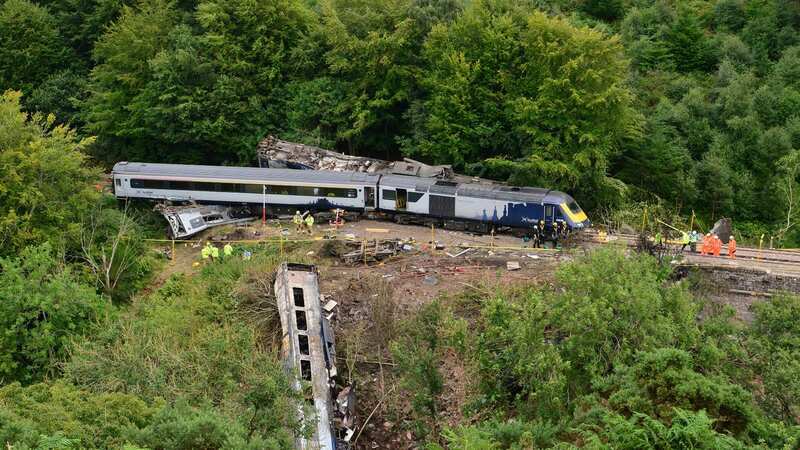
Network Rail has pleaded guilty at the High Court to health and safety failings over a rail crash that claimed three lives near Stonehaven, Aberdeenshire, in 2020.
Train driver Brett McCullough, 45, conductor Donald Dinnie, 58, and passenger Christopher Stuchbury, 62, died in the derailment near Stonehaven, Aberdeenshire, on August 12, 2020. At the High Court in Aberdeen this morning, the company admitted a charge covering the period from May 1, 2011 to August 12, 2020.
The partner of Mr Dinnie has said her life has been “turned upside down” as a result of the crash. Trish Ewen, 59, said they should have been planning their retirement. She said: “The last three years has completely turned my life upside down. Donald and I should be thinking about retiring together and planning the rest of our lives – instead he was taken and I’ve been left to exist alone."
Network Rail admitted it failed to ensure, so far as was reasonably practical, that railway workers not in its employment and members of the public travelling by train were not exposed to the “risk of serious injury and death from train derailment” as a result of failures in the construction, inspection and maintenance of drainage assets and in adverse and extreme weather planning.
The charge states that in particular, Network Rail failed to ensure, so far as was reasonably practicable, that a drainage asset located off-track of the Dundee to Aberdeen railway line near Stonehaven, constructed by Carillion between May 1, 2011 and December 31, 2012, was “constructed properly” and in accordance with the design drawings. The charge also says Network Rail failed to conduct a handover meeting with the contractors to check the drainage asset had been properly constructed and built in accordance with the design.
 Paco Rabanne dies aged 88 as tributes pour in for fashion and perfume legend
Network Rail also admitted it did not have an adequate system of training and quality assurance in place in relation to the analysis of weather forecasts, which resulted in no emergency extreme weather action teleconference being held on the morning of August 12. Court documents outline how there was a forecast of “extreme rainfall” and reports of severe weather, landslips and flooding in Aberdeenshire and the surrounding area on the day of the crash.
 Investigators at the scene in Stonehaven (PA)
The charge states Network Rail failed to impose an emergency speed restriction “in absence of current information about the integrity of the railway line and drainage assets between Montrose and Stonehaven”, and failed to inform the driver that it was unsafe to drive the train at a speed of 75mph or caution him to reduce his speed. The charge outlines how the drainage asset which had not been properly constructed failed, gravel was washed out from the drainage trench and on to the railway track, which the train struck, causing it to derail, decouple and strike a bridge parapet.
As well as the three deaths, a further six people were injured in the crash. Network Rail admitted breaching two sections of the Health and Safety at Work etc Act 1974.
Speaking after the prosecution, Ms Ewen who was Mr Dinnie’s partner of eight years, recalled the day Mr Dinnie died. She said received a phone call while she was at work to say there had been a train accident. Ms Ewen said: “I went to a family member’s house and we all sat around the television – we didn’t know what else to do. We all just sat there looking at the news footage seeing shots of ambulances and helicopters and fire engines.”
She said the family had not received a call to confirm if it had been Mr Dinnie’s train but Ms Ewen said she knew in her gut that it was. Ms Ewen added: “Despite this gut feeling, I still actually expected Donald to be fine – I told myself, ‘He is the conductor so he’ll be busy helping the passengers.’ While later we heard the driver died and that’s when my stomach started turning and I feared the worst. I felt dizzy. Like the blood drained from my head.
“My hands and arms felt heavy and shaky and almost disconnected from the rest of my body. I was just in a daze. The day started like any other – Donald and I preparing breakfast, talking about our plans for that evening after work. I couldn’t understand how things went from that to this. I couldn’t understand how Donald was here, then gone.
“I couldn’t comprehend how our life together went from normal to over. Just like that.”
A 32-year-old woman who survived the crash has shared her memories of Mr Dinnie on the day. She said she felt guilty about surviving when she thought of him, but that he was a “chatty and genuinely nice man” and that he made passengers feel safe. She said: “I spoke with Donald that day about the possibility of the weather stopping us from making it to our destination. He made sure I had access to the train wi-fi, so I could notify my family of the delay.
“Donald spoke to me about his partner, even joking that the weather would mean he’d get to finish early and was excited to get home. He kept us all informed, thinking of other people the whole time and making sure we were all okay. When I learned he died I felt an overwhelming sadness.”
The loss of Mr Dinnie has been difficult for Ms Ewen to come to terms with. She added: “You don’t know what to do, where to turn and there’s genuinely nothing to do but brace yourself for each new day without your loved one. It’s right there is criminal accountability for this totally avoidable incident that has affected so many people and families but I believe imposing a fine is counter-productive as it’s essentially the Government paying a fine to itself. I think any financial penalty would be better invested in improving the railways or making sure all the Rail Accident Investigation Bureau report recommendations are acted on.”
 Jeremy Clarkson’s daughter gives birth to first child and shares adorable name
Read more similar news:
Comments:
comments powered by Disqus