Britain and Germany deepen defence ties with new long-range missile project

Britain and Germany are entering a “golden age” of defence co-operation as they build a long-range missile designed to defend Europe against Russia.
In what could mark a shift away from the traditional “Franco-German engine” of leadership, Berlin and London hope to deliver by 2034 a deep precision strike (DPS) missile which could be used to destroy Vladimir Putin’s resupply lines inside Russia.
Sources familiar with Britain’s defence strategy say they have cast aside a Cold War-era view of Germany as passive and ineffectual, and now believe it is essential to countering Putin.
The two sides have bonded over their “straightforward” approach to defence co-operation, which for the Germans is a welcome departure from the squabbling and clash of egos which have marred their relationship with France.
They have also largely turned the page on the tumultuous Brexit years, with old arguments over EU regulations giving way to joint defence projects to counter Moscow, including a closely guarded long-range missile programme.

“The UK for some years wanted Germany to play a role on defence that it just couldn’t politically, but now that’s changed, there is an enormous sense of opportunity,” said a UK security source, alluding to Germany’s new goal of building the strongest conventional army on the Continent.
“Will there be a golden age? There’s certainly interest on both sides,” said another source, who predicted a “renewed push” on deepening the bilateral relationship under Andy Burnham, the new Prime Minister.
At the heart of the new relationship are two bilateral treaties, Trinity House and the Kensington agreement, which have unlocked a string of German defence industry-led projects in the UK.
They include a fleet of sea drones that will protect British waters from Russian saboteurs, a £400m “Gun Hall” that ramps up artillery production and Rheinmetall’s latest version of the Boxer, a British Army infantry vehicle.

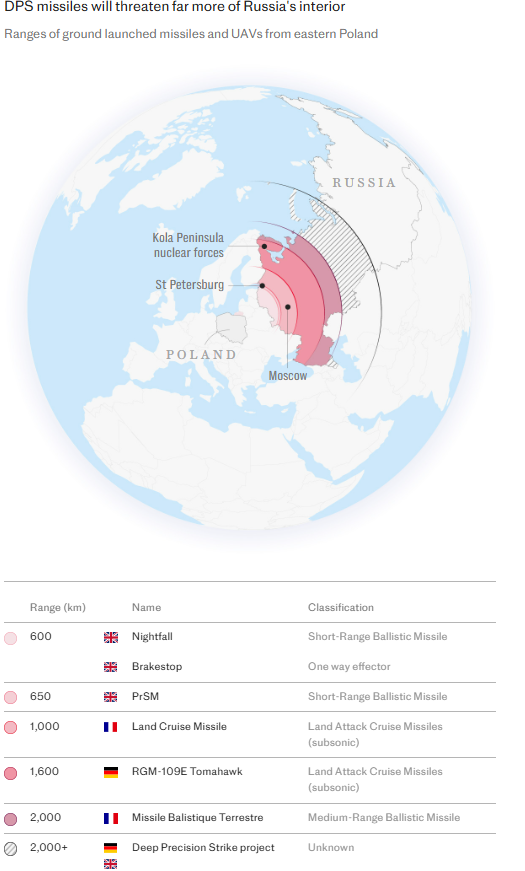
But The Telegraph understands the jewel of the crown is a DPS missile programme, which aims to produce a missile capable of destroying strategic targets in Russia from more than 1,243 miles away.
The £30bn DPS programme was announced as a British-led project of 12 allied nations at the Nato summit in Ankara earlier this month, with Germany expected to play a prominent role.
Defence industry sources say the project will probably draw on a combination of German funding and British expertise, following the model of recent German-funded expansion of arms factories in the UK, which have also created hundreds of jobs.
The German government last year passed historic reforms which allow unlimited spending on major defence projects, as part of its “Zeitenwende” policy – a fundamental shift in Berlin on European security in response to Putin’s war on Ukraine.
British officials are eager to move the project from a 2024-era letter of intent to a formal programme in 2027 and, ideally, the completion of the weapon by 2034.
Two versions of the DPS missile are under consideration: a low-flying cruise missile which flies under Russian air defences, and a hypersonic missile which travels at five times the speed of sound.
The Telegraph understands that on the British side, there is a sense that the project is moving forward at a good pace, and potential for it to become a symbol of Europe weaning itself off American military support.
US-Europe tensions rose this week as the Trump administration said European countries were deluded if they believed they could eclipse the US as major security powers.
“The simple fact of the matter is that no alternative country or countries can compete with the US defence industrial base, either in quantity or quality,” Elbridge Colby, the US undersecretary of defence, wrote on X.
“The United States, as the president says, makes the best equipment, and we make it at a scale that no plausible competitor can match,” he added.
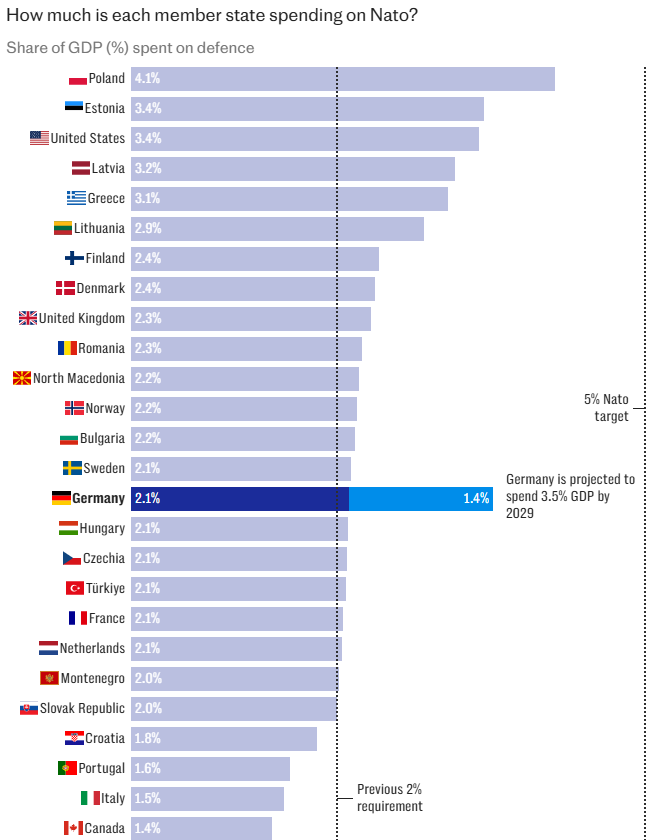
His mockery of uppity “middle powers” has raised eyebrows, as the Trump administration has repeatedly complained that Nato’s European members do not spend enough funds on defence.
On the German side, officials are optimistic about the DPS programme but do not see it as the “centre of gravity” on long-range missile projects. Rather, they see it as one among several projects with potential, such as the French-led European Long-Range Strike Approach (Elsa).
There are also some concerns that the project needs to move even faster than its current timeline for completion in 2034.
Beyond that, the key details of the programme are being kept tightly under wraps.
But Dr Sidharth Kaushal, a missile expert at the British security think tank Rusi, said whatever form the project takes, it would have a major influence on Nato deterrence against Russia.
“Fundamentally, DPS is the ability to strike a target that is strategically significant, such as the enemy’s headquarters, or paralysing its ability to sustain the front line by striking logistics nodes,” he said.
Currently, he said, Nato’s arsenal would struggle to hit key targets located deep within Russia because of a lack of long-range capabilities. “There is almost nothing beyond a relatively small number of Tomahawks that could hit those targets,” he said, alluding to the American 1,490-mile-range cruise missile.
Significant German investment
Since the signing of Trinity House in 2024, and the Kensington Treaty last year, German defence firms have significantly increased investment in the British arms trade.
Defence industry sources have welcomed a spirit of “direct” communication and “getting on with it”, in contrast with the doomed Franco-German FCAS fighter-jet project which collapsed because of infighting over its core functions.
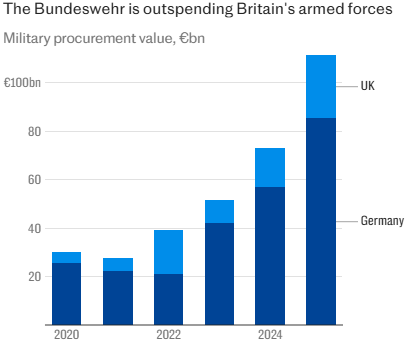
“Germany has made the financial commitments, they are spending dizzying amounts,” said one source. “They take a while to make a decision, but once they’ve made it, they really get on with it in this sort of logical Prussian manner.”
The source praised Andrew Jonathan Mitchell, the British ambassador to Berlin, for “getting more stuck into the security side of things” than any of his post-war predecessors.
In 2025, Rheinmetall, the German arms giant run by Armin Papperger – who is so critical to European rearmament that Russia tried to assassinate him – opened a “UK Gun Hall” in Telford, which produces artillery systems and tank guns for the British Army’s Challenger 3.
An estimated 400 British manufacturing jobs have been created for the new facility, while Rheinmetall has also taken on production of several hundred Boxer fighting vehicles for UK forces.
In March, Heckler & Koch, the German gun-maker famed for arming the SAS with its MP5 submachine gun, acquired an Essex-based machinery firm to increase production of weapons parts.
Helsing, a German defence firm which specialises in AI, recently opened a hi-tech underwater drone factory in Plymouth to produce surveillance drones.
Those industry projects, it is hoped, have laid the groundwork for a new Anglo-German defence partnership that will be tested by the hugely ambitious DPS missile system.
However, the programme is at risk of facing similar issues to FCAS, the Franco-German “fighter jet of the future” project.

FCAS collapsed as the Germans felt frustrated that the French side only wished to use them as a funding source for the fighter jet and not share expertise.
The French side of the project also alienated the Germans with an ego-driven sense of superiority, driven by Berlin’s comparative lack of investment in defence over previous decades.
There are also concerns that the level of ambition for the new alliance is slightly lopsided, with the British side more enthusiastic than Germany – which would like to keep its options open.
Some military experts fear that the timeline of the DPS programme is simply too long, especially considering how fast Ukraine has managed to move in the long-range sphere.
Ben Hodges, the former commander of the US army in Europe, said the 10-year timeline was “ridiculous” and that the project lacked a “sense of urgency”.
“The Ukrainians already have drones that can go 2,000 kilometres with a big warhead,” he said. “We’re not talking about putting people on the moon.”

Technology & Business Editor
Read more similar news:
Comments:
comments powered by Disqus