Europe warned to build its own nuclear deterrent as Russia pressures NATO
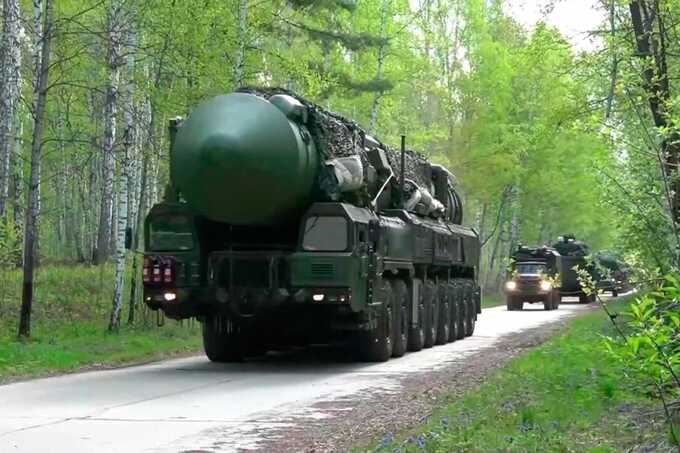
Russia is expanding its nuclear-capable, long-range weapon systems to press Europe and fracture NATO. Europeans need to plug the gaps in their nuclear capabilities and create a strategic deterrent that can function without US support.
Mutually assured uncertainty
In May 2026, Russia moved some of its nuclear warheads to Belarus. The two countries held joint nuclear exercises to practise using the non-strategic nuclear weaponry Vladimir Putin has entrusted to Alexander Lukashenko, his friendly authoritarian neighbour. Moscow also brandished other parts of its nuclear arsenal—the world’s largest and most diversified—during a large-scale exercise spanning three days “to prepare and use nuclear forces in the face of the threat of aggression”. In total, the Russian-Belarusian drills involved 64,000 military personnel and over 200 missile launchers.
If Russia can claim victory in its war of aggression against Ukraine, it will partly be thanks to the same nuclear weapons that in May 2026 Putin paraded across north-west Russia’s Leningrad and Central military districts. Russia has not yet deployed these in combat but, since 2014 (and especially since the full-scale invasion in 2022), Western leaders have hesitated to provide specific weapon systems or loosen restrictions on their use by Ukraine’s armed forces. Amid fear of escalation, they have also refrained from supporting Ukraine more directly, for example, by sending troops to fight alongside the Ukrainian army or fighter jets to protect Ukraine’s skies.
So, even short of direct employment, it seems that Russia’s nuclear arsenal has already succeeded in intimidating the West and constraining European support to Ukraine. Now Russia’s developing theory of victory (that is, its strategic framework for how to succeed in conflict), and its military concepts and capabilities, indicate that it is prepared to pursue a nuclearised confrontation in Europe. To achieve its dual goal of fracturing the West and keeping war outside its borders, Russia is ready to fight and win a limited nuclear war.
But Europeans, without the once firm guarantee of US support, have few ideas for how to meet such a challenge—and even fewer capabilities. Instead, they find themselves on the edge of chaos, inhabiting the uncomfortable space between order and disorder where a continued loss of coherence in their nuclear strategy and approach to America’s waning support for NATO could eventually lead their deterrence of Russia to fail. Europeans urgently need to unite around a shared vision for credible strategic deterrence and identify how to achieve it. If they do not, Russia could be more emboldened to stage an attack that threatens European territorial integrity and cohesion.
This paper details Russia’s approach for a nuclearised confrontation with Europe and the nuclear and strategic non-nuclear capabilities it would rely on. Drawing on interviews with more than two dozen officials and experts from Estonia, Finland, Germany, the Netherlands, Norway, Poland and Sweden, it outlines the lack of coherence in Europe’s current approach towards developing an effective deterrent and suggests how it should amend its strategy to prepare for future Russian aggression. The paper recommends how Europeans can close persistent gaps—in their nuclear forces, conventional long-range strike, missile defence, and intelligence, surveillance and reconnaissance (ISR) systems—and shore up their strategic thinking and policy coherence.
The overall goal is for Europeans to form an integrated strategic deterrence posture for themselves. This approach needs to complement the US nuclear umbrella and contribute to burden-shifting in NATO. If the worst came to pass, it should function in lieu of them both. Europe’s two nuclear-armed powers, France and Britain, are central to any such effort, but Europe’s non-nuclear countries cannot leave the conceptual and operational questions to these two. Generating requirements and capabilities for deterrence and assurance that are credible in the eyes of both allies and adversaries will require significant contributions at every level. Failing to do so would allow Putin to bend Europe’s borders and leave behind a fractured, weakened continent.
The Russian threat
Putin’s Russia is prepared for war with Europe: it has developed the capabilities and coercion tactics to be able to scare Europeans into acquiescence. To be prepared to face such a conflict, Europe needs to fully understand how Russia expects to fight and win a war with Europe, and what capabilities it has to do so.
The seed for Russia’s modern military capabilities came in the late 1970s. Then, the emergence of conventional long-range precision weapons caused Moscow’s military thinkers to work hard to understand their implications for conflict with nuclear-armed adversaries. But little practical implementation followed their conceptual efforts. Instead, the US developed the weapons and before the Soviet Union could catch up, it collapsed.
Spurred by demonstrations of overwhelming Western airpower in the second Gulf War and in Kosovo, Moscow began developing a strategic reconnaissance-strike complex—a system to find and strike enemy targets at long range using networked sensors and precision weapons. It modernised old and fielded new nuclear-capable long-range ballistic and cruise missiles as well as sensors and command-and-control systems. The result was a leap in Russia’s threat capabilities: a suite of long-range weapons able to reach far into Europe and to carry conventional—or nuclear—warheads. Russia first tested some of these weapons in Syria after 2015, and has used them regularly against Ukraine since 2022.
Nevertheless, Russia’s inability to coerce Ukraine’s surrender or further constrain Western support by raising the nuclear spectre has led to intense debate among Russia-based experts on the strategic use of such nuclear-capable strike systems. But Russia has not abandoned its doctrine or its capabilities. Instead, it is doubling down and expanding production of key weapon systems. Another conflict in Europe involving Russia would likely see even more intense nuclear coercion and larger-scale use of long-range conventional weapons by Russia from the outset. According to Russia’s logic, if at first you do not succeed, escalate and escalate again.
Russia’s theory of victory
Two philosophies have shaped Russia’s strategic outlook since at least the 19th century. They provide the broader context for how some analysts of Russian military strategy—according to official documents, leaders’ statements, military journals and exercises—form a Russian theory of victory. The first philosophy is that the main threat to Russia stems from an “unrelenting” West; the second is that the best way for Russia to protect itself is by “waging war away from Russia”. These approaches explain Russia’s proclivity to pre-empt perceived threats before they reach Russian territory, and reinforce its desire for buffer zones (Armenia, Belarus, Ukraine) in its near abroad. These dual philosophies create a blueprint to understand Moscow’s theory of victory, that is, how Russia would plan to achieve its goals in a conflict.
This thinking runs through Russia’s strategy today. In December 2021, Russia presented draft treaties to the US and NATO (which they rejected) to reverse central and eastern European countries’ efforts to join Euro-Atlantic security structures since 1997—in line with Russia’s first philosophy of “Western encroachment”. In doing so, Russia attempted to impose limits on its neighbours’ sovereignty and their ability to resist intimidation and domination via diplomacy.
Since 2022, Russia’s war against Ukraine has been the most violent expression of this desire. Now that Russia sees NATO and its members, and especially European countries, as vassals of the US and rarely as independent actors, growing uncertainties around America’s future role in European security and US extended nuclear deterrence are feeding Russia’s perception of its advantage. If Russia’s leaders view war to be imminent and inevitable, the Russian theory of victory supposes an immediate, rapid and overwhelming use of military force before the US and NATO can prepare for an attack.
Because Russia would be unable to defeat NATO militarily, it would instead selectively impose costs, risks and psychological pressure on NATO leaders and populations. Its aim would be to weaken NATO politically and militarily so it can induce acquiescence on key decisions—such as whether to resist Russian aggression or to respond to Russian escalation. As deterrence strategist Brad Roberts argues, it could achieve this “by creating an image of a terrible price to be paid in confronting Russia militarily, by creating the expectation that political confrontation would become military confrontation, and by reinforcing the expectation that any military confrontation would be a nuclear confrontation”.
Russia’s theory of victory, concepts and capabilities aim to first break NATO; then impose Russia’s political objectives on a helpless and divided Europe. The idea is that Moscow would be able to achieve its long-held ambitions with the West out of the way.
Russia’s concept for escalation management
Russia’s dual philosophies on conflict explain the strategic role played by long-range weapons—nuclear and conventional—in Russia’s theory of victory. In this context, strategic non-nuclear weapons do not replace nuclear weapons. Rather, the latter enhance the credibility of the threat to use the former. Long-range weapons mean nowhere in Europe is safe. Russia’s thinking is that their use will deter any European retaliation, because this could always be met with Russia using strategic nuclear weapons in the next round of strikes.
Russian military doctrine distinguishes between the fundamental aspects of local, regional and large-scale war; its weaponry is geared towards containing and managing escalation at these separate and distinct scales. As it stands, Russia’s arsenal consists of strategic nuclear, non-strategic nuclear and strategic non-nuclear forces.
Russian doctrine can indicate which behaviours are likely and the credibility of its threat to use nuclear weapons. According to its strategic toolbox, the use of non-strategic nuclear weapons in a local conflict to achieve limited objectives is unlikely because their use comes at too high a cost. In breaking the nuclear taboo, Russia would risk roping in other nuclear armed powers to respond.
However, a regional conflict for Moscow would be far more existential. According to its theory of victory, the aim would still be to contain the conflict and avoid escalation to a large scale by fracturing coalitions and deterring major powers from joining. But this time, it could do so by threatening the use of strategic non-nuclear weapons and non-strategic nuclear weapons to inflict calibrated and selective damage or force capitulation. Here, Russia’s strategic nuclear forces act as deterrence and coercion through escalation dominance: Russia has the nuclear trump card and is not afraid to play it. A regional conflict could thereby facilitate limited and suggestive nuclear strikes.
Russian capabilities support this logic as conventional and non-strategic nuclear weapons have no constraints on their integrated employment. Put simply, most are dual-capable, meaning they can carry both conventional and nuclear payloads. As such, Russian long-range systems and their operating units can assume both strategic non-nuclear and non-strategic nuclear roles or provide conventional fire support.
Russian targets for strategic operations include high-value military assets as well as political and economic assets. Among these, strategic operations for the destruction of critically important enemy targets (SODCIT) use strikes on critical and civilian infrastructure to psychologically affect leaders and populations. Attacks on Ukrainian hospitals and churches stem from Russian thinking on targeting for a strategic effect.
The war against Ukraine reveals gaps between Russia’s ambition and the capability of its armed forces in the field. Striking mobile targets, such as an Iskander missile launcher, at ranges beyond 500km remains a challenge. Having said that, Russia’s long-range drone forces are improving their ability to strike at shorter, tactical-operational depths. So, Russia’s adversaries should not discount its ability for innovation.
Despite Russia’s military shortcomings, its military thinkers still see its experience in the war as validating its presumptions about the character of modern warfare. These range from the importance of long-range precision strike capabilities to using non-military means, such as influencing adversaries decision-making to achieve battlefield and strategic objectives. As Russia’s experiences have merely confirmed its doctrine, trends visible before 2022 could well accelerate, including the deepening integration of nuclear and non-nuclear strategic capabilities in a unified concept for strategic operation. Unlike European doctrine, the threat of nuclear use is integral to a Russian theory of victory; it has the long-range capabilities to give that credibility, and it is likely to keep developing them.
Russia’s evolving capabilities
Just as Russia has had its presumptions about modern warfare confirmed in Ukraine, Russian leaders are also learning what capabilities are most effective and how they need to be improved to fight a larger-scale conflict.
Russia has a diverse and growing arsenal of nuclear-capable long-range weapon systems which can be launched from aircraft, surface ships and submarines, or ground launchers. Russia’s programme to modernise its Soviet-era strategic nuclear forces is in its final stages: it is equipped with approximately 2,600 strategic nuclear warheads, of which about 1,800 are permanently deployed on missiles and at bomber bases.
Nuclear weapons and land-based missiles in Russia and Belarus
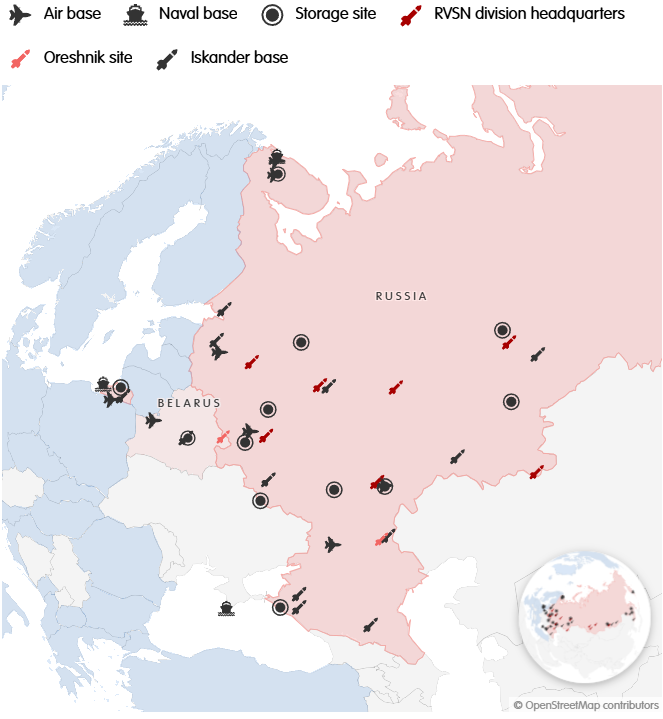
The dual-capable, long-range strike systems of Russia’s general purpose forces have also improved considerably since the early 2000s. It has Iskander land-based ballistic and cruise missile variants, Kalibr supersonic and Tsirkon hypersonic cruise missiles and Kinzhal air-launched ballistic missiles. The Russian military is assigned around 1,800 non-strategic nuclear warheads, including warheads for gravity bombs, depth charges, torpedoes, anti-aircraft, anti-ship, anti-submarine, anti-ballistic missile systems and nuclear mines, in addition to other dual-capable missile systems.
In sum, Russia’s nuclear arsenal is larger and more diversified than that of any one NATO country, including America’s. It is ten times bigger than the combined arsenals of Britain and France. But numbers alone cannot tell the whole story.
Russia’s long-range systems have underperformed. In the early days of its full-scale invasion of Ukraine, flaws in Russia’s campaign plan and targeting, alongside Ukrainian adaptability, prevented Russia’s long-range attacks from achieving the decisive strategic effect. Russian cruise and ballistic missiles struck targets across the entirety of Ukrainian territory, but Ukraine’s relocation of its aircraft, air-defence systems and other critical assets protected them. Ukraine was able to keep Russia from gaining control of the airspace over the battlefield.
Previously touted by Putin as specifically designed to evade missile defences, Ukraine’s Western-provided anti-missile systems have also intercepted Russia’s Kinzhal air-launched ballistic missiles and its Tsirkon hypersonic cruise missiles in up to a third of cases. This is because these systems decelerate in their final approach to the target. These strikes degraded but failed to disintegrate or disable Ukraine’s armed forces or to produce the psychological pressure to force its surrender.
Despite SODCIT, Russian target lists omitted some of Ukraine’s high-value political, economic and military-related assets (power plants, civil administration, military headquarters, for example). This oversight occurred because Russian leaders assumed that they would quickly depose Ukraine’s leadership and then control these assets through proxies. The same would not be true for the port of Rotterdam or Berlin’s Charité hospital. Planning for a ten-day war against a neighbouring country (essentially a local conflict in Russian doctrine) differs from planning to collapse a coalition’s cohesion in a regional, if not large-scale conflict—such as one with NATO.
Therefore, Russia would consider how to use its strategic toolkit—including its long-range weapons—in a conflict with NATO more expansively than it had initially planned in Ukraine.
Russian nuclear and long-range weapon systems
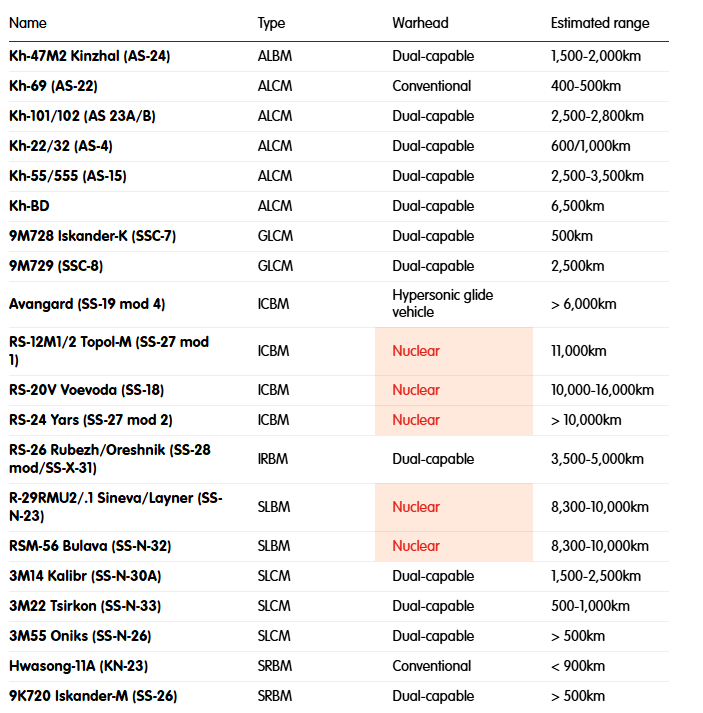
Despite proven weaknesses in its missile systems, Russia is innovating to ensure that intercept rates do not creep too high. It is also using other systems, such as the Oreshnik ballistic missile, which it has fired against Ukraine three times so far. While Oreshnik lacks precision, this matters less when Russia aims it at large industrial compounds or uses it for indiscriminate terror bombing of urban areas. Imprecision also matters less for Russia when these dual-capable systems carry a nuclear payload, which produce exponentially greater explosive power.
Even as Russia continues firing missiles at Ukraine, it is replenishing and expanding its stockpiles. Russian solid-propellant rocket motor production, for instance, has grown since 2023. Its strategic nuclear and general-purpose forces depend on solid-propellant rocket motors for their long-range systems. In mid-2025, Ukrainian intelligence estimated Russian monthly production to be at 60-70 Iskander ground-launched ballistic missiles, 60-70 Kh-101 air-launched cruise missiles, 10-15 Kinzhal air-launched ballistic missiles and at least 75-100 long-range munitions of other types. This is a considerable increase from the year prior, with plans to expand further.
These numbers suggest that some of Russia’s monthly weapons production ends up in storage; that what Russia fires at Ukraine exceeds the number of anti-missile interceptors the latter receives from the West; and that Russian production exceeds European production of long-range weapons.
Russia is also expanding its air capabilities beyond missiles: its long-range drone forces could soon become a strategic non-nuclear asset. In November 2025, the Russian armed forces established the unmanned systems forces as a separate combat arm akin to the strategic rocket forces. This new organisation institutionalises drone warfare and provides drone forces with a command structure for organising, training and equipping. But Russian military thinkers are still contemplating whether long-range drones can form an integral part of combined-arms operations to foster coercion and fracture cohesion, like Russian doctrine assumes for dual-capable long-range precision missiles. So far, when Russia combines drones and missiles for attacks against Ukraine, the drones saturate Ukraine’s air defences and improve the ability of missiles to reach their designated targets.
In a conflict with Russia, Europeans would initially confront thousands of drones and missiles. Their deployment would threaten European defences, exacerbate Europe’s psychological and political paralysis, and deepen the current incoherence on nuclear and defence policy across the EU and NATO. Europeans would be right to be anxious.
Europe’s nuclear anxiety
Over the last 20 years, Russia’s dialling-up of nuclear intimidation has not gone unnoticed. In 2007, Putin ordered the resumption of strategic bomber patrols against European military installations which, along with Russian nuclear-capable tactical fighters, regularly fly mock-attack manoeuvres. In 2015, Russia threatened to target the Danish navy with nuclear weapons if it integrated its vessels into NATO’s ballistic missile defence system. Russia’s initial invasion of Ukraine in 2014 also featured a flurry of nuclear activities; a playbook it has repeated since 2022.
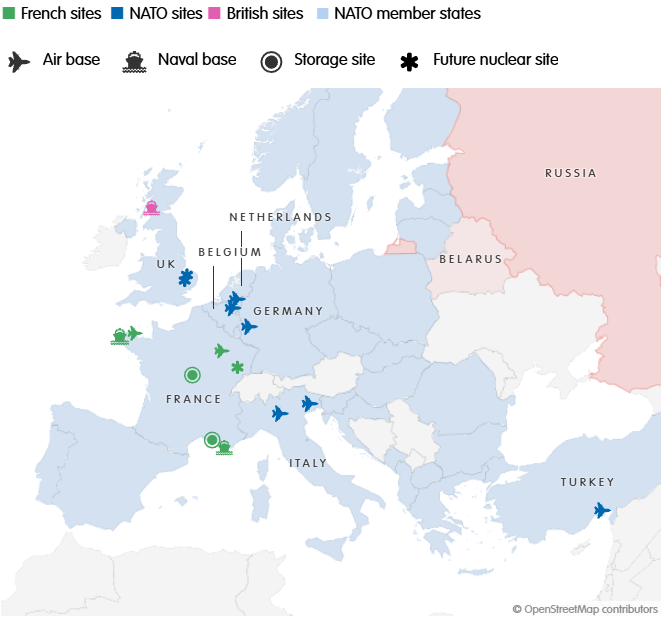
NATO has avoided tit-for-tat responses. Instead, following deep reductions of allied nuclear forces at the end of the cold war, US administrations engaged with NATO’s Nuclear Planning Group and its subordinate forums to maintain support for post-cold-war nuclear-sharing arrangements. In practice, this saw select European countries—Belgium, Germany, Italy and the Netherlands, as well as Turkey—host US nuclear weapons and provide tactical aviation to the NATO nuclear mission. Fighter jets, nuclear bombs and associated infrastructure have seen upgrades, but NATO still abides by its 1997 pledge to not place nuclear weapons on the territory of “new members”.
Nuclear weapons in European NATO countries
Interviews showed that European countries have varying degrees of satisfaction with this setup. Finland and Sweden joined NATO in 2022 for the nuclear deterrent, “after all,” as one Swedish interlocutor remarked “there is no Article 5 for a good partner.” They joined without formal caveats on military activity, but have issued political declarations prohibiting the peacetime deployment of nuclear weapons to their territories.[1] This aligns with Denmark’s and Norway’s long-standing legal stipulations to that respect, thus maintaining Nordic coherence on nuclear policy.[2]
Dutch officials drive conversations on increasing the visibility of NATO’s nuclear deterrent and adopting conventional long-range precision weapons to bolster NATO’s mix of deterrent capabilities.[3] Polish leaders, on the other hand, want to assume a larger role in NATO nuclear sharing by certifying Poland’s F-35A dual-use jets for the nuclear mission or hosting US nuclear weapons.[4] Meanwhile, Germany purchased the F-35A specifically to maintain its involvement with the NATO nuclear mission. But in the shadow of US unreliability, Berlin is now seeking a more European approach to nuclear deterrence.
However, most respondents reported productive working-level relations with US counterparts in NATO and bilateral formats, even acknowledging that American leadership is still developing NATO’s deterrence posture. At the same time, they observed fractures stemming from America’s stance on Greenland and Iran, and Trump’s mercurial attitudes. In the words of a Finnish interlocutor, an invasion of Greenland would present “a nasty problem for Nordic cooperation”, and would obliterate the credibility of US extended nuclear deterrence. In such a scenario, Russia might take the opportunity to act against NATO countries and European NATO members would have no choice but to still cooperate on finding a deterrent for Russia.
European perceptions of threats, deterrence and alliance credibility.
Country profiles based on interviewee responses, March-June 2026
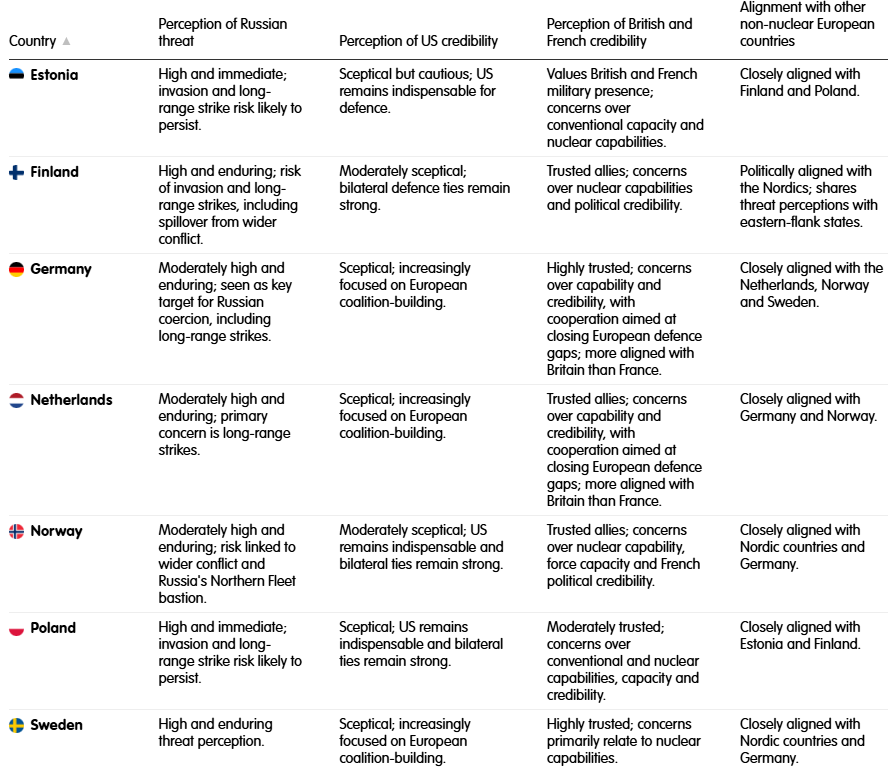
With NATO in a bind, most interviewees still believe that their country’s bilateral relationship with America—based on what they see as enduring US strategic interests in the high north, eastern flank and bases in central Europe—will fare well. At the working level, this conclusion makes sense as cooperation with America continues smoothly; where it falls down is that “in the end the American president is who decides” on the extension of its nuclear deterrence, according to a Swedish interviewee.[5] Yet, among Europeans, one Estonian interlocutor observed, “western Europe is afraid of nuclear war and eastern Europe is afraid of occupation”—this is one division Russia works to deepen and exploit.
Amid this uncertainty, France and Britain, Europe’s two nuclear-armed powers, are seeking to strengthen deterrence and alleviate nuclear anxiety in Europe. Their July 2025 Northwood declaration claimed that the two nations would respond to any extreme threat to Europe. French president Emmanuel Macron’s “forward deterrence” proposal of March 2026 explicitly aims to enhance a continental “feeling of security”, while Britain will resume its role in NATO nuclear sharing.
But where interviewees are keen to engage with France and Britain (Norway’s prime minister described it as a “hedging strategy”), none believe that their current nuclear postures could compensate for America’s role. British and French domestic political uncertainty further raised doubts for many about the durability of the two’s current initiatives. France’s nuclear doctrine receives considerable scrutiny, with many open questions remaining to be cleared up in consultations and a desire expressed by most interlocutors for France to multilateralise its deterrence outreach and activities.
This predicament could lead to some national governments concluding that the only way to prevent Russian domination is to launch their own nuclear-weapons programme. To date, such discussions have been vague and lacked political and military leaders’ buy-in. In any case, they face near insurmountable technical and financial obstacles. One Swedish interlocutor noted that, with regard to developing an independent nuclear capacity, “when you know what it means [to do so], you realise it is all just talk.”[6]
But this perspective could gain further traction if Russian aggression fails to produce a sufficiently forceful response from Britain, France and the US or if nuclear weapons detonate elsewhere. The latter scenario would normalise their use and may prompt nuclear proliferation.
The US nuclear umbrella is irreplaceable for the foreseeable future; Europeans cannot abandon it. But they must build something that approximates its deterrent effects, lest Russian leaders see America abandoning its defence of Europe as an opportunity to apply their theory of victory, concepts and capabilities.
How Europeans should create an integrated strategic deterrence posture
The doctrine behind the machine
Europeans do not need to emulate the US or Russia by developing thousands of nuclear warheads. Rather, they need the ability to negate Russia’s theory of victory by denying it a strategic advantage at key decision points: first to deter conflict and second—if deterrence fails—to manage escalation in line with European objectives.
This is a project for the coming decade. By the mid-2030s, the European integrated strategic deterrence posture, underpinned by credible strategy and concepts, should have nuclear and conventional long-range strike capabilities which can credibly threaten devastating retaliation to a Russian attack; air and missile defences to deny Russia confidence in its long-range coercion strategy; and intelligence capabilities to outpace Russian moves throughout crisis and conflict. Relying on only one of these assets without integrating it with the others would leave Europe exposed to Russia’s strategic coercion.
Meanwhile, a coalition of European leaders, such as a “strategic posture group” within a European-led NATO and backed by Europe’s brightest deterrence strategists, would ensure collective responsibility, multilateral coherence, joint planning and rapid action to navigate a nuclearised confrontation with Russia. But construction on this project must begin now to allow Europeans to gradually acquaint themselves with the practice of strategic deterrence.
The raison d’être of the European integrated strategic deterrence posture is twofold: preserving individual political sovereignty and territorial integrity; and preserving European cohesion. These are mutually constitutive. A loss of country sovereignty would collapse European cohesion, while the loss of cohesion would expose countries to threats to their political sovereignty and territorial integrity. Just as Russia’s theory of victory seeks to affect Europeans’ assessment of the benefits, costs and risks of different courses of action, so should Europe force Russia to assume the costs and risks of escalation at key decision points.
What Europeans can do: Six principles behind a deterrent
Below are a set of principles—the contours of a theory of victory—that should guide a European construction project. Each principle aims to dissuade Russia from pursuing certain options or objectives towards Europe at key decision points. Together, the principles aim to address Russia’s theory of victory: fracture NATO and prevent getting major powers involved; have escalation superiority; and ultimately threaten use of its nuclear capabilities to deter a European response.
These principles should underpin a European theory of victory which can guide Europe’s deterrence adaptations. It would be counterproductive to try to detach this from NATO strategic documents and thinking, because that is how most European countries have come to approach deterrence strategy. Still, a European theory of victory, concepts and capabilities based on their specific deterrence requirements should be narrowly tailored to the Russian threat—and to how Russian leaders view their own strengths and vulnerabilities.
America’s military prowess, meanwhile, remains central to NATO but must account for multiple nuclear-armed challengers. Regardless of whether America is willing to aid European defence, a US force posture that is optimised for contingencies in the Asia-Pacific or elsewhere is less suited to Europeans and could produce undesirable escalatory pressures. Europeans therefore need to account for the possible absence of US strategic assets (nuclear and non-nuclear) and leadership. If they fail to do this, it could expose Europe to considerable risks of deterrence failure and defeat in conflict.
Consequently, a European theory of victory guiding the construction of a European integrated strategic deterrence posture needs to differ from how NATO—as an alliance of 32 Euro-Atlantic countries—plans to deter and defend itself against Russia. Several EU members categorically reject the notion of nuclear deterrence. This suggests that E5 leaders—Britain, France, Germany, Italy and Poland, possibly alongside Baltic, Dutch, Nordic and Spanish representation—should take the lead instead.
Macron has called for mutual support or shouldering between nuclear and non-nuclear capabilities, as well as nuclear-armed and non-nuclear European countries. The following sections therefore elaborate on European conceptual and capability gaps in four interrelated areas—nuclear forces, conventional long-range strike, missile defence, and ISR—and how to close them. These four pillars should make up Europe’s strategic toolkit to realise the six principles outlined above.
Nuclear forces
The unique role of Britain and France
Britain and France, Europe’s two nuclear-armed powers, are adapting their nuclear postures to address the deteriorating security environment. Both initially developed their nuclear deterrents under the umbrella of US extended nuclear deterrence, meaning their forces were historically configured almost exclusively to protect national vital interests rather than carry out the escalation management or damage limitation functions deemed necessary by the US. Nevertheless, since 1974, NATO has recognised British and French nuclear forces as “contributing to the overall [strength] of the deterrence of the Alliance”, with London and Paris serving as “separate centres of decision-making”. Having three potential places of nuclear launch decisions complicates the risk calculus for Europe’s potential adversaries. However, both also shy away from a more fundamental reappraisal of their doctrines.
Britain has approximately 260 warheads for its strategic ballistic-missile submarines. The Labour government is set to re-establish an airborne nuclear capability and resume participation in NATO’s nuclear-sharing arrangements; it is acquiring F-35A fighter jets and has seemingly agreed to host US nuclear bombs at RAF Lakenheath. On one hand, this enhances the operational credibility of NATO’s nuclear posture by adding another country, its aircraft and bases to the setup. On the other, Trump is jeopardising the effectiveness of Britain’s role by raising doubts about his willingness to risk nuclear escalation on Europe’s behalf and authorise the use of US bombs. And, although Britain’s sea-based strategic deterrent is operationally independent from America, it draws from a US-based pool of common missiles. This structural dependence could erode the British strategic nuclear deterrent if the US denies Britain access.
France’s nuclear forces, by contrast, are operationally and structurally independent from the US. France has around 290 nuclear warheads: of these, 240 are assigned to its strategic ballistic-missile submarines, while 50 are designated for the nuclear-armed cruise missiles of France’s land-based and carrier-based nuclear aviation. France, too, plans to expand the airleg of its nuclear deterrent by reactivating Luxeuil-Saint-Sauveur air base; Macron’s nuclear deterrence speech in March 2026 announced an increase of warheads in France’s arsenal. He also reiterated the fundamental link between European collective security and French national security: a “different strategic universe”, he says, has led France to evolve how it operationalises the European dimension of its national interests.
Macron’s “forward deterrence” proposal entails steering groups, enhanced cooperation on select non-nuclear capabilities and the participation of European partners in French nuclear exercises. He also advocates for the deployment of French nuclear-capable aviation to other European countries to create an “archipelago” of dispersed forces across Europe, with the aim of increasing their survivability and establishing a strong link between European partner territory and French deterrence. Some of these activities have variously occurred in recent years, but Macron’s proposal rationalises them within one framework—with the possibility of further evolution.
Macron also explicitly rejects the idea of nuclear sharing, or for France to join NATO’s nuclear consultations and planning. And while the European dimension of France’s vital interest features prominently in the speech, there is no commitment to defend the vital interests of its allies. For most Europeans, US policy—which has traditionally “consider[ed] the use of nuclear weapons […] to defend the vital interests of the United States or its allies and partners”—seems to remain the baseline.
So, despite French and European security being fundamentally linked, forward deterrence is not a French version of extended nuclear deterrence; it is a class of its own, aimed primarily at enhancing the credibility of French nuclear deterrence. After all, French doubts about US extended nuclear deterrence were a key motivator for its independent nuclear weapons programme. In 1961, France’s then-president Charles de Gaulle reportedly asked his American counterpart John F. Kennedy whether the US would “trade New York for Paris”. Referencing this episode, a Norwegian interview respondent interrogated France’s willingness to “risk Paris for Vilnius”.
Our interviewees also questioned the level of European partner involvement in French nuclear operations: if France’s nuclear forces must be able to execute any mission independently, what is the contribution of France’s European partners exactly? British nuclear policy did not elicit the same degree of scrutiny. This is because, as one Nordic interviewee put it, European partners are familiar with Britain’s nuclear grammar by virtue of its participation in NATO nuclear formats and its assigning of nuclear forces to the alliance.
If Britain and France—by virtue of the evolving nuclear landscape and US disengagement from Europe—extend nuclear deterrence to their European partners (recognising that Macron has not offered to do, but that other Europeans would desire it), they will face a similar conundrum to one that has plagued US strategists for decades. How can they ensure that Russia does not perceive its stakes to be greater than Britain’s and France’s in a conflict that plays out close to Russian borders? How can Britain and France resist Russian attempts to de-couple them from European frontline security by imposing calibrated and selective costs, risks and psychological pressure with nuclear and conventional long-range weapons?
Many interviewees commented on what they perceive as limitations to the British and French deterrence posture’s ability to deal with the challenge of limited nuclear employment by Russia. Although Britain retains a low-yield nuclear warhead, this sits atop a submarine-launched ballistic missile. A submarine that depends on invisibility for its survival is by definition a poor instrument for signalling resolve in the face of the threat of limited nuclear use. France’s air-launched nuclear-armed cruise missiles provide for greater operational and signalling flexibility, but its doctrinal limitation to one “unique and non-renewable” nuclear warning shot—despite potentially consisting of multiple weapons being employed in one such strike operation—forces France to face a choice. It must either conduct a large-scale strategic nuclear attack if Russia persists and invite retaliation in kind, or fold.
Recommendation: Address the imbalance
Macron posits that strategic non-nuclear capabilities, including conventional long-range precision weapons and missile defence, can help manage escalation below the nuclear threshold. But British and French nuclear forces arguably face their greatest challenge in addressing limited nuclear employment for coercive purposes by Russia. Britain and France should ensure their commitment to extended nuclear deterrence is based on greater flexibility, perhaps through the joint development of a next generation nuclear-armed cruise missile for their air forces. A separate, national development of this system is likely financially infeasible for Britain, while British collaboration would lessen the budgetary burden of the programme for France. As France and NATO recognise, nuclear-capable aircraft are uniquely able to signal nuclear resolve, including by deploying them to dispersed locations and partner countries.
Britain and France should also cooperate on nuclear-armed cruise missiles for their submarines. The Royal Navy can manoeuvre military aviation equipment via its carriers, but these do not have a nuclear deterrent role. Furthermore, French carrier-based nuclear aviation would lose some benefits of dispersal when French land-based nuclear aviation begins forward-deterrence operations across Europe. For the cost of one aircraft-carrier strike group (in 1997, construction of the French aircraft carrier Charles de Gaulle was estimated to cost approximately €3.4bn), either country could expand their fleet of nuclear-powered attack submarines and equip each with nuclear-armed and conventional cruise missiles. This provides flexibility in deterring or countering limited nuclear employment by Russia.
Developing an air-launched or submarine-launched low-yield nuclear cruise missile proposal is no quick fix—the production and introduction of new nuclear capabilities is a long game. But this could bring a meaningful and substantial boost to the nuclear component of Europe’s future integrated strategic deterrence posture. If Britain and France decide on this development now, it would send a signal to Russia already that Europeans will not let themselves be intimidated by threats of limited nuclear use.
Beyond such capability adjustments, Britain and France should consult their European partners over nuclear strategy and operational planning, with the aim of determining how to navigate deterrence thresholds. Where ambiguity could be useful for deterrence by creating incalculable risks, Europeans need greater clarity about the collective responsibility of nuclear and non-nuclear countries for European security. Creating a European-led centre of excellence for integrated strategic deterrence may support this effort through concept and doctrine development, analysis and education of civilian and military leaders, strategists and operators.
Britain and France should use their long-standing trilateral format on nuclear matters with the US to remind Washington that its interests would be affected amid an escalating war with Russia. Therefore, it is better to sustain cooperation across the Atlantic in order to deter Russian aggression in the first place.
Conventional long-range strike capabilities
The problem of the US monopoly
Conventional long-range precision weapons can enhance the operational credibility of nuclear deterrence. They increase the probability that a nuclear strike reaches its designated target by suppressing or destroying adversary missile defences. But this is only the narrowest conception of their use for strategic deterrence and well behind how NATO countries have considered conventional long-range weapons, or “deep precision strike”, in recent years.
Europeans now see conventional long-range weapons as useful for the battlefield and for strategic purposes, such as deterrence and escalation management. Throughout the 1990s and early 2000s, however, only the US could afford to develop and operate conventional long-range precision strike at scale. This quasi-monopoly in NATO was reinforced by America’s desire to retain control of allied escalation in conflict and led Washington to deny allies access to US-developed long-range weapons. In turn, US allies—apart from nuclear-armed Britain and France—were largely willing to forego such capabilities. This allowed the advancement of arms-control objectives, and also meant that the US would shoulder the burden of escalation. But Europeans have realised that, without American forces and capabilities, and US-made weapons and munitions, they possess precious few long-range precision systems; they are potentially ill-equipped to independently deter and manage escalation.
Now, amid serious gaps in European land forces, some military leaders are calling to prioritise long-range drones and rocket artillery for tactical-operational fire support which extends out to 500km, rather than getting lost in abstractions about deep-precision strike. But, while Europe needs drones and rocket artillery to achieve an effective conventional forward-defence posture, they are insufficient against a Russian military whose leaders believe it can defeat Europe through superior operational design and strategy. Surrendering the conventional long-range strike echelon also leaves Europeans few counter-escalation options to deter Russian strategic operations, and strengthens Russian perceptions of strategic-operational advantage.
If western European leaders hesitate to reinforce frontline states for fear of Russian nuclear or conventional attacks on their countries, tactical fires to support these manoeuvring brigades are for nothing. However, if Europe does not adapt its nuclear posture, a conventional counterstrike strategy alone will not deter Russia from threatening limited nuclear employment in response.
Recommendation: Use geography to Europe’s advantage
A lesson from Ukraine has been to “hit the archer, not the arrow”. In practice, this means suppressing adversary missile attacks by targeting launchers and associated logistics and command-and-control nodes, rather than trying to intercept them with missile defences. At scale and in depth, such a deep-strike campaign could deny Russia use of its dual-capable long-range missiles for coercion. Currently, however, Europeans would struggle to identify and target Russian mobile launchers over vast distances without US assets; Russian missile production is also outpacing Europe’s, which hardly promises success for Europeans either.
Rather than seeking to deny Russia’s missile-based coercion strategy, Europeans should also threaten punishment and retaliation against high-value targets if Moscow opted to attack. Ukraine is improving its ability to hit Russia’s oil and gas infrastructure and put pressure on its state budget; stationary targets, including industries that serve Russia’s armed forces, such as weapons and munitions factories, are also fair game. But Ukraine’s experience also shows that achieving a sustained effect—that is, preventing the repair and reconstitution of this infrastructure—requires sustaining the strike campaign, which in turn requires many weapons.
The concept of “precise mass”—large numbers of affordable long-range drones—coupled with fewer but more capable ballistic and cruise missiles—could provide Europeans with a high-low mix of long-range strike systems. Depending on geography, their ranges would not necessarily need to exceed 1,000km to hold high-value targets at risk; from northern Europe, for instance, shorter-range weapons could cover much of Russia’s north-western Leningrad military district. Given most of central Europe is land, ground-launched long-range options are particularly relevant, while sea-launched systems are useful in the high north; ships or submarines in the western Pacific could strike Russia’s far east. Air-launched weapons provide flexibility across different geographies.
Positioning future European deep-strike capabilities
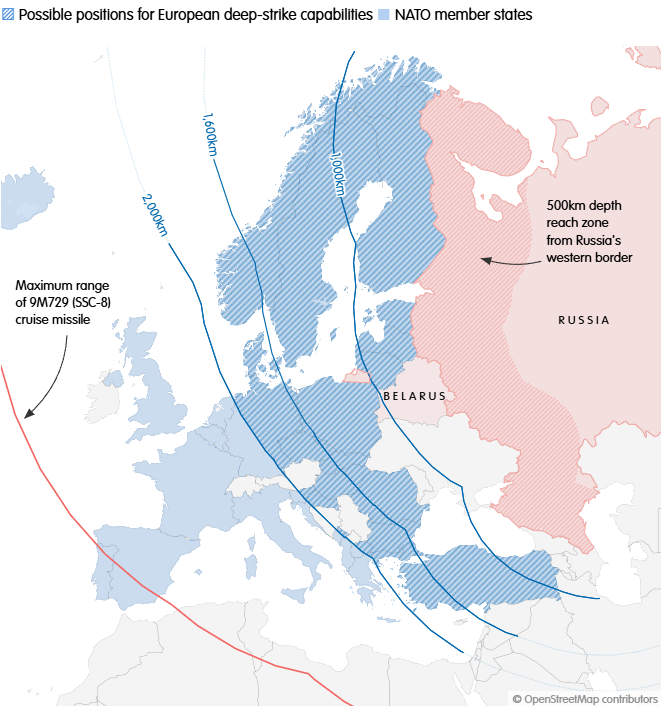
The locations from which military forces operate can further enhance the credibility of alliance commitments. During the Euromissiles crisis of the 1980s, Europeans called for the deployment of US nuclear-armed long-range weapons to Europe to maintain strategic balance with the Soviet Union and prevent a de-coupling of European and North American security. The 2024 agreement between Washington and Berlin to deploy the US army’s conventional long-range precision weapons to Germany followed a similar “coupling” logic.
In 2016, NATO established small multinational battlegroups in several frontline countries to implicate many allies in a Russian attack against one ally. These are growing and should become a robust forward-defence posture. If NATO also introduces conventional ground-launched systems ranging several thousands of kilometres, these could facilitate rearward deployments of Baltic long-range strike forces: new long-range fire battalions in Britain, France and Germany would include Baltic missile batteries under specialised command-and-control arrangements. This more continuous strategic depth could then prevent Russia from geographically isolating its target of aggression and give frontline countries a genuine stake in Europe’s integrated strategic deterrence posture akin to NATO’s nuclear-sharing arrangements.
Allied governments approved the resumption of planning for strikes against targets deep inside Russia in 2023. NATO has also advanced discussions on the operational and doctrinal implications of conventional long-range precision weapons and formulated corresponding capability requirements; their command and control should largely reside with NATO’s Joint Force Commands, as proposed elsewhere. The European Long-Range Strike Approach, launched by France, Germany, Italy and Poland in July 2024 and subsequently joined by Britain, the Netherlands and Sweden, aims to generate European-developed varied deep-strike capabilities. But progress has been incremental at best—now Europeans must accelerate it.
Air and missile defence
Beyond concealment
As discussed, air and missile defence can enhance the operational credibility of nuclear deterrence by protecting nuclear assets from adversary air and missile attacks. Britain and France, however, have historically prioritised concealment and dispersal above active missile defence to protect their nuclear submarines and aircraft. They have opted to maintain only limited numbers of ground-based air-defence systems, which they use for roles other than protecting nuclear assets.
Non-nuclear Europeans also did not prioritise air and missile defence after 1991, partly over doubts that they could deliver the desired levels of protection against modern missile threats. Their reliability under combat conditions and at beyond-tactical ranges has been demonstrated only relatively recently, with Western-produced missile defence systems successfully intercepting Russian long-range ballistic and cruise missiles in Ukraine (and Iranian missiles in the Middle East).
But a European integrated strategic deterrence posture requires a missile defence system with a clear capability: in the event of a Russian attack, it must protect British, French and NATO nuclear bases in Europe, and blunt attempts to exert pressure on Europeans by employing strategic non-nuclear and (potentially) non-strategic nuclear weapons at scale. In the “decisive” initial period of war and at other key decision points during a conflict, Russia would try to confront Europeans with the dilemma: do they resist and endure further pain, or fold?
Air and missile defence to protect high-value military, political and economic assets could also deter Russia from conducting strikes in the first place. It can do this by reducing the probability that a missile will reach its target and making it harder for Russia to calculate how much damage it needs to inflict, in order to compel European de-escalation. Rather than undermining Russia’s strategic nuclear deterrent, missile defence aims to deny Russia any advantage it can gain through its own strategic non-nuclear and non-strategic nuclear assets. An effective missile defence also buys time and flexibility for decisionmakers and improves escalation-management options.
Recommendation: Improve procurement frameworks
Efforts are underway to at least quadruple NATO’s air and missile defence assets. Europeans should now base their defence from Russian missiles and other air threats on European networks and cloud infrastructure, since these require diverse and dispersed radars and other sensors for detecting, identifying and tracking. They also rely on command-and-control systems that fuse this data for comprehensive situational awareness and to guide interceptors to their targets.
Russia’s combined drone-missile attacks could well number over 1,000 individual systems; only AI can meet these requirements at speed and on a continental scale, and it requires cloud infrastructure to process the data and digital networks to relay relevant information on direction, targets and timing. Leaving this vulnerable to disruption is risky; Europeans need to strengthen the nervous system of NATO’s Integrated Air and Missile Defence architecture and make it more suitable for specifically European use. But it also needs to maintain interoperability to plug in sensors and interceptors for whichever allied country they are being provided by or procured from.
Moreover, European procurement frameworks should distinguish between owner and operator, like the cold-war-style, US-West Germany cost-sharing agreement in which German soldiers operated US-owned air defence systems. An updated version could see smaller European countries use assets owned collectively (for example, by the EU or NATO) or by larger European countries and thereby make it easier for Europeans to scale up their air and missile defences. NATO’s Multinational Multi-Role Tanker Transport Fleet and Airborne Early Warning and Control Force already follow similar models.
But using missile defences to always protect all of Europe’s territory, against all possible threats, is technically infeasible and prohibitively expensive. In any case, some assets are more efficiently protected from missiles through operational or infrastructure adaptations, including concealment and dispersal. For example, Europeans should consider hardening of shelters and storage sites for military equipment and munitions, and other protections. This, combined with jamming missile-guidance systems to confuse their terminal approach and prevent direct hits, also enhances the survivability of targets. The same goes for protecting civilian decision-making centres. Ukraine has demonstrated how moving its air-defence assets in February 2022—and keeping them moving ever since—has made it harder for Russia to strike them. Europeans would do well to internalise these lessons more thoroughly than US Central Command arguably had.
Strategic intelligence and targeting
Europe’s intelligence gap
NATO defines intelligence as the product of surveillance and reconnaissance supplemented with expertise and further analysis. Thus, intelligence, surveillance, and reconnaissance are understood in tandem; capabilities that allow for better surveillance and reconnaissance facilitate better intelligence.
ISR is essential to a European integrated strategic deterrence posture. It forms the basis for early-warning systems which ensure the protection of high-value military, political and economic assets. Allies can use ISR to monitor Russian activity and discover when assets are being repositioned or moved—and assess whether this action threatens NATO. Good intelligence helps to anticipate adversary courses of action and allows NATO countries to alert and position their forces, including air and missile defence systems to intercept Russian missiles or, if necessary, offensive strike capabilities to target Russian missile launchers. Thus, ISR capabilities contribute to escalation management by providing NATO with a better understanding of Russian capabilities and (where possible) whether Moscow intends to deploy them.
Conventional military equipment like uninhabited aerial vehicles (UAV), aircraft and ships can be equipped with signals intelligence and communication interception technology (SIGINT) to conduct ISR operations. SIGINT capabilities intercept communication signals and signals from radar systems to gather information about enemy movements and plans: they are the “ears” of intelligence gathering, while the “eyes” (imagery and geospatial intelligence, or IMINT) collect information via aerial and satellite photography.
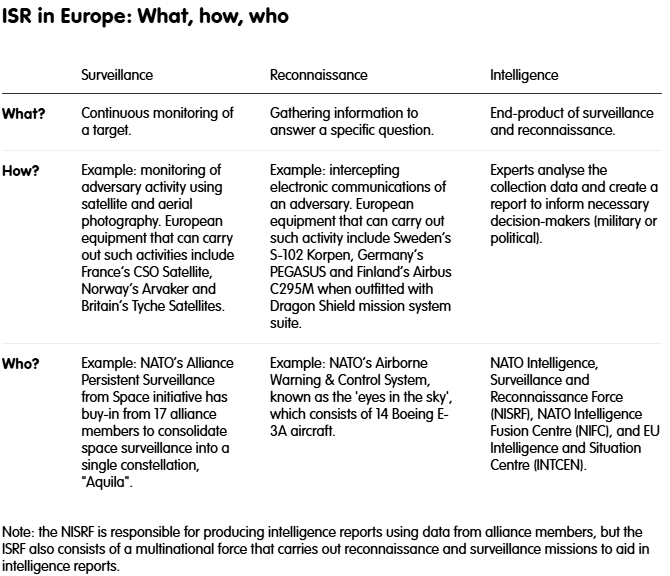
As it stands, Europe lacks sufficient systems and the capabilities to carry out ISR separately from America. Its over-reliance on US intelligence sharing for military missions became evident in the lead up to Russia’s full-scale invasion of Ukraine in 2022 when American (and British) intelligence reports uncovered Russia’s intention to invade. The US also has the advantage of speed: it could use data from satellite imagery and intercepted military communications to generate a warning for Europe and Ukraine within hours. This is a process which experts predict would take the equivalent European agencies multiple days.
Europe does not have sufficient space-based and uncrewed ISR systems, nor the requisite ships and aircraft equipped with SIGINT abilities. In fact, it has only three “big wing” signals intelligence aircraft for gathering electronic and communications intelligence, where the US Air Force has 17. Meeting the requirement for eight such aircraft could cost Europeans an estimated $4-4.8bn. Only a few European navies operate SIGINT ships that collect data at sea, a capability which is increasingly important in the Nordic and Baltic regions. Perhaps most troubling, Europe is unlikely to be able to replace America’s space-based ISR capabilities within the next five to ten years. Modern-day satellites, which are critical for ISR, are able to identify specific weapons, vehicles and even people. Europe would need to invest more than $4.8bn in space-based ISR capabilities (and related ground-based infrastructure) to be able to operate such systems autonomously from the US.
Happily, when it comes to intelligence, Europeans are not starting from scratch. In fact, certain European allies are crucial providers of intelligence, even to the US. During interviews for this paper, respondents from Norway highlighted the country’s role as the “eyes and ears” of NATO due to its position in the high north, which allows it to monitor Russian activity in and around the Kola peninsula (the home of its nuclear submarines and Northern Fleet). Additionally, Swedish intelligence services were the first to report on the Chernobyl disaster. But there is a lot of work to do.
Recommendation: Integrate Europe’s ISR capabilities
European allies need to invest in the above capabilities and address their ISR gap with the US. They should continue to acquire capabilities that carry out surveillance and reconnaissance, and better integrate the resulting data to produce high-level intelligence. More urgently, they should invest in a greater quantity of aircraft, ships and UAVs equipped with SIGINT and IMINT sensors—and acquire the necessary satellite technology for ISR, such as NATO’s Aquila satellite constellation.
Europe’s sophisticated satellite systems are generally designed for civilian use and not optimised to provide real-time updates to track military movements. But the EU—via the European Defence Fund in particular—could generate the funds necessary to develop and invest in this technology, and facilitate public-private partnerships for developing dual-use satellite networks. The European Defence Fund has agreed on funding for the EU’s ODIN’S EYE initiative, a multinational effort to develop a space-based missile early-warning architecture to detect and track the launch of ballistic missiles. The EU can also further reduce its overreliance on the US by encouraging commercial satellite companies to enter into government contracts, like Finnish company ICEYE is planning for the Netherlands and Poland.
Crucially, Europeans need to consolidate their approach to information sharing and intelligence. The processing of surveillance and reconnaissance data is fragmented, partly because European intelligence is being guarded at the national level and only shared when necessary. Many European countries have robust national intelligence agencies, including France’s Directorate General for External Security (DGSE), Germany’s Federal Intelligence Service (BND), Italy’s External Intelligence and Security Agency (AISE) and Britain’s Defence Intelligence—but they have their own policies and legal frameworks for intelligence sharing and technology gaps, which cause variation in quality across countries.
Initiatives like the NISRF, NIFC and the EU’s INTCEN are already in place to better process intelligence, but a more concerted effort should be undertaken by alliance members to improve the functionality and capability of these mechanisms. The BND’s proposal to replicate Five Eyes by creating a “Euro Eyes” intelligence-sharing alliance may help reduce fragmentation further: the Dutch government suggested that this format could include Britain, France, Germany, Poland and the Nordic countries, alongside the Netherlands. Britain could potentially guide it, based on its experience as a Five Eyes member.
Fracture clinic
Russia has long prepared for how to use nuclear and strategic non-nuclear weapons to defeat the West away from its home front. To limit Europe’s capacity to respond, Russia wants to fracture NATO—and it has the required nuclear and strategic non-nuclear capabilities to do so. With the transatlantic alliance already in a more precarious state than it was a few years ago, Europe needs to prepare to face Russia on its own.
A European integrated strategic deterrence posture rests on investing in military capabilities that allow for greater freedom of action in the face of Russian nuclear coercion; and to prevail without having to go to war. This requires work from Europe’s nuclear and non-nuclear allies. France and Britain must continue investing in nuclear capabilities, specifically to enhance their flexibility to respond to limited nuclear employment for coercive purposes by Russia. They also need to work with Europe’s non-nuclear allies to develop conventional long-range strike capabilities which can credibly threaten devastating retaliation to a Russian attack; air and missile defences to deny Russia confidence in its long-range coercion strategy; and intelligence capabilities to outpace Russian moves throughout crisis and conflict.
Also required is the strategic-political leadership of a strategic posture group, an operational command and control of (non-nuclear) capabilities through European-led joint force commands, and intellectual capacity building via a centre of excellence for integrated strategic deterrence. All the above investments will reinforce forward defence and help Europe realise the six key principles they need to negate Russia’s theory of victory.
Ultimately, this specific European integrated strategic deterrence posture is just one proposal responding to the concerns and expectations European officials and experts expressed in the research interviews. It does not present a definitive solution; on the contrary, we welcome challenges to it. But Europeans urgently need to be able to start pushing through the chaos. Otherwise, their persistent incoherence amid American disengagement may be perceived by Russian leaders as an opportunity to apply their coercion strategy and capabilities against Europe.
Rafael Loss is a policy fellow at the European Council on Foreign Relations. His work focuses on security and defence in the Euro-Atlantic area, military operations, innovation and technology, and nuclear strategy and arms control.
Katrine Westgaard is a programme and research assistant for the European Power programme at the European Council on Foreign Relations. Her work focuses on transatlantic relations and Nordic-Baltic security.
Acknowledgments
For their thoughtful comments on various drafts, we thank Svein Efjestad, Brad Roberts, Jim Stokes and an unnamed French official, as well as ECFR colleagues Jana Kobzová, Nevada Joan Lee, Nicu Popescu and Nick Witney. Conversations with officials and experts in and from Estonia, Finland, Germany, the Netherlands, Norway, Poland and Sweden, and additional exchanges with policymakers and analysts in other places, provided much of the empirical foundation upon which we built our argument—we are grateful to each and every one of them for taking the time to share their perspectives and insights with us. We also extend our gratitude to Camille Grand for his support during this project.
We are indebted to Amy Sandys, Portia Kentish and Jeremy Cliffe for their editing excellence, and to Nastassia Zenovich for her visualising wizardry. Any remaining errors are ours alone.
Separately, Rafael Loss would like to thank Marta Prochwicz Jazowska and Katrine Westgaard for being fantastic collaborators in conducting research in Warsaw and in Stockholm and Oslo, respectively, and Gabrielė Valodskaitė for ensuring the smoothest possible project coordination.
Annexe
Methodology
Here we present the findings of structured research interviews—all carried out between March and June 2026—with more than two dozen officials and experts from seven European countries: Estonia, Finland, Germany, the Netherlands, Norway, Poland and Sweden. Of these countries, four (Estonia, Finland, Norway and Poland) border Russia and three (Germany, the Netherlands and Norway) engaged in nuclear consultations through NATO throughout the cold war and ever since. Germany and the Netherlands have for decades hosted US nuclear weapons on their territory and continue to provide dual-capable fighter aircraft to NATO’s nuclear mission. Meanwhile, Finland and Sweden joined the alliance after Russia launched its full-scale invasion of Ukraine. All seven countries are major stakeholders in the evolving European deterrence discourse.
The authors conducted the interviews in person or online between March and June 2026. Additional conversations with researchers and policymakers from other countries and NATO and desk research substantiated our analysis. As one interlocutor remarked, it is crucial that we avoid imposing one single national perspective on nuclear weapons and deterrence on any one country. Institutional affiliations, personal experiences and other factors colour the interview subjects’ views. We therefore sought official and expert perspectives: civilian and military, defence and foreign affairs. Where we observed noteworthy differences between respondents from the same country, we have tried to emphasise and contextualise these, rather than sand them down.
Still, the information contained in the country profiles should be considered as indicative, not definitive. It is certainly preliminary, given the fast-changing deterrence landscape in Europe.

Editor-in-Chief
Read more similar news:
Comments:
comments powered by Disqus