Government caught between keeping lights on and cutting Drax emissions
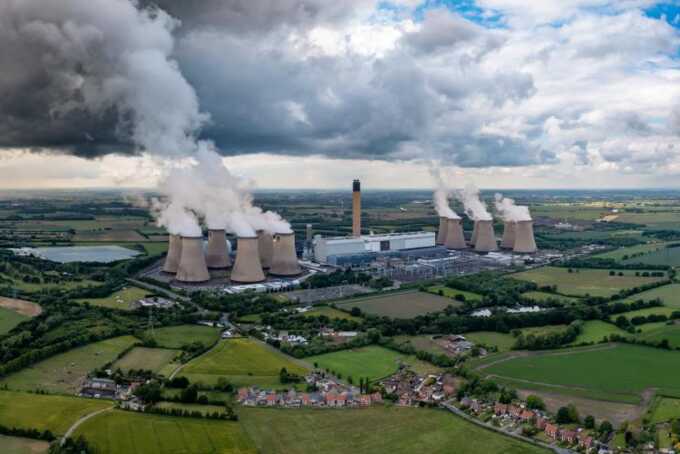
Drax, the UK’s largest carbon emitter, is planning to bypass UK Government climate regulations to power a hyperscale AI data centre – facing opposition from MPs across all three major parties.
Veteran Conservative MP Sir Roger Gale told Byline Times that Drax was employing "sleight of hand" by asserting that the energy it generates from wood pellets transported over 5,000 miles across the Atlantic is clean. Labour MP Alex Sobel described the proposal as "ludicrous." Liberal Democrat MP Pippa Heylings said she intends to bring the issue directly to the Secretary of State for Energy Security and Net Zero, Ed Miliband.
The Department for Energy Security and Net Zero (DESNZ) was unable to explain how it plans to oversee the sustainability standards it has set for the company.
Sidestepping Sustainability
Drax’s biomass power station near Selby, North Yorkshire, emits about 13.2 million tonnes of carbon annually, more than any other single site in the UK. Earlier this year, DESNZ announced plans to cut the company’s biomass subsidies from £1 billion a year to £460 million – roughly £1.2 million a day – with the new regime beginning in 2027.
The reduced subsidies are tied to requirements for reduced carbon emissions and a new set of sustainability standards. By imposing a 27% operational limit, the Government hopes to reduce onsite carbon emissions by half to an estimated 6.6 million tonnes of CO₂ a year by shifting Drax away from near-continuous power generation to a backup role primarily used when wind and solar output is low.
Yet, Drax’s proposed 100 MW data centre, which could be operational as early as 2027 with plans to expand capacity to 1 GW by around 2030, not only bypasses the National Grid but would also increase emissions back up to around 11 million tonnes of CO₂ per year. The AI proposal also bypasses sustainability standards entirely.
Under the new rules, Drax’s wood pellets must come from entirely sustainable origins, supply-chain emissions must reduce by about 36%, and no Government subsidies will support biomass sourced from primary or old-growth forests.
When asked how it plans to monitor these targets, a DESNZ spokesperson stated only: “Drax must use 100% sustainably sourced biomass, with not a penny of subsidy paid for anything less.”
Cross-Party Opposition
Conservative MP Sir Roger Gale stated he had “no objection whatsoever” to Drax expanding into AI or other emerging industries that require significant energy, provided the power generated is “genuinely clean, not merely presented as such.”
He went on to criticize the firm for “claiming to generate clean power while producing carbon emissions from burning wood pellets that have been shipped over 5,000 miles across the Atlantic.” He added: “That is sleight of hand. It simply is not true. They have no right to make that claim, and we have a duty to hold them accountable for it.”
Labour MP Alex Sobel, representing Leeds Central and Headingley, said the idea that AI data centres could be powered by Drax’s wood power station was “ludicrous.”
“I think that we do need data centres, but they should be powered by proper renewable energy, through solar, wind, or other renewables. Drax is not a renewable power station,” he said.
Liberal Democrat MP Phillippa Heylings told Byline Times she was so worried about the situation at Drax that she planned to raise the issue with Miliband.
“There is a consultation underway currently, but what is really needed is a coherent national strategy for AI and data centres,” she said. “We know we’re going to need them, but we also need to think about where they should be located.”
Heylings argued that data centres should be co-located next to genuine clean energy generation wherever possible. “In my view, they should be alongside renewable power sources but I would not include wood-burning energy plants in that category,” she said. “The danger is that projects like this could lock in demand for wood pellet power generation, such as at Drax, well into the future.”
Dr. Mary Stevens, experiments programme manager at Friends of the Earth, accused Drax of “attempting to use the boom in AI infrastructure to prolong its dirty business.”
“Data centres need to be powered by additional, new renewable energy,” Stevens told Byline Times. “Whatever it might say, Drax is not renewable energy.”
Retreat from Carbon Capture
After decades of ministerial hopes that a technology would emerge to turn biomass into the carbon-neutral energy solution it was claimed to be, Drax announced proposals in December 2019 for Bioenergy with Carbon Capture and Storage (BECCS) – a technology designed to capture the carbon from burned wood pellets before it enters the atmosphere and store it under the North Sea. The company stated its intention to become carbon negative by 2030.
By February 2026, the Climate Change Committee (CCC), the Government’s independent adviser on climate policy, appeared to have given up waiting. In its Seventh Carbon Budget, the committee stated that if the UK is to meet its net zero targets, all large-scale biomass power plants operating without BECCS should be shut down after 2027.
Yet a few months later, in its Annual Financial Report, Drax disclosed it was effectively abandoning all future investment in BECCS in favour of more commercially lucrative ventures: battery energy storage systems and the construction of, and direct supply of energy to, its proposed onsite data centre.
Drax’s chief executive Will Gardiner had signalled the shift in December 2025, when he stated the flagship BECCS project at Selby “requires the right support from UK Government, including the development of a business model and, importantly, a regional carbon transport and storage network to connect to.”
In translation: Drax will only construct BECCS if the Government funds it. The power station continues to emit 36,000 tonnes of CO₂ into the atmosphere every day.
When asked about BECCS no longer being a priority for Drax, despite the UK Government’s commitment to support the technology with up to £21.7 billion over the next 25 years, a DESNZ spokesperson stated: “No final decisions around the deployment of large-scale bioenergy with carbon capture and storage projects have been made, and any support would need to offer value for money for taxpayers.”
Energy Security Tension
DESNZ faces a structural bind. The department is committed to a low-carbon future founded on genuinely renewable energy, yet the Drax biomass station remains fundamental to UK energy security.
The Government cannot risk shutting Drax down without first replacing the power it generates with truly renewable alternatives, for fear of shortages, higher prices, and greater reliance on gas imports.
But allowing the plant to continue emitting CO₂ at its current rate damages the UK’s credibility as a leader in climate change and compromises its chance of achieving net zero by 2050.
At the time of writing, Drax had not responded to a request for comment. The Climate Change Committee declined to comment.

Deputy Editor
Read more similar news:
Comments:
comments powered by Disqus