Police refuse to ban pro-Palestine march despite anti-Semitic attacks
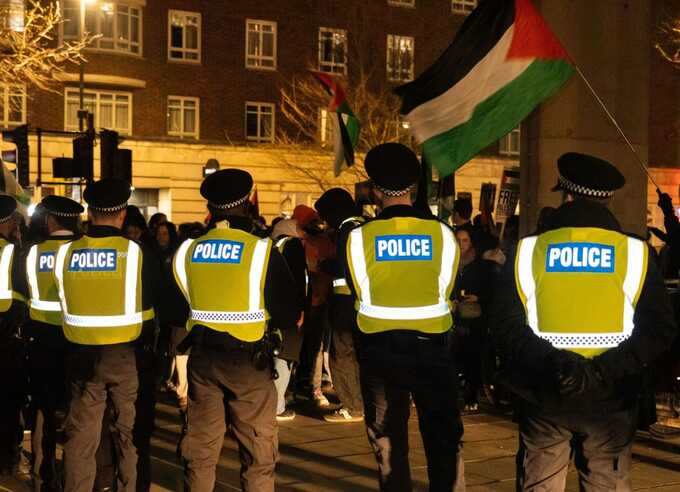
The police have resisted calls to ban a major pro-Palestine march on Saturday despite a recent surge in anti-Semitic attacks.
Metropolitan Police chiefs have decided that the legal threshold for banning a pro-Palestine march marking Nakba Day or a parallel far-right march organized by Tommy Robinson on May 16 had not been met.
There had been calls by the Government’s terror watchdog and Sir Ephraim Mirvis, the chief rabbi, for a temporary ban on pro-Palestine marches in the wake of last month’s Golders Green terror attack, in which two Jewish men were stabbed.
Scotland Yard will instead impose strict conditions on routes, gathering points, and timings to prevent serious disruption and disorder. It will be backed by a “significant” police presence to ensure the two events pass off peacefully.
Details of the policing operation and timings are expected to be announced on Wednesday before the marches, which are set to attract tens of thousands of people.
The Met can request the Home Secretary’s consent to ban a march only if there is a risk of public disorder so severe that the force judges it cannot be contained by placing conditions on it and its policing operations.
The Met has sought a ban only twice in the past 14 years, once in March, when Shabana Mahmood agreed to block an Al Quds march organized by an organization linked to Iran, and in 2012 to stop planned marches by the far-right English Defence League.
However, after the Golders Green attack, Jonathan Hall, KC, the independent reviewer of terrorism legislation, said he believed the UK may have reached the point where there needed to be a “moratorium” on pro-Palestine marches.
“It’s clearly impossible at the moment for any of these pro-Palestine marches not to incubate within them some sort of anti-Semitic or demonizing language,” he said.
He was supported by Sir Ephraim, who said the marches had contributed to a “tone of Jew hatred within our country,” adding that the UK was witnessing the “normalization of anti-Semitism.”
After the Golders Green attack, Sir Keir Starmer signaled he was ready to take new powers to ban pro-Palestine protests. He said the Government would consider “further powers” to ban protests in certain instances, citing the “cumulative” impact of repeated pro-Palestine demonstrations on the Jewish community.
However, on Monday, he also said his Labour Government would block “far-right agitators” from traveling to Britain for Robinson’s Unite the Kingdom protest. Seven far-right commentators or influencers have so far been banned from entry to the UK on the grounds that their presence is “not conducive to the public good.”
Sir Keir said: “We will not allow people to come to the UK to threaten our communities and spread hate on our streets.”
Robinson’s most recent rally in London last September was attended by between 110,000 and 150,000 people, while about 5,000 were involved in an anti-racism counter-demonstration. Robinson has called on attendees not to wear masks, drink alcohol excessively, and to be peaceful and respectful.
The Stop the War Coalition’s annual march to mark Nakba Day on the same day commemorates the 1948 displacement of Palestinians during the creation of Israel.
According to the Palestine Solidarity Campaign, the march is to “reaffirm our commitment to the inalienable rights of the Palestinian people, including the refugees’ right to return home.”
“We march against the far-right in Britain who glorify Israel’s racism and brutality. Our unity and solidarity is stronger than their hatred and division,” its promotional literature states.

It is headlined: “Nakba 78: March for Palestine – United against Tommy Robinson & the far Right.”
“We need everyone who can make it to be in London for this crucial demonstration,” it said.
The Met Police is expected to draft in extra officers from other forces under mutual aid agreements. There is added pressure as the marches coincide with the FA Cup final at Wembley.
Sir Mark Rowley, the Met Commissioner, said earlier this month that march bans were only legally available in “extreme” circumstances.
“We’re looking ahead at what restrictions we put on them and in extreme [circumstances] it is possible to restrict an event to a static protest rather than a march. That is the limit of what the restrictions allow. So we will look at those options and come to a view of what restrictions the law justifies,” he said.
Politics Editor
Read more similar news:
Comments:
comments powered by Disqus