Seven years of EU political ad data vanish from Google’s Transparency tool

Google’s Ad Transparency tool no longer displays political online advertisements that have run on its platforms, past or present, from any countries in the European Union, making seven years of data from 27 different countries inaccessible.
Liz Carolan, who publishes the Irish technology and politics newsletter The Briefing, observed this change on September 28. Carolan noted that until last week, Google’s Ad Transparency tool allowed visitors to search ads that have run in EU countries since 2018, including data about targeting, spending per ad, and the candidates or parties involved. This week, political ads from Ireland and the other 26 EU countries have disappeared from the Ad Transparency political ads country selection page.
“We had been told that Google would try to stop people from placing political ads, a ‘ban’ that was to take effect this week. I did not read anywhere that this would mean the erasure of this archive of our political history,” Carolan wrote.
The change is in response to the EU’s upcoming Regulation on Transparency and Targeting of Political Advertising (TTPA), a law set to enter full force on October 10. The TTPA outlines new regulations for advertisers in the EU, including requirements that political ads “must be clearly labelled as such and include information on who paid for it, to which election, referendum, legislative or regulatory process it is linked, and whether targeting or ad-delivery techniques have been used,” according to an EU summary of the law, and limits targeting and ad delivery of political advertising to strict conditions, requiring consent from the targets regarding using their data for political ads. Certain categories of demographic data, like racial or ethnic origin or political opinions, cannot be used for profiling by advertisers.
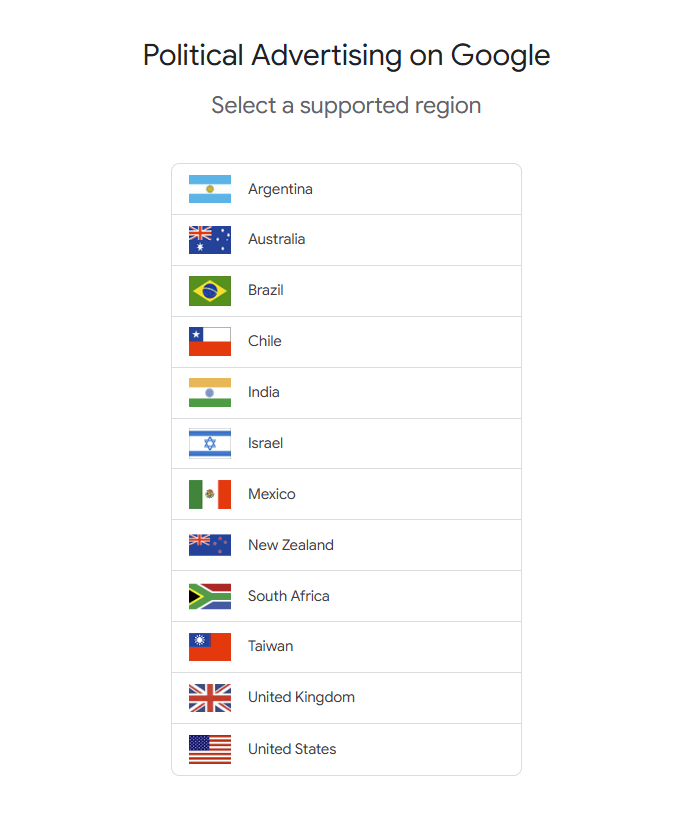
On August 5, Google posted new guidelines for political ads in EU countries, stating that past ads would still be accessible in the Transparency Center: “As of September 2025, the EU Political Ads Transparency report will be no longer available. However, EU Election Ads previously shown in the Political Ads Transparency Report will remain publicly accessible in the Ads Transparency Center, subject to retention policies.”
In July, Meta also announced it would no longer allow “political, electoral and social issue ads” on its platforms in the EU, citing the "unworkable requirements and legal uncertainties" introduced by the TTPA. Past ads from the EU are still visible in Meta’s ad library.
The law specifies that online ads will be available in “an online European repository,” but this repository has not yet launched. Researchers and journalists rely on platforms like Google’s Ad Transparency platform and Meta’s similar platform for information on who was running political ads and how; now, they must wait for the repository to be launched.
Google announced in November 2024 that it would stop serving political ads in the EU in October 2025, ahead of the TTPA. “Additionally, paid political promotions, where they qualify as political ads under the TTPA, will no longer be permitted on YouTube in the EU,” Google’s Vice President for Government Affairs and Public Policy for Europe, Annette Kroeber-Riel, wrote in a company blog post.
“The European Union’s upcoming Regulation on Transparency and Targeting of Political Advertising (TTPA) unfortunately introduces significant new operational challenges and legal uncertainties for political advertisers and platforms,” Kroeber-Riel wrote. “For example, the TTPA defines political advertising so broadly that it could encompass ads related to a vast range of issues, making them difficult to reliably identify at scale. There is also a lack of reliable local election data allowing for consistent and accurate identification of all ads related to any local, regional or national election across any of the 27 EU Member States. Also, key technical guidance may not be finalized until mere months before the regulation is enforced.” The law is vague, but it doesn’t specifically require platforms to delete past ads. It is likely that many ads stored by Google in the Transparency Center would violate the law today; instead of sifting through hundreds of thousands of ads, Google may have opted to remove the entire EU.
A Google spokesperson told 404 Media: "The existing EU Political Ads Transparency Report will no longer be available as of September 2025. However, historical EU Election Ads previously displayed in this report will remain publicly accessible within the Ads Transparency Center, subject to our retention policies – in this case 365 days." Carolan told me she was able to find a few election ads from Ireland’s Parliamentary Election last November by searching in the "all topics" section, but without the financial data or other previously available important context for the ads.

Head of Investigations
Read more similar news:
Comments:
comments powered by Disqus