Trump announces 100% tariff on drug imports unless firms build in US
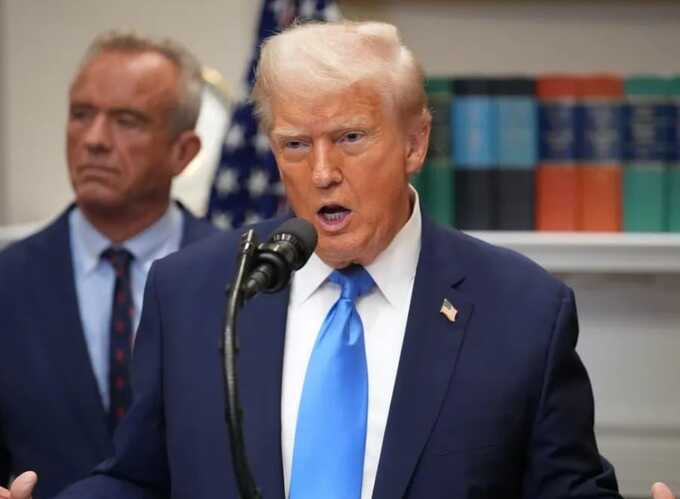
US President Donald Trump has announced a new set of tariffs, including a 100% levy on imported branded or patented drugs starting 1 October unless the company is establishing a factory in the US.
Washington will also impose a 25% import tax on all heavy-duty trucks and 50% levies on kitchen and bathroom cabinets, as the president revealed the industry-focused measures.
"The reason for this is the large-scale ’FLOODING’ of these products into the United States by other outside countries," Trump posted on his Truth Social platform on Thursday, citing the need to protect US manufacturers.
The announcements come despite US businesses urging the White House not to impose further tariffs.
However, Neil Shearing, chief economist at Capital Economics, remarked that the tariff announcement on pharmaceuticals was "not quite as big a move as it appears at first sight".
This is due to exemptions available for generic drugs and companies building factories in the US.
"Many of the world’s largest pharmaceutical companies either already have some production in the US or have announced plans to establish production in the near future," he stated.
The European Federation of Pharmaceutical Industries and Associations has called for "urgent discussions" to ensure that Trump’s plans for new tariffs do not harm patients in the EU or the US.
European officials have said that pharmaceutical exports are protected from tariffs higher than 15%, under terms of a framework agreed between the US and the EU earlier this year.
The UK exported more than $6 billion (£4.5 billion) worth of pharmaceutical products to the US last year, according to the United Nations.
In the trade agreement signed by the US and UK in June, the two countries stated they intended to negotiate "significantly preferential treatment outcomes on pharmaceuticals."
In response to Trump’s recent announcement, a UK government representative said: "We know this will be concerning for industry, which is why we’ve been actively engaging with the US and will continue to do so over the coming days."
Among the UK’s largest pharmaceutical companies, GlaxoSmithKline already has US manufacturing plants and recently pledged to invest $30 billion (£22 billion) in research and manufacturing in the US over the next five years.
AstraZeneca also has plants in the US and announced in July plans to invest $50 billion in the country by 2030.
William Bain, head of trade policy at the British Chambers of Commerce, stated, "The UK’s leading pharmaceutical companies have committed to significant investment in the US, including in advanced manufacturing. We believe this should provide them protection from any new duties."
In the past few weeks, several pharmaceutical companies have withdrawn investment from the UK, citing a poor environment for the sector.
However, Jane Sydenham, investment director at Rathbones, said the focus on the US was a key factor in these decisions.
"I think there’s been this ongoing narrative that the UK can’t attract investment and we’re a low-growth economy," she mentioned on the BBC’s Today programme.
"But the reality in this particular sector is that it is really more about Donald Trump’s agenda and the uncertainty that’s creating for these companies and where they might need to invest to address the tariff proposals."
The tariffs on heavy trucks would protect US manufacturers from "unfair outside competition" and the duties would uplift American companies such as Peterbilt and Mack Trucks, Trump noted.
The new levies on kitchen and bathroom cabinets, along with some other furniture, were in response to high levels of imports harming local manufacturers, the president said.
He added that the US would begin imposing a 30% tariff on upholstered furniture starting next week.
Swedish furniture giant Ikea remarked that the tariffs on furniture imports make doing business "more difficult".
"The tariffs are impacting our business in a manner similar to other companies, and we are closely monitoring the evolving situation."
Trump’s tariff policies have been a central feature of his second term in the White House.
His extensive tariffs on more than 90 countries were implemented in early August, as part of his initiatives aimed at boosting jobs and manufacturing in the US, among other political goals.
Trump had previously imposed sector-specific tariffs on steel, copper, aluminum, cars, and vehicle components.
Earlier this year, the US Chamber of Commerce urged the White House against introducing new tariffs, arguing that many parts used in truck production are sourced "overwhelmingly" from countries such as Mexico, Canada, Germany, Finland, and Japan.
Mexico and Canada are among the largest suppliers of parts for medium and heavy-duty trucks, accounting for more than half of total US imports in the sector last year, said the chamber.
It warned that it was "impractical" to expect many of these parts to be sourced domestically, resulting in higher costs for the industry.
The new tariffs favor domestic producers but are "terrible" for consumers as prices are likely to rise, said trade expert Deborah Elms from the research firm Hinrich Foundation.
The levies would cover more products at higher rates than Trump’s reciprocal tariffs, which were aimed at correcting trade imbalances with other countries.
These industry-specific import taxes could serve as a backup plan to secure revenues as Trump’s extensive duties on global trading partners are being challenged in court, according to Ms. Elms.

World Affairs Correspondent
Read more similar news:
Comments:
comments powered by Disqus