Tragedy in Lisbon: three Britons among dead in funicular crash
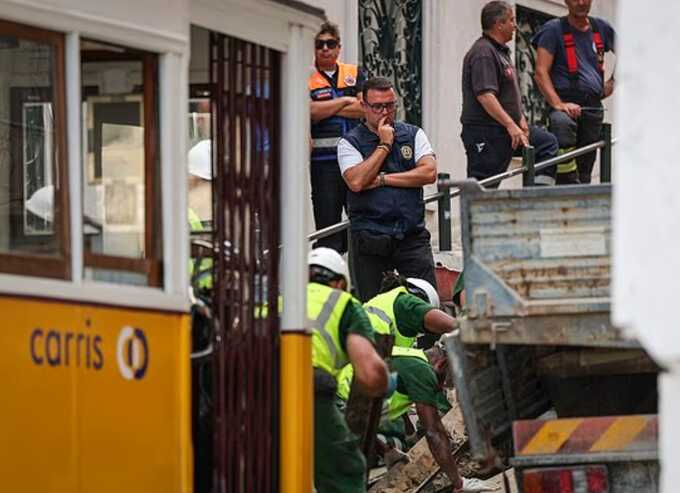
Three British nationals are among those who were killed in the Gloria funicular tram disaster in Lisbon, authorities announced on Friday.
The unnamed Brits - a man in his 80s, a man in his 40s and a woman in her 30s - were among 16 people who died when the iconic streetcar derailed and crashed in the Portuguese capital on Wednesday evening.
The investigating Policia Judiciaria said that it had now identified all of those who perished and confirmed there were no British nationals among the injured survivors.
Sir Keir Starmer said this morning he was ’deeply saddened’.
A Number 10 spokesman said: ’His thoughts are with their families and those affected by this terrible incident. We stand united with Portugal during this difficult time.’
A police statement this morning confirmed the nationalities of others who died in the crash. They included five Portuguese, two South Koreans, one Swiss, two Canadians, one Ukrainian, one American and one French national.
A German father also thought to have died in the crash was found to be in a Lisbon hospital, police said. It didn’t provide an explanation for the error.
Local media reported on Thursday that a German child was rescued from the scene as his father lay dying and his mother was trapped with a broken spine.
The family, from Hamburg, travelled to Portugal to identify the body, but could not find the 46-year-old among the victims.
They were later taken to the São José hospital in Lisbon, where he was still alive.
Police published the list of victims’ nationalities following forensic identification. The identities of the victims have not yet been disclosed officially.
The distinctive yellow-and-white Elevador da Gloria was packed with locals and international tourists when it came off its rails on Wednesday evening.
Sixteen people were killed and a further 21 injured in the crash.
The first investigative report examining what caused the popular Lisbon tourist attraction to crash was expected to be released on Friday.
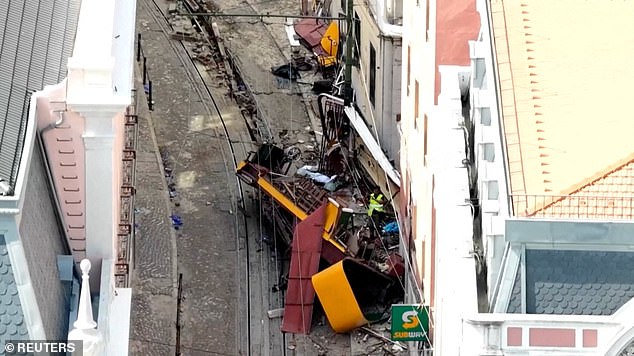
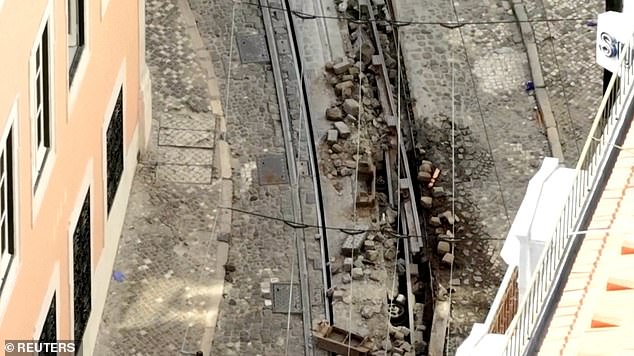
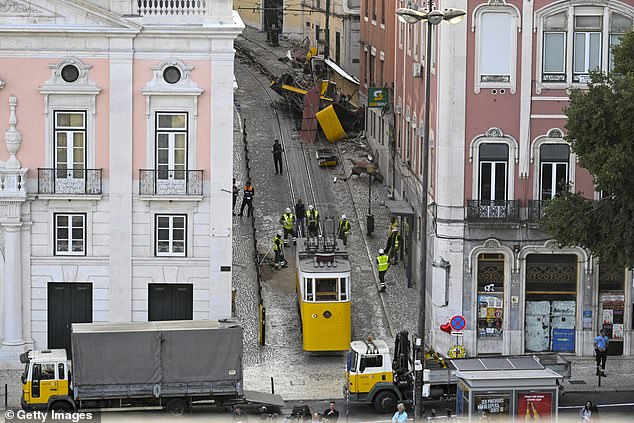
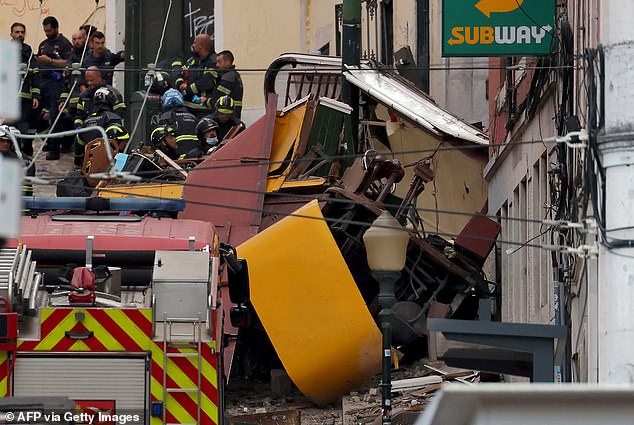
Official details about the crash in downtown Lisbon were still scant Friday morning, but details were beginning to emerge about those killed in the accident.
Well placed sources said the three Brits killed were an 82-year-old man, a 44-year-old man and a 36-year-old woman.
They have not been named by police. It is not clear if they knew each other.
Portuguese police confirmed today no British nationals are among the injured survivors.
Sandra Coelho, from Portugal, was identified earlier among the fatalities. She was an employee of the Santa Casa da Misericórdia in Lisbon, the largest charity in Portugal.
Alda Matias, also from Portugal, was also identified as one of four employees of the company who lost their lives in the disaster. She worked as a lawyer in Lisbon.
Ana Lopes, from Proença-a-Nova in Portugal, was the third known employee of the Santa Casa da Misericórdia. She leaves behind a daughter, according to CNN Portugal.
Pedro Trinidade, from Portugal, lost his life in the crash. He was a teacher at the Higher School of Hotel Management and Tourism, a referee and a member of the Portuguese Volleyball Federation.
André Marques, 40, was identified on Thursday as the vehicle’s brakeman. Carris, the company that operates the funicular, said he was a ’dedicated, kind and happy professional, always willing to contribute to the greater good’.
Eyewitnesses told local media that the carriage coursed down the hill, apparently out of control, before crashing into a building not far from the Restauradores Square, near the bottom of the hill.
Teresa d’Avó told Portuguese TV channel SIC the train struck a building ’with brutal force and collapsed like a cardboard box’. She also said she was certain that there was a person on the pavement at the time the funicular crashed.
One Lisbon tram passenger told of the terrifying moment the carriage derailed. Abel Esteves, 75, his wife and grandson were among 40 passengers in the lower car who witnessed the tram plunge toward them before derailing at the last second.
’I told my wife: ’We’re all going to die here’,’ he said. ’It picked up a brutal speed, took a slight turn and hit the building with a loud bang.’

Sandra Coelho, from Portugal, worked at the largest charity in the country. Her life was sadly taken during the funicular crash on Wednesday evening
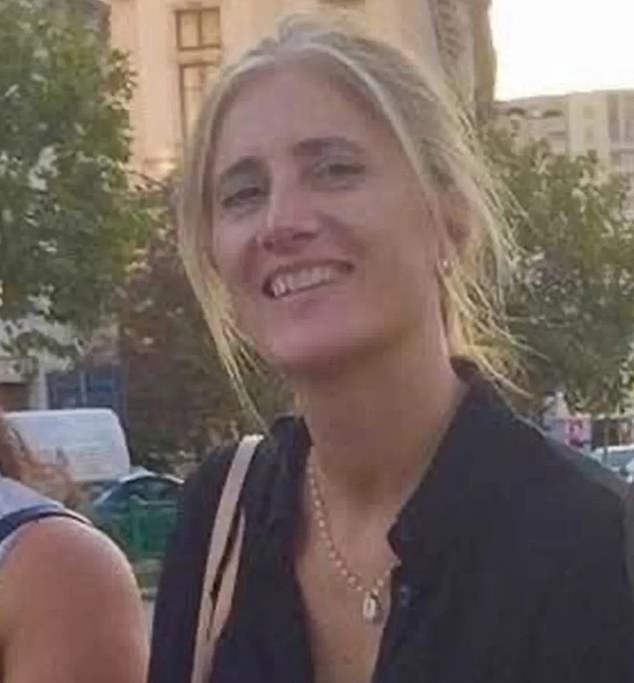
Alda Matias, who also worked at the Santa Casa da Misericórdia in Lisbon, was among the victims

Ana Lopes, who was born in Proença-a-Nova, also lost her life in the accident. She leaves behind a daughter
Fifteen people were initially counted among the fatalities. One person died in the night on Thursday, authorities confirmed.
Carris president Pedro Bogas clarified that the brakeman, Mr Marques, was found dead ’at the controls of the vehicle’.
’Our brakeman was at the controls until the very last moment. And that’s something that touches us all deeply. Everyone here is very dedicated and professional,’ he said.
Mr Marques, from Portugal, had worked for Carris for 15 years and leaves behind two young children, CNN Portugal reports.
Spaniards, Israelis, Portuguese, Brazilians, Italians and French people were injured, the executive director of Portugal’s National Health Service, Álvaro Santos Almeida, said. Five remained in serious condition.
’This tragedy - goes beyond our borders,’ Montenegro said in a televised address from his official residence.
Lisbon hosted around 8.5 million tourists last year, and long lines of people typically form for the streetcar’s short and picturesque trip a few hundred meters up and down a city street. Thursday was a national day of mourning.
The electric streetcar, also known as a funicular, is harnessed by steel cables and can carry more than 40 people.
Officials declined to comment on whether a faulty brake or a snapped cable may have prompted the descending streetcar to careen into a building where the steep downtown road bends.
’The city needs answers,’ the mayor said, adding that talk of possible causes is ’mere speculation.’
Aside from investigations by police, public prosecutors and government transport experts, the company that operates Lisbon’s streetcars and buses, Carris, said it has opened its own investigation.
The government’s Office for Air and Rail Accident Investigations said it would issue a preliminary technical report Friday.
The streetcar’s wreckage was removed from the scene overnight and placed in police custody.
The streetcar, which has been in service since 1914, underwent a scheduled full maintenance program last year and the company conducted a 30-minute visual inspection of it every day, Carris’ CEO Pedro de Brito Bogas said Thursday.
The streetcar was last inspected just nine hours before the derailment, he said during a news conference, but he didn’t detail the visual inspection nor specify when questioned whether all the cables were tested.
The elevator was maintained by six technicians, supervised by three engineers, Carris’ president said in the wake of the crash.
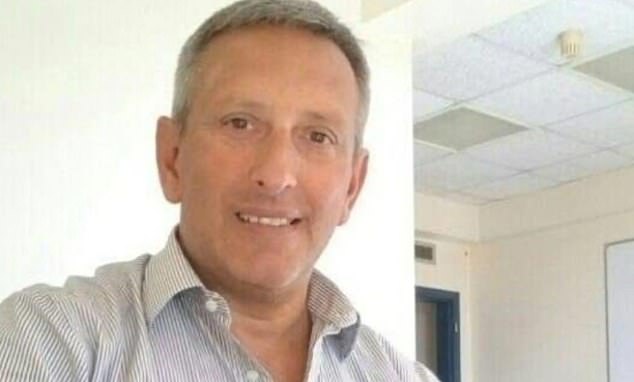
Pedro Trindade, a high school professor, was killed in the crash on September 3
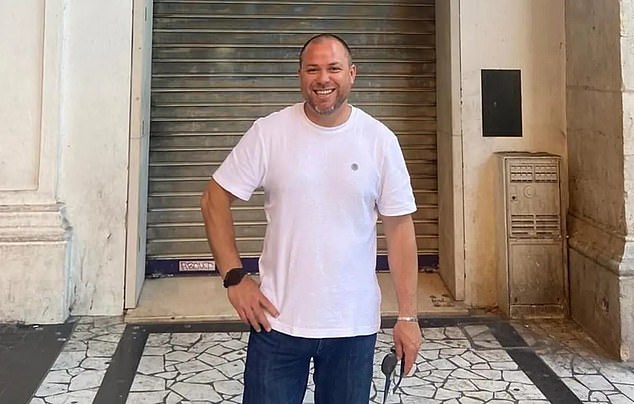 Mr Marques, from Portugal, had worked for Carris for 15 years and leaves behind two young children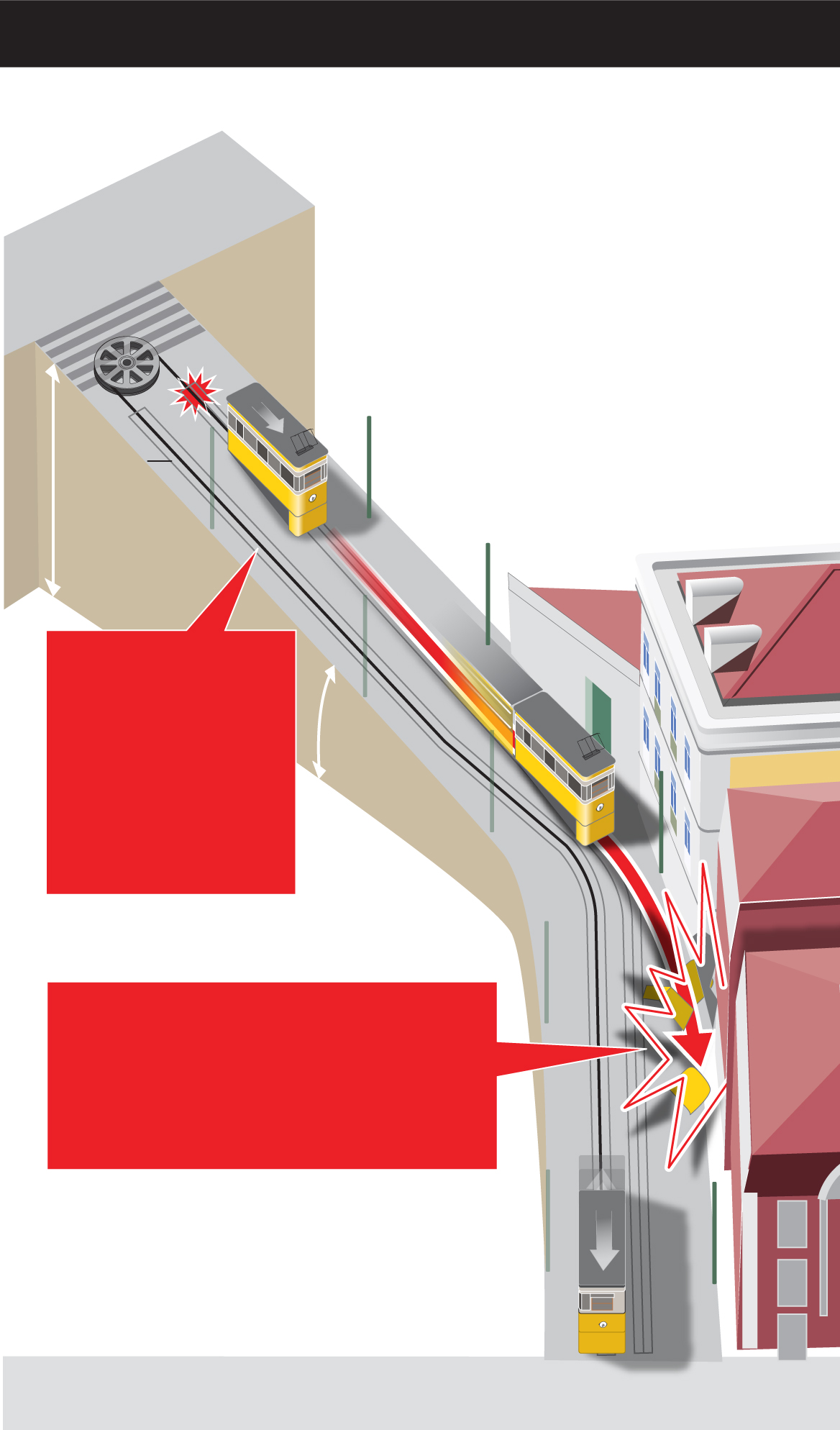
The Lisbon Firefighters Regiment said previously that the accident was caused by a cable that came loose in the structure of the funicular.
Carris said ’we cannot assume the problem lies with the cable’, however.
’If it had originated from something very obvious, we would have already identified it. The situation is unimaginable, unusual,’ Mr Bogas said.
Chief police investigator Nelson Oliveira said a preliminary police report with a broader scope is expected within 45 days.
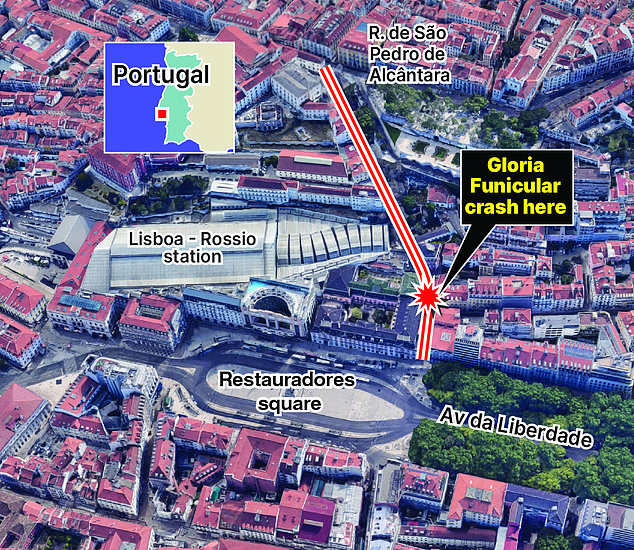
Wednesday’s tragedy unfolded as the descending yellow streetcar veered off a steep stretch of tracks near Liberty Avenue.
Eyewitnesses told local media that the carriage coursed down the hill, apparently out of control, before crashing into a building on Rua da Gloria, not far from the Restauradores Square.
Felicity Ferriter, a 70-year-old British tourist, said she was unpacking her suitcase at a nearby hotel when she heard ’a horrendous crash.’
The couple had seen the streetcar when they arrived and intended to ride on it the next day.
’It was to be one of the highlights of our holiday,’ she said, adding: ’It could have been us.’
Footage from the site showed the tram, which carries people up and down a hillside in the Portuguese capital, practically destroyed and emergency workers pulling people out of the mangled vehicle.

Alda Matias died after Lisbon’s famous Elevador da Glória derailed

A former volleyball referee was tonight named as the second victim of the deadly tram disaster in Lisbon that killed 16. The Portuguese Volley Ball Federation announced that Pedro Trinidade (pictured) had died in the dramatic Elevador da Gloria funicular crash on Wednesday evening
Flags flew at half-staff and people left flowers at the site of the crash as Portugal declared a day of mourning on Thursday.
The Pope sent condolences and blessings to victims, relatives and rescuers.
’This is one of the greatest human tragedies in our recent history,’ Prime Minister Luis Montenegro said in a televised statement, adding that he expects the investigation into the causes of the accident to be concluded swiftly.
He said Portugal state airline TAP had offered to provide transport for the families of the victims and to repatriate the injured and the deceased.
Eliane Chaves, a Brazilian who has lived in Lisbon for 20 years, said she walked past the Ascensor da Glória - one of the symbols of the city - every day.
’People say that it was negligence but it was not negligence,’ she said, tears streaming down her cheeks. ’They supervise it thoroughly. It was an accident, just like a plane or car accident can happen.’
Shortly after its journey began, the first sign of disaster presented itself at the bottom of the hill, some 850ft away. The opposite cable car suddenly shunted, witnesses said, then unaware of the impending tragedy at the other end.
Near the top of the hill, as Lisbon’s rush hour swarmed with commuters and visitors alike, a busy streetcar carrying families and tourists began its descent - only for a fault with its cables to occur.
Despite having gone through a full maintenance service, albeit a year ago, the car was left without brakes on a treacherous 17.7 per cent steep slope separating the glitzy Bairro Alto nightlife district from the city centre.
The vehicle began to careen down the its course before coming off the tracks just after 6pm as it reached a sharp bend near the bottom.
The speeding cable car overshot the turn, flipping on to its side, smashing into a hotel building, causing the carriage to fall apart.
Smoke plumed into the street as locals rushed to the scene to help passengers from the wreckage. Fifteen were initially counted among the dead, and nearly two dozen rushed to hospital.
Residents told local outlets that the railway is popular with tourists at this time of year, and often overcrowded.
The victims, including some foreign nationals, have all been recovered from the wreckage, according to the emergency services.
Fabiana Pavel, president of the Bairro Alto Residents’ Association, told the BBC’s Radio 4 Today Programme that the crash could have been due to ’excessive tourism’ - a growing concern across southern Europe as locals are priced out of homes and economies become more dependent on foreign visitors.
’The use of it in recent years is certainly inappropriate,’ she said, explaining locals were often unable to use the railway ’because it became a tourist attraction’.
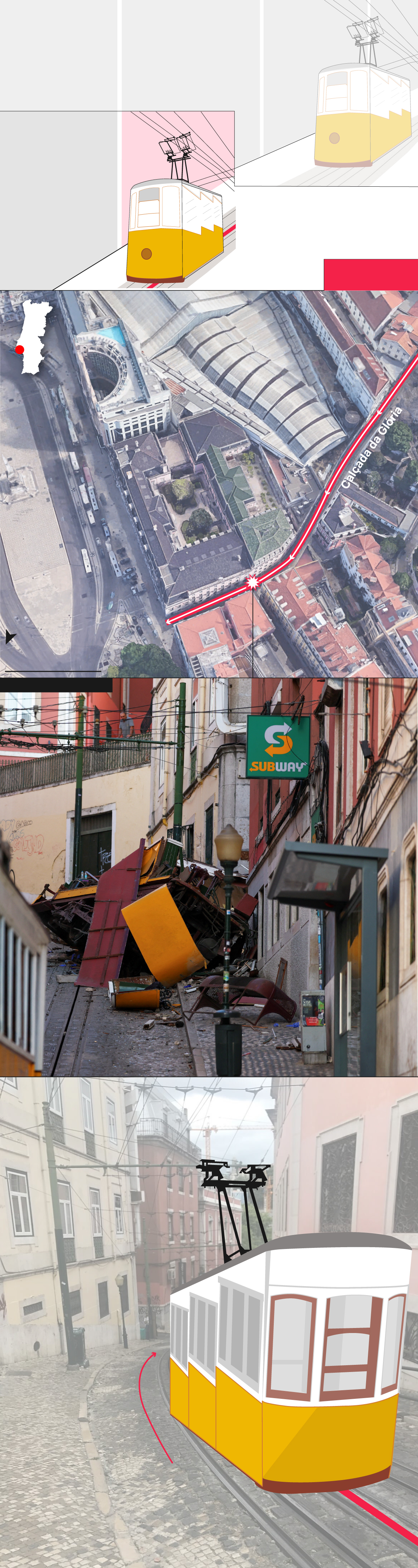
Investigators are still scrambling to establish the exact cause of the tragedy, and Carris, the company that operates the streetcar, confirmed routine inspections had been carried out to make sure the funicular itself was safe last year.
The Elevador da Glória funicular - one of three in Lisbon - takes some three million people across a few hundred metres of the city’s steep hills each year on a curved, traffic-free road in tandem with one going the other way between Restauradores Square in the city centre, at 56ft altitude, to Bairro Alto, at 144ft.
Its two cars are attached to opposite ends of a haulage cable with traction provided by electric motors on the two cars.
Wednesday’s tragedy unfolded as the descending yellow streetcar veered off a steep stretch of tracks near Liberty Avenue.
Eyewitnesses told local media that the carriage coursed down the hill, apparently out of control, before crashing into a building on Rua da Gloria, not far from the Restauradores Square.
Some said they heard a loud noise before the streetcar, which was travelling downhill, sped down its steep slope, seemingly out of control. One witness said the streetcar toppled onto a man on a sidewalk.
Teresa d’Avó described the streetcar to Portuguese TV channel SIC as out-of-control and seeming to have no brakes, and said she watched passersby run into the middle of the nearby Avenida da Liberdade, or Freedom Avenue, the city’s main thoroughfare.
She also said she was certain that there was a person on the pavement at the time the funicular came hurtling down and crashed into the building.
The car at the bottom of the line was apparently undamaged, but video from bystanders aired by CNN Portugal showed it jolting violently when the other one derailed and several passengers jumping out of its windows and people shouting.
The crash occurred at the start of the evening rush hour. Residents said it was likely a busy time for the funicular.
Workers would have been leaving work and tourists and locals stepping out to shop, eat out or end the day over a drink. Suddenly, there was pandemonium.
’It was panic,’ bystander Bruno Pereira told CNN Portugal. ’We all ran, everyone there. Some tried to pull people out from under the tram.’
He said he stayed at the scene for some time to help foreign tourists who needed someone to speak to them in French or English.
’People wouldn’t let us go, they hugged us. Suddenly, a little boy came with his arms up, asking to be picked up,’ he said.
Yasmin, who did not give her second name, told the outlet that she arrived to see the streetcar already overturned.
’People were screaming, many people on the ground, already dead... It’s a scene I’ve never seen before. So many people screaming, so much blood. I’ve never seen anything like this.’
At the time of the crash, the streetcar would likely have been full with tourists and locals alike, she said.
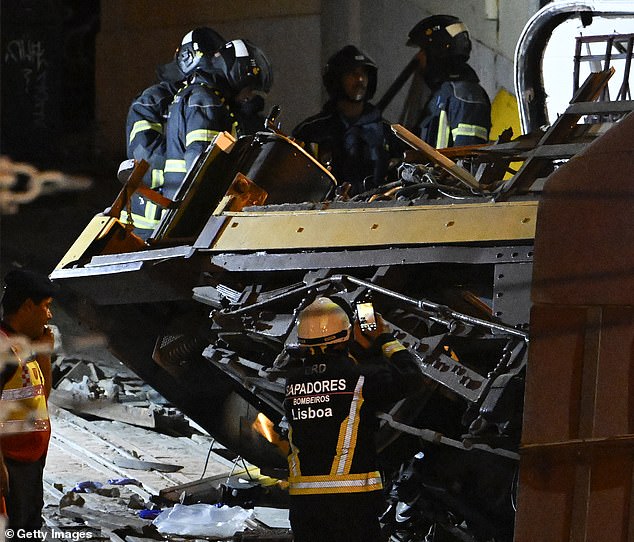
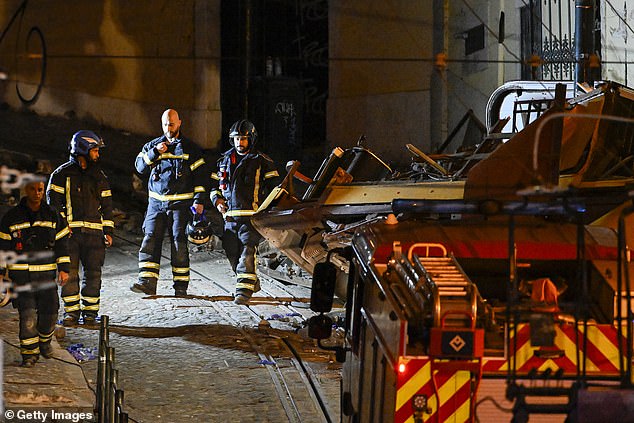
Emergency officials said all victims were pulled out of the carriage in just over two hours from the time of the crash.
Footage showed police and rescue personnel working into the night around the mangled funicular lying on its side against a wall of the street.
Several dozen emergency workers were at the scene but most stood down after about two hours.
The exact cause of the accident is still unclear. Fernando Nunes da Silva, an engineering expert and former Lisbon city council member, told SIC Noticias that he believed Wednesday’s crash was caused by a broken traction cable.
’It’s most likely that the traction cable broke and when that cable broke the brakes didn’t work,’ he told the outlet. ’The descending elevator gained momentum and continued at great speed.’
He said these elevators ’have a very sturdy metal structure and were built at a time when very rigid structures were highly valued’.
’For the [elevator] to be in that condition, it had to be hit very hard. There is no record of the elevator having had an accident in the last few decades.’
’Something surprising is that the brakes didn’t work because when a situation like this happens, there are devices in the vehicle that allow braking to be applied.
’Even if this doesn’t prevent the derailment, it could have reduced the impact.’
Local outlet Publico reported that the crash was caused by a break in the safety cable, connecting the two cabins and ensuring the counterweight.
Carris, the company that operates the streetcar, said ’all maintenance protocols have been carried out’, including monthly and weekly maintenance programmes and daily inspections.
Carris said in a statement that ’all maintenance protocols were implemented and adhered to,’ and that the last inspection took place last year.
General maintenance was carried out in 2022, per its four-year schedule. The last interim repair, performed every two years, was carried out in 2024.
It offered its deepest condolences to the victims and their families in a social media post, and promised that all due diligence would be taken in finding the causes of the accident.
Prosecutors said they were opening an investigation into the accident’s circumstances.
Lisbon’s City Council suspended operations of other streetcars in the city and ordered immediate inspections, local media reported.

Editor-in-Chief
Read more similar news:
Comments:
comments powered by Disqus