Gooch gang boss Lee Amos dies of heart attack in prison
Lee Amos was disliked by his enemies, the police, and many others for his atrocious crimes.
To his family, he was a caring father and son trying to make the most of his time behind bars. It’s a contrast many who have written about major criminals recognize.
Gooch gang leader Amos committed terrible acts in his younger years, contributing to Manchester’s unwanted nickname ’Gunchester’ in the 2000s. He felt he was ’untouchable’.
However, the picture that emerged this week - during an inquest into his death from a heart attack at HMP Oakwood, a privately-run category C prison in Staffordshire, on April 22 last year - was of a frail man whose loved ones sought answers about his care in custody.
Amos suffered from Crohn’s disease. A fellow inmate held his hand and comforted him, saying ’everything’s going to be alright,’ while he sweated and turned blue, grasping his chest in agony in cell 201 on A Wing.
It wasn’t alright. Amos had an undiagnosed heart condition. He died of a heart attack, just as his father – who hadn’t played much of a role in his early childhood – had done four years earlier. Amos was 48.
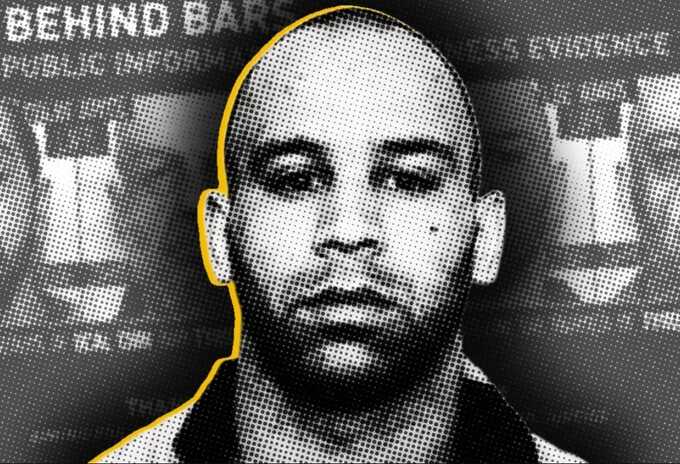
He never became the older version of himself that police illustrated for a billboard when he and an associate were jailed in 2009 for a drive-by shooting two years prior.
Mourners took cover when Amos and four other Gooch gang members opened fire, killing Tyrone Gilbert, 24. Amos was also suspected in the murder of the man for whom the wake was being held – Ucal Chin – but the jury that convicted him of Mr. Gilbert’s murder couldn’t reach a verdict. The judge ordered the charge to remain on file.

Nicknamed ’Cabbo’, Amos was sentenced to life with a minimum term of 35 years. Fellow Gooch gang leader Colin ’Piggy’ Joyce was also jailed for Mr. Gilbert’s murder and ordered to serve at least 39 years.
Six former Gooch members testified against them, also convicting them of attempted murder and possession of firearms. Six weeks before Mr. Gilbert’s funeral, Joyce ’executed’ Mr. Chin, 23, in a daylight attack.
Joyce drove up in an Audi and riddled Mr. Chin’s car with 9mm bullets from a converted Russian Baikal self-loading pistol. Mr. Chin was killed because Amos and Joyce believed he was part of the Longsight Crew.
The artificially-aged faces of the notorious gang members were widely displayed across Manchester. A large billboard along Princess Parkway appeared with the words: "Ageing behind bars."
Police stated at the time: "There are no untouchables."
Detectives also suspected Amos was involved in the fatal shooting of Jessie James, 15, on the evening of September 8, 2006, in Moss Side - even if he didn’t fire the weapon.
A senior officer told the Manchester Evening News shortly after Amos’ death last year: "His name was in the mix. There’s no doubt about that. But in the end, there was no evidence that he pulled the trigger. For me, there were other stronger candidates, but his name was certainly linked."
None of Amos’ crimes were mentioned at Stoke-on-Trent and North Staffordshire Coroners’ Court on Wednesday (August 20), only that he was a serving prisoner receiving treatment for Crohn’s disease, a chronic bowel condition causing severe pain.
Amos’ brother Joseph, in a statement read at the inquest, said his sibling - the eldest of four - was born at North Manchester General Hospital in February 1976, but he grew up in Longsight and Moss Side in south Manchester.
He was raised by his mother as his Nigerian father did not have contact with their family, he said. He also mentioned the murder of their brother Stephen Babatunde Amos in 2002.

Stephen was shot outside Bexx Bar in Ashton-under-Lyne while Lee Amos was imprisoned for another offence, possessing a cache of firearms. Determined for revenge, Joyce and Amos waited patiently in jail.
Once released on parole, there was a dramatic rise in gun crime, culminating in the two deadly drive-by shootings.
Amos worked at a trainer stall in a market until he was 18, then he was unemployed, Joseph said. His brother was ’always trustworthy,’ and his family consistently supported him while he ’offered his assistance when needed,’ he said.
Amos lived at his mother’s home with his partner of ten years, with whom he had a daughter in 1990 and a son in 2001, Joseph added.
Amos later moved to Nottingham, and in 2002 received a three-year sentence, as the inquest found. He was arrested in 2006 and had been imprisoned ever since, frequently visited by friends and relatives. He was diagnosed with Crohn’s disease during his imprisonment in 2018.
It ’shocked the family’ when their father died of a heart attack in Nigeria, while their mother also had health issues, Joseph said.
Amos ’moved around’ various prisons and arrived at HMP Oakwood in July 2023. He organized and led several prison projects and even earned a degree in social policy, according to the inquest. He trained in the prison gym ’most days’ and ’never raised any concerns’ with fellow inmates.
The day before his death, Joseph said he spoke to Amos on the phone. They talked about football and ’how bad Manchester United were.’ He was ’in good spirits,’ as the inquest heard. His death had ’come as a shock to the family as he was ’loved’ as a father, son, and friend, Joseph added.
The inquest revealed how another inmate, Mathew Wright, on the same wing, told police he witnessed Amos sweating, ’clutching his chest, and struggling to breathe after a gym visit.

Mr. Wright thought Amos had merely ’worked hard in the gym’ that morning, Detective Constable Hayley Taylor of Staffordshire Police told the inquest.
Amos asked the inmate to sit with him, but his condition worsened, and prison staff and paramedics were summoned to the prison, the detective said.
DC Taylor mentioned that Mr. Wright comforted Amos, held his hand, and reassured him ’everything’s going to be alright’ until help arrived.
The inmate described Amos’ lips turning blue, and when paramedics came, they started CPR before he was taken to New Cross Hospital in Wolverhampton, where he died.
His cell was locked down, and a search found no illegal drugs, just painkillers and his prescribed medication. Injuries on his body were ’consistent’ with revival attempts, DC Taylor told the court. She confirmed ’nothing untoward’ had occurred to Amos involving other parties.
Christopher Morris, an advanced nurse practitioner based at HMP Oakwood, stated Amos had arrived at the prison on July 23, 2023, after stays at other prisons and that he underwent a ’comprehensive’ health screening in accordance with guidelines from the National Institute for Health and Care Excellence (NICE). By that time, he’d been diagnosed with Crohn’s disease, he said. Health notes from other prisons were forwarded to HMP Oakwood, he remarked.
While at HMP Oakwood, he received Crohn’s treatment under the supervision of a gastroenteritis consultant at New Cross Hospital, Mr. Morris said.
Five days before his demise, Amos was given antibiotics for a tooth abscess, the court was informed. Otherwise, his health was viewed as ’good,’ and his notes contained ’nothing’ to indicate he was at cardiac arrest risk, said Mr. Morris.
The inquest attended by several of Amos’ family queried why there was a disparity between blood test results recorded at the prison and the hospital.
Mr. Morris stated that while the prison typically sent blood results to the hospital, the hospital did not reciprocate. When asked how medical personnel concluded he was okay, Mr. Morris said all results were ’within acceptable ranges.’

Mr. Morris confirmed Amos received his Crohn’s medication 14 days late once. He said it was ’likely’ scheduled for delivery but couldn’t explain the delay.
Questioned why there was no ’care plan’ for treating his Crohn’s disease at the prison, Mr. Morris responded Crohn’s disease wasn’t listed under the NHS’s long-term conditions needing a care plan. Amos was supposedly ’managing well’ with his condition.
HMP Oakwood custody officer Sophie Evans, in a statement read during the inquest, described Amos as ’pleasant and easy to interact with.’ She maintained a ’strictly professional’ demeanor while Amos ’kept to himself.’ He was ’polite,’ raising a ’number of concerns’ with her during his term, Ms. Evans stated.
During the morning before his deterioration, she had opened his cell door and said ’hello,’ seeing him already dressed in shorts and a ’gym top,’ ready for his typical gym session, the witness indicated. "He seemed his normal self," she noted. He inquired about a ’project’ he was pursuing in prison.
Ms. Evans recalled later that Mr. Wright shouted from Amos’ cell door for help, prompting a call for prison staff and an ambulance.
The witness reported asking Amos if he was okay, and he replied ’yes,’ albeit mentioning a ’tingling’ sensation in his left arm. Mr. Wright was holding Amos’ hand at this time, she recounted.
Amos was placed in the recovery position, and an emergency button was pressed, said Ms. Evans. Amos was ’sweating massively,’ ’cold to the touch,’ and was turning blue, she stated. Amos then ’started to go into seizure,’ and staff began administering CPR.
A defibrillator was brought to the cell, and about ten minutes later paramedics arrived, taking Amos to the hospital, the inquest was informed.
A post-mortem examination determined Amos died from cardiac arrest linked with ’ventricular fibrillation’ and ’cardiomegaly.’ The examination found Amos had ’underlying cardiac disease.’
Area coroner Emma Serrano, recording a natural causes conclusion, stated: "All the evidence I have heard leads me to conclude this was a cardiac-related death." He died ’suddenly and unexpectedly’ with ’no medical history’ of heart problems, she added.

World Affairs Correspondent
Read more similar news:
Comments:
comments powered by Disqus