Putin’s chess front: FIDE accused of shielding Russia’s war crimes with global tournaments
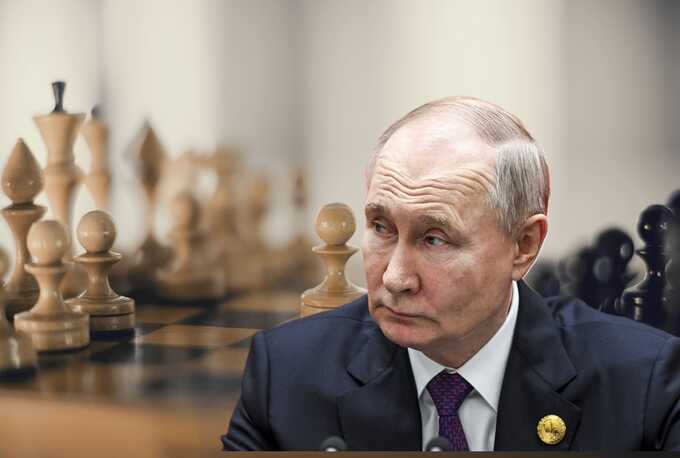
For more than 1,000 years, chess has been synonymous with war. Now, Vladimir Putin is combining the ancient game with modern skulduggery as he tries to win an all-too-real 21st century conflict.
The geopolitical strategy of the Soviets and Russians has been deeply entwined with knights, rooks, kings and queens for so long that it’s difficult to tell where sport ends and real battle begins, reports by Politico.
Three years after the full-scale invasion of Ukraine, one of Russia’s top players has become a vocal propagandist for the Kremlin’s war, even personally delivering military equipment to the front line. Facing him, not across 64 black and white squares but over the gaping divide that separates Putin’s supporters from the rest, are the most famous grandmaster of all time and the coach of the world’s current best player, who rail against the president’s behavior.
As the western world closed its doors to Russia after the 2022 invasion — withdrawing business, banning exports and prohibiting its sports teams from participating in international competitions — Moscow somehow managed to retain control over key chess institutions, shielding Russia from sporting sanctions and allowing its players to continue competing internationally. It even hosted lucrative tournaments in the occupied Ukrainian territories of Crimea and Donbas.
To Moscow’s critics, world chess has become a soft power tool for the Kremlin to normalize and institutionalize its murderous occupation of its neighbor.
Bureaucrat and attack dog
The connections between the Kremlin and chess are deeply embedded. And if one man personifies the blurred lines between politics and sport, it’s Arkady Dvorkovich.
With his graying hair and placid smile, the president of the World Chess Federation (known by its French acronym, FIDE) exudes the air of a middling sports bureaucrat.
Yet that unthreatening appearance masks Dvorkovich’s remarkable resume as a top Kremlin apparatchik, serving as a deputy prime minister in the Putin regime from 2012 until 2018. Before that, he was senior aide to then-President Dmitry Medvedev, now one of the most aggressive public supporters of the war on Ukraine.
“FIDE today is an instrument of Russia’s geopolitical work,” Oleksandr Kamyshin, head of the Ukrainian Chess Federation, told POLITICO. “He is the bearer and implementer of tasks that take place from the Kremlin.”
Dvorkovich’s role running world chess has also attracted fierce criticism from Garry Kasparov, one of chess’s biggest names.
Kasparov, the six-time world champion and Russian dissident, highlighted how Dvorkovich has repeatedly used chess diplomacy to further Moscow’s influence. He described FIDE as the KGB’s “foreign hand,” and cited examples where the arrival of Kremlin delegations coincided with FIDE events in strategic regions such as Kazakhstan and Pakistan.
Kasparov said those patterns demonstrated how FIDE activities often align with Russia’s geopolitical objectives, even if they’re not direct proof of collusion between Moscow and world chess.

The connections between the Kremlin and chess are deeply embedded. And if one man personifies the blurred lines between sport and politics, it’s Arkady Dvorkovich. | Tristan Fewings/Getty Images for World Chess
Dvorkovich previously headed Skolkovo, a Moscow-based innovation center sanctioned by the U.S. for producing military technologies for the Russian Armed Forces. Though Dvorkovich left Skolkovo six months before sanctions were imposed, he made a statement in March 2022 that was relayed to Russian media by the Skolkovo Foundation echoing Kremlin propaganda on Ukraine.
He claimed to have been “raised on patriotism” and expressed pride in Russia’s soldiers, while referencing “Nazism,” a term frequently weaponized by Russian officials to justify aggression in their neighboring country.
Dvorkovich’s wife, Zumrud Rustamova, still runs businesses in Russia. She has led the Cyprus office of Russian senator and billionaire Suleyman Kerimov’s investment holding Nafta Moskva for nearly a decade, while simultaneously serving in leading, lucrative positions at polymetallic groups.
Neither Dvorkovich nor his wife are sanctioned by the EU or the U.S., but Ukrainian President Volodymyr Zelenskyy whacked Rustamova with sanctions in 2023.
Malcolm Pein, a British master chess player and journalist, said FIDE’s governance structure has shifted under Dvorkovich’s leadership, consolidating key positions in Russian hands.
“FIDE is completely under Russia. Using a significant number of resources, they secured Dvorkovich to the presidency, amending the constitution,” Pein said.

Garry Kasparov, the six-time world champion and Russian dissident, highlighted how Dvorkovich has repeatedly used chess diplomacy to further Moscow’s influence. | Saul Loeb/AFP via Getty Images
“You’ll see if you look on the FIDE website that a lot of the key positions are held by Russians, but the most important thing is of course the position of president,” he added. “Dvorkovich is in a difficult position, trying to reconcile what should be the proper interests of a global sporting body with what are the interests of the dictatorship that’s invaded another country.”
Despite the long shadow cast by his Kremlin links, Dvorkovich’s defenders argue that he is merely focused on ensuring competitors are not unfairly penalized by broader geopolitical conflicts. Dvorkovich has said that FIDE’s ethical decisions aim to ensure that “sports, including chess, remain accessible to players from all over the world.”
Dvorkovich and FIDE did not respond to several requests for comment across multiple channels about his government connections.
From chess board to front line
If Dvorkovich, perhaps, is seen as a Kremlin pawn moving slowly and strategically in bland meeting rooms around the world, Putin also has a dark knight acting with swashbuckling effectiveness directly in enemy territory.
Sergey Karyakin, a chess grandmaster born in Crimea — the Ukrainian peninsula illegally annexed by Russia in 2014 — has been a vocal supporter for years of Putin’s war. Lately, he has traded his chess pieces for an active role on the front line, where he helps promote Moscow’s view of the conflict across the airwaves.
“He’s actually not only doing propaganda,” Peter Heine Nielsen, the Danish coach of multiple world champion Magnus Carlsen, told POLITICO. “He is at the front delivering weapons. It’s the worst ever seen in history. It has all conditions for a lifetime ban.”

“FIDE today is an instrument of Russia’s geopolitical work,” Oleksandr Kamyshin, head of the Ukrainian Chess Federation, told POLITICO. | Roslan Rahman/AFP via Getty Images
Karyakin has also been documented visiting war zones such as occupied Avdiivka, which Russian forces captured in February 2024, and delivering equipment to the Kremlin’s troops. In September 2024, he survived a drone attack near Kharkiv while traveling with the Russian military. His role as a propagandist, where he publishes on Telegram to around 24,500 followers, includes spreading disinformation about the war.
The EU hit Karyakin with sanctions in February, alleging he supported Moscow’s war “including by publishing an open letter to President Vladimir Putin, travelling to the Ukrainian territories occupied by Russia and gathering military supplies in support of the Russian Armed Forces. For these actions, he has been awarded the Russian Federation medal ‘For Merit to the Fatherland.’”
Karyakin did not respond to multiple requests for comment by POLITICO.
Despite Karyakin’s documented activities, FIDE has reacted tepidly.
In March 2022, the body’s Ethics and Disciplinary Commission suspended Karyakin for six months, citing violations of the organization’s code. This move was seen by opponents of Russian influence in chess as a strategic attempt to protect Dvorkovich from criticism. Yet, Karyakin’s propaganda only intensified after his suspension, and FIDE failed to impose further penalties.
Critics detect the Kremlin’s hand guiding FIDE, pressuring Dvorkovich and protecting Karyakin.

Chess holds a storied position in Russian history, deeply intertwined with the nation’s culture and politics. | Roslan Rahman/AFP via Getty Images
In September 2024, Karyakin was appointed to Russia’s Federation Council as a representative of occupied Crimea. This alignment with the Kremlin makes sporting sanctions politically sensitive for Dvorkovich, who still remains under some pressure to balance international norms with his relationship to Russian authorities.
“Karyakin is doing a lot of chess activities for United Russia [Putin’s political party], seen often with Medvedev, for instance, Dvorkovich’s former boss,” Nielsen said. “Karyakin has protection, and that will have consequences for Dvorkovich if he bans him.”
He suggested that Western governments — as the EU has done — should bypass sports organizations and impose their own crippling sanctions: “I’ll certainly be encouraging the British government to do that.”
Karyakin’s stark case underscores the broader struggle for international sports organizations to enforce ethical standards amid escalating geopolitical pressures.
“It’s this typical balancing thing,” Nielsen said. “But the reasonable question is, why are FIDE and others not doing their job?”
The Soviet monopoly
Chess holds a storied position in Russian history, deeply rooted in the nation’s culture and politics.
The game first gained popularity among Russian aristocrats in the 19th century, but it was after the communists took over and established the Soviet Union that it was elevated it to new heights. They promoted chess as an inexpensive yet effective tool to unify the huge multiethnic population.

Under Joseph Stalin’s directive in the 1930s, chess became a state-sponsored pursuit, with schools, clubs and competitions proliferating across the USSR. The game’s intellectual rigor made it an ideal vehicle for showcasing Soviet superiority on the world stage.
The Soviet chess machine was unparalleled. Promising talents were identified early and nurtured through a robust network of schools and mentorship programs, most notably under the tutelage of world champion Mikhail Botvinnik. Chess magazines, grand tournaments and films portrayed the game as a prestigious pursuit, accessible to all citizens, from factory workers to academics.
It was a strategic tool as much as a pastime. Top players like Anatoly Karpov in the 1970s and Kasparov in the 1980s became household names, earning prestige and privileges rare for Soviet citizens, including opportunities to travel abroad during the Cold War.
The Soviet dominance of the world championship, with eight winners spanning several decades, was testament to the state’s investment. However, the collapse of the USSR in 1991 dismantled much of the infrastructure that had sustained this control. Clubs were privatized, top players emigrated and funding dwindled, marking a decline in Russia’s once-unquestioned supremacy.
Despite those setbacks, Russian influence in chess persisted — which brings us back to FIDE.
Since 1982, the organization has been heavily influenced by Russian figures, such as Kirsan Ilyumzhinov and Dvorkovich, who both served as president. Ilyumzhinov even played chess with Libyan dictator Muammar Gaddafi during their concurrent reigns.
Controversy has dogged Russian chess in recent years, as Putin has become more aggressive on the world stage.
For a time, the federation’s only official sponsors were Russian companies, including state-owned giants like Russian Railways and atomic energy corporation Rosatom, highlighting its reliance on Kremlin-linked capital and raising questions about financial transparency.
Western sanctions following the 2022 invasion limited Russian players’ participation in global events under their national flag. But Russians continue to compete in individual capacities, often without having publicly condemned the war. And in 2023, the Russian Chess Federation controversially shifted its affiliation from the European Chess Union to the Asian Chess Federation, a move seen by critics as a cynical attempt to circumvent sanctions.
‘Pure indoctrination’
Russian oversight of world chess has sparked questions for FIDE about its neutrality and commitment to international law — after a heated legal dispute over chess tournaments with big cash prizes being held in Ukraine’s occupied territories.
In June last year, FIDE’s Ethics Commission issued a landmark ruling against the Russian Chess Federation (RCF), imposing a two-year suspension on the body following a complaint from the Ukrainian Chess Federation.
The charges were serious: organizing chess tournaments in occupied territories, collaborating with sanctioned individuals and breaching FIDE’s own neutrality policy. The decision also reprimanded Dvorkovich.
But in a controversial turn of events, the Commission overturned much of this ruling on appeal just three months later. On Sept. 13, the suspension was replaced with a €45,000 fine — and Dvorkovich’s reprimand was revoked entirely.
Nielsen opposed the decision vehemently. “By softening the penalties, FIDE legitimizes RCF’s actions in occupied territories,” he said. He noted that regional chess federations in Crimea and Donetsk were formally integrated into the Russian system, a clear violation of FIDE’s statutes and Ukraine’s territorial sovereignty.
“FIDE has turned a blind eye,” Nielsen added. “This is not about children playing chess; it’s about Russia institutionalizing occupation through sport.”
The chess federation’s Ethics Commission is composed of seven members. According to official documents, the decision to soften sanctions was made by three people: Francois Strydom, chair of the commission from South Africa, American David Hater and Indian Ravindra Dongre.
Strydom, a South African lawyer and longtime chess bureaucrat who, according to Nielsen, ultimately played a decisive role in the softening of sanctions, also holds a prominent position — head of the Dispute Resolution Chamber — connected to the International Boxing Association (IBA), an under-fire organization led by Russian official Umar Kremlev.
The veteran official’s connections (revealed by Ukrainian sports news outlet Tribuna) to SILA International Lawyers, a firm representing various Russian sports bodies, further fueled allegations of bias.
Strydom did not respond to POLITICO’s request for comment, but on a public Facebook page he described criticism of his links to Russia as “conspiracy theories.”
Critics have pointed out that Russian chess competitions in Crimea and the Donbas are particularly sinister.
“What Russia is doing in the occupied territories is pure indoctrination,” Kamyshin, president of Ukraine’s chess federation, told POLITICO. “We are losing to them since we cannot organize so many tournaments. [Our] latest tournament for 70 children was held in October in Irpin and the prize fund was only $500.”
According to documents obtained by Tribuna, RCF-organized tournaments in occupied regions require players to submit personal data and obtain Russian documentation, entrenching Moscow’s control. Ukrainian representatives, including chess chief Kamyshin, argue this violates not only FIDE rules but also the Olympic Charter.
“Russia has organized more than 2,600 tournaments in the occupied Ukrainian regions over the last 10 years,” Nielsen said, adding that they are funded by deep Russian pockets.
More than 6,000 players from Russian-controlled territories in Ukraine have been registered by the RCF in its rating database, with nearly 5,000 under the age of 20.
‘Naive’ about Russia
Opponents of Russian influence in chess haven’t been checkmated yet, however, and their fightback is exemplified by people like Nielsen and his wife, Viktorija Čmilytė-Nielsen, a former speaker of the Lithuanian parliament.
Nielsen’s journey from promising young chess player to world-class coach and outspoken activist has been shaped by his experiences in Russia.
Early in his career, Nielsen traveled to Russian chess hubs to learn from their rich tradition in the game, only to witness the intertwining of chess with oligarchic and political influences. “I was one of those Westerners who believed engagement with Russia would lead to peace,” he said. “I see now how naive I was.”
Nielsen’s worldview was further shaped by his wife, Čmilytė-Nielsen, who is also a chess grandmaster.
Introduced to chess at the age of six, she achieved stunning early victories, including European and World Youth Championships. After transitioning to politics in adulthood, Čmilytė-Nielsen became a key supporter of Ukraine in Lithuania, leading her parliament to adopt resolutions condemning Moscow’s aggression and recognizing Russia as a state sponsor of terrorism.
Her staunch support for Ukraine galvanized Nielsen’s own political activism.
“Living in Lithuania, where the understanding of Russia is sharper, and seeing my wife’s leadership during these challenging times, profoundly impacted my perspective,” he told POLITICO. “She went to the front lines in 2021 and told me her impressions about this war. That made me rethink what Russia is actually doing in Ukraine.”
When Russia launched its 2022 invasion, Nielsen became one of the most vocal supporters of Ukrainian sovereignty in the world of chess. He joined forces with Ukrainian grandmaster Andrii Baryshpolets in the 2022 FIDE elections, in an ill-fated challenge to Dvorkovich’s leadership.
“I initially hesitated to join the FIDE presidential campaign, but seeing the deep ties between chess and politics, and inspired by my wife’s insights on Ukraine and Lithuania’s role, I felt it was my duty to stand up for transparency and integrity in the chess world,” he said.
Ukraine’s uphill struggle
For Ukraine’s Kamyshin, the chessboard represents more than strategy: It is a battleground where principles, diplomacy and national identity intersect.
Kyiv’s former minister for strategic industries, who ran the country’s rail infrastructure in the early days of Russia’s war, Kamyshin was elected as president of the country’s chess federation in early September 2024. He is one of the most influential people in the country and is closely connected to President Volodymyr Zelenskyy. And he has several ambitious goals for his term in charge.
Kamyshin wants to strengthen Ukraine’s position within FIDE, advocate for the suspension of Russia’s chess federation and push for the removal of Russian citizens from FIDE’s leadership. It will be an uphill struggle.
“FIDE today is a lost strategic front for the civilized world,” Kamyshin said, highlighting how Moscow has entrenched itself in the chess governing body, controlling its decisions and operations. “This is not just a Russian citizen leading FIDE — this is a federation run by Russian standards.”
One of the most contentious ongoing issues in chess diplomacy, Kamyshin said, is Russia’s push to reintegrate its players under national flags and anthems despite its ongoing aggression. “As long as they wage an unjust war, killing our athletes, chess players, and civilians, this is unacceptable,” he said.
Beyond the geopolitical struggle as Putin’s forces press ahead in Ukraine’s east and U.S President Donald Trump looks set to scale back American support for Kyiv, Kamyshin is driven by his mission to rebuild chess in Ukraine as both a strategic tool and a symbol of resilience.
“Ukrainians need to become smarter and stronger,” he said. “Chess is a vital element of that strategy. We’ll fight on every front — on the chessboard and beyond.”
World Affairs Correspondent
Read more similar news:
Comments:
comments powered by Disqus