NASA releases amazing image of star cluster which looks 'like Christmas tree'
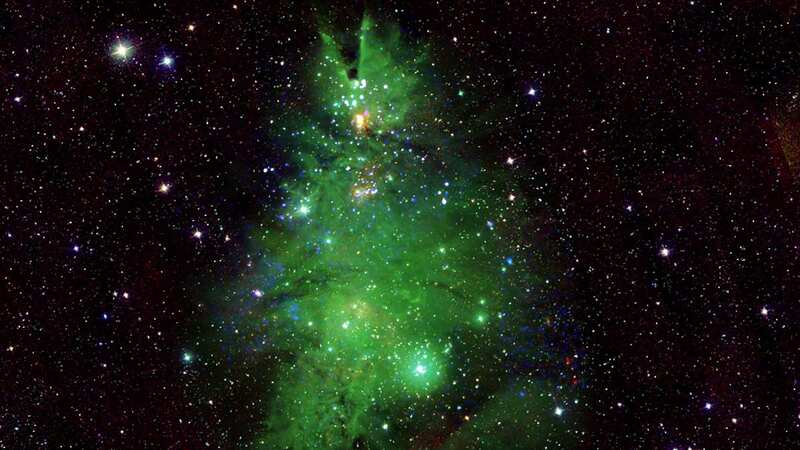
Be it the glow from the fairy lights in your tree or your neighbour's brazen decorations, it's difficult to escape the twinkle of Christmas lights right now — but few are more festive than this cosmic cluster.
NASA has released a new image of what's been dubbed the 'Christmas Tree Cluster' - a group of new stars in the Milky Way forming the shape of a festive Nordic fir.
Its real name - NGC 2264 - may be somewhat less evocative of the Christmas spirit, but doesn't detract away from the resemblance noticed by scientists. The stars making up the formation are thought to be between one and five million years old - very young for our universe - and are around 2,500 light years from Earth.
According to NASA, the stars range from being less than a tenth of the mass of the Sun, to others which are seven times as big. The emerald glow is due to the image having been enhanced, while the blue and white flecks seen are a result of X-rays detected by the telescope.
 X-Rays from the stars were detected by NASA's Chandra X-Ray observatory (NASA / SWNS)
This new image was captured by the National Science Foundation’s WIYN 0.9-meter telescope on Kitt Peak, with the green haze coming from nebula gases. Although its uncanny resemblance to a Christmas tree, NASA scientists have rotated it almost upside down for a festive novelty.
 Green comet last seen by Neanderthals 50,000 years ago to fly past earth tonight
A NASA spokesperson said X-rays from the stars were detected by the organisation's Chandra X-ray Observatory, with young stars more likely to give out stronger flares. They said: "The variations observed by Chandra and other telescopes are caused by several different processes.
"Some of these are related to activity involving magnetic fields, including flares like those undergone by the Sun — but much more powerful — and hot spots and dark regions on the surfaces of the stars that go in and out of view as the stars rotate. There can also be changes in the thickness of gas obscuring the stars, and changes in the amount of material still falling onto the stars from disks of surrounding gas."
Read more similar news:
Comments:
comments powered by Disqus