Powerful laser will be 'million, billion, billion times brighter than Sun'
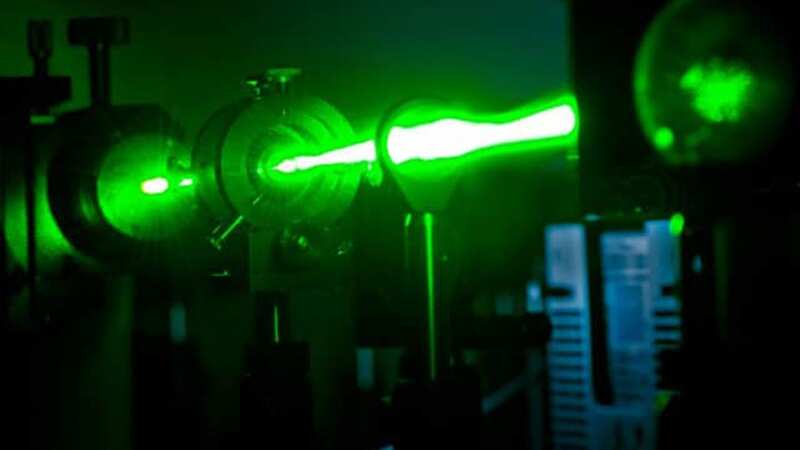
Scientists say the world's most powerful laserbeam will be "a million, billion, billion times brighter" than the sun.
British experts are in the process of building a super laser which will cost a staggering £85million, a single pulse of which will deliver more power than the National Grid supply. It's hoped the beam, named the Vulcan 20-20 laser, will speed up advances in nuclear fusion, renewable energy and batteries.
The mega device - which is to be constructed at a site in Oxfordshire - will outshine the current brightest beam 'the Vulcan', which can heat matter to a staggering 10million Celsius and helped map how Covid infected and damaged cells during the pandemic. It's estimated it will take six years to build.
Scientists hope Vulcan 20-20 will provide a better understanding of astrophysical phenomena such as supernovas and solar flares. Experts say it could also be harnessed to study a new particle acceleration method for radiotherapy treatments for cancer.
Science minister George Freeman said: "Reestablishing Britain as home to the world's most powerful laser is an exciting opportunity to explore the unexplored in astronomy and physics.''
 'Weird' comet heading towards the sun could be from another solar system
Professor Mark Thomson, executive chair of the Science and Technology Facilities Council (STFC), which provided the funding, said: "The Central Laser Facility has been a driving force behind discoveries that have advanced our understanding of diverse areas from the fundamental properties of matter under extreme conditions to the formation of stars and planets."
Earlier this year, the Mirror reported, that a new laser has been developed by scientists to detect aliens on other planets. The miniature device has been tailored to NASA space missions with an aim to revolutionise the search for extraterrestrial life.
The instrument, which only weighs about 17 pounds, is a scaled-down combination of two tools.The pulsed ultraviolet laser removes small amounts of material. A scanner named Orbitrap then delivers high-resolution data about their chemistry.
Read more similar news:
Comments:
comments powered by Disqus