Student suspended again over hairstyle despite new law on hair discrimination
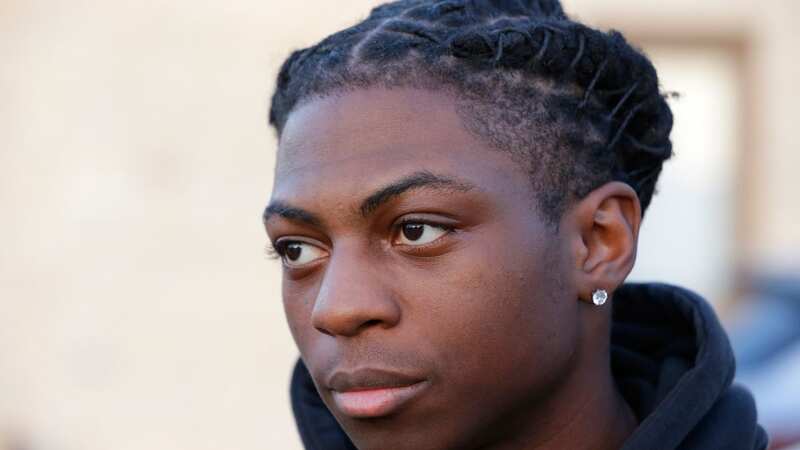
A Black high school student has been suspended for a second time over his hairstyle months after a new law came into force banning hair discrimination.
Darryl George, 17, was suspended from Barbers Hill High School in Mont Belvieu, Texas, and was told he would have to leave school last week because his hair fell below his eyebrows and ear lobes. In defiance of the school decision, Darryl's mum Darresha George said her son will be returning to the establishment wearing his dreadlocks in a ponytail.
However, George has reportedly been suspended for more than two weeks over his loc hairstyle which Barbers Hill Independent School District says violates its dress and grooming code. The school prohibits male students from having hair extending below the eyebrows, ear lobes or top of a t-shirt collar, but young Darryl's hair was pinned up. Ms George said she was confused about how her son's hair violated the code because of this reason.
Now a lawyer representing the family has told how school officials have asked to meet with George and his mother to dicuss continued disciplinary action. The family have also previously told the teen would be placed in a Disciplinary Alternative Education Program, also known as alternative school, if he didn’t cut his hair, Booker said.
For all the latest news, politics, sports, and showbiz from the USA, go to The Mirror US
 Darryl George, left, a 17-year-old junior, and his mother Darresha George, right, talk with reporters outside the school (AP)
Lawyer Allie Booker told CNN : "What I expect for them to try to do is to put him out of school,” Booker told CNN. “But they won’t do it with our consent.” George's suspensions come just days after the CROWN act came into effect on September 1 - which prohibits race-based hair discrimination in Texas workplaces, schools and housing policies.
Twenty states have passed the CROWN Act — an acronym for Creating a Respectful and Open World for Natural Hair, according to the CROWN Coalition, an organization that champions the legislation. The movement against natural hair discrimination reached national headlines in 2020 with a series of instances, including two students near Houston who were told to cut their hair or be disciplined.
 In this photo provided by Darresha George, her son Darryl George, 17, a junior at Barbers Hill High School in Mont Belvieu, Texas, sits for a photo showing his locs pinned above his ears and neck (AP)
The specifics of the act relate to protective hairstyles including Afros, braids, dreadlocks, twists or Bantu knots. This is not yet federal law - the version passed in the House, but not the Senate, last year - but 24 states have their own version of CROWN. Ms George said she was told by school officials the act does not cover the length of hair. Attorney Booker said the school's argument doesn't hold up because length is considered part of a hairstyle, which is protected under the law.
"We are going to continue to fight, because you can't tell someone that hairstyles are protected and then be restrictive. If style is protected, then style is protected," Ms Booker said. Candice Matthews, national minister of politics for the New Black Panther Nation, explained hair can be an important part of a Black person's identity and has been both historically and culturally important. "Dreadlocks are perceived as a connection to wisdom," Matthews said.
 Darryl George, center left, a 17-year-old junior, and his mother Darresha George, center right, share words of encouragement before walking across the street to go into Barbers Hill High School (AP)
She continued: "This is not a fad, and this is not about getting attention. Hair is our connection to our soul, our heritage and our connection to God." Historians say braids and other hairstyles served as methods of communication across African societies, including to identify tribal affiliation or marriage status, and as clues to safety and freedom for those who were captured and enslaved.
After slavery was abolished, Black American hair became political. Although the Civil Rights Act of 1964 banned discrimination on the basis of race, colour, religion, sex, and national origin, Black people continued to face professional and social stigma for not adopting grooming habits that fit white, European beauty standards and norms.
In a statement shared with CNN, David Bloom, director of communications for the Barbers Hill Independent School District, said the district is “unable to provide any comment with respect to disciplinary matters involving a student.”
Comments:
comments powered by Disqus