Crater on surface of Mars may have been caused by alien spaceship crash
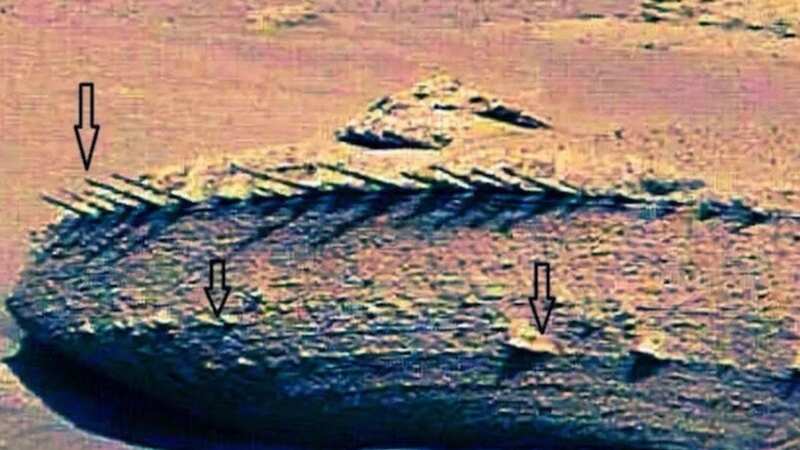
Scientists have admitted that a crate on the surface of Mars could have been caused by an alien spaceship crash.
The rocks appear to be scarred with wheels, an axle and debris, with experts stating a “fragment from an extra-terrestrial or terrestrial spacecraft cannot be discounted with absolute certainty”. The unusual images have been captured by Nasa's Curiosity Rover, showing bizarre spikes and bumps.
The rover was exploring the 96-mile Gale Crater in April when it made the discovery. Dr Nathalie Cabrol described it as “the most bizarre rock” she had seen in 20 years of studying Mars. Now a new research paper concludes the formations may be “sand spikes” like those which are formed on Earth during strong earthquakes.
The authors, including Prof Richard Armstrong of Aston University, said the objects are unlikely to be from the ten human-made spacecraft that have crashed or disappeared on Mars. Prof Armstrong added: “One can only speculate about extraterrestrial origins. Mars images often show strange formations which ‘look like’ familiar objects.”
This comes as Nasa's Perseverance rover found diverse organic matter in the Jezero crater, which experts say suggests a more complex system than previously thought may have existed in the past.
 Green comet last seen by Neanderthals 50,000 years ago to fly past earth tonight
A number of different explanations for the origins of organic matter on the Red Planet include water-rock interactions and biotic origins - derived from living organisms. Deposits by interplanetary dust or meteors are also being considered by scientists. According to the study, understanding more about Martian organic matter could shed light on the availability of carbon sources, with implications for the search for potential signs of life.
The Scanning Habitable Environments with Raman and Luminescence for Organics and Chemicals (Sherloc) instrument on the rover is the first tool to enable fine-scale mapping and analysis of organic molecules and minerals on Mars. Perseverance landed within the Jezero crater, the site of an ancient lake basin with high potential for past habitability, in February 2021.
Since then scientists have been exploring the geological make-up of the crater floor using a suite of tools on board the rover that can take pictures of and analyse the rocks. Sunanda Sharma, Ryan Roppel and their colleagues analysed observations from two formations on the Jezero crater floor.
Signals of organic molecules were detected on all 10 targets that Sherloc observed in the Jezero crater floor, concentrated in the Maaz formation, more than in the Seitah formation. The data showed diverse mineral association and spatial distribution that may be unique to each formation.
The researchers suggest the diversity among these observations may provide insight into different ways that organic matter may have originated: potentially through deposition by water, or in combination with volcanic materials.
Writing in the Nature journal, the authors said: "Our findings suggest there may be a diversity of aromatic molecules prevalent on the Martian surface, and these materials persist despite exposure to surface conditions.
"These potential organic molecules are largely found within minerals linked to aqueous processes, indicating that these processes may have had a key role in organic synthesis, transport or preservation."
Read more similar news:
Comments:
comments powered by Disqus