20 August 2023 , 06:00
527
0
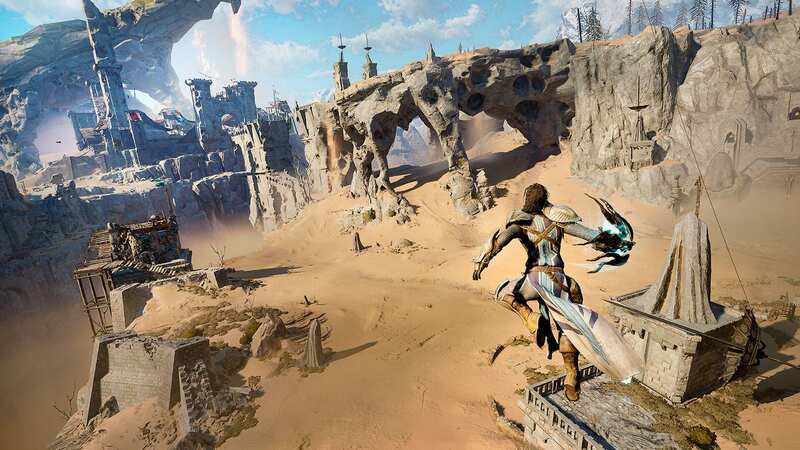
The new release from Deck13 Interactive demonstrates that rougher is sometimes better when it comes to third-person action games.
Most modern video games demand a lot of your time to be enjoyed to their fullest these days. The progenitor for this way of thinking – at least on consoles anyway – is Destiny. With its infinitely repeatable strike missions, multiplayer raids, and endless seasonal content drops, developer Bungie doesn't want you to ever stop playing.
It became a popular tactic, swiftly adopted by the likes of Overwatch, Fortnite, and even PvE-centric titles like this year’s Diablo 4. One new release I’ve been enjoying lately that is unabashedly not that, however, is scrappy third-person, open-world action RPG, Atlas Fallen.
Right off the bat, Atlas Fallen has all the hallmarks of a rough-around-the-edges AA title you’d expect to find in the bargain bin of a brick-and-mortal video game store. Wildly generic title? Check. Faceless central character? Uh-uh. How about a combat system that is fun but never really develops beyond the first few hours? Oh, you bet. I mean all this as a compliment of course, in case you couldn’t tell, as someone who longs for the days when single-player titles packed with creative ideas used to be everywhere.
In the case of Atlas Fallen, its central idea appears to be ‘sand is cool’. I’ve never believed this to be the case myself, but the developers over at Deck13 Interactive clearly have, breaking free from the Soulslike confines of previous titles Lords of the Fallen and The Surge duology to make a game where you command those granular particles at will. In fairness, controlling sand has its perks, such as letting you skate across caverns and hilly surfaces with ease, blocking giant enemy attacks, and raising buried obelisks. Put simply, this is AA game design at its very best.
 Why Star Wars Jedi: Survivor's six week delay is a good thing
The drawbacks of such an odd premise and central mechanic is that the story is mostly gobbledygook, being mainly an excuse to see you skate across the sands over to your next objective. Speaking of which, most objectives are rudimentary and merely consist of fetch quests that a first-party or higher budgeted title could never get away with. Atlas Fallen can, though, because the fluidity of the traversal is that good; in the 10 or 12 hours I’ve spent bashing huge beasts and collecting McGuffins to upgrade armour pieces so far, sliding up and down the sands has formed a large part of my enjoyment.
That’s not to say that the combat system in Atlas Fallen is lacking. In fact, it’s quite the opposite. Rather than devolving into a rather tiresome hack-and-slash affair, beating up creatures as a god of the sand is all built around momentum; the more damage you deal out to enemies over time unlocks certain abilities contained within your gauntlet. Spread across three tiers, you can choose to unleash a level 2 power, knowing that you won’t be able to perform one at the next level until your momentum is built up again. This system combines with some fairly snappy dodging and parrying to coalesce nicely.
My sense is that Deck13 Interactive hopes that as my custom character levels up, I will eventually equip my gauntlet with new powers capable of directly changing the flow of combat. Not once have I ever felt the inclination to do this, given the power setup gifted to me early on, which I came to appreciate incredibly quickly. Why would I give up the ability to summon a giant tornado? Especially when you consider that it’s hard to maintain high momentum seeing as you take higher damage the more it fills. I much prefer spamming Essence Stone abilities at the lower end.
Atlas Fallen has a lot of things going for it, particularly when it comes to combat and traversal. What ultimately lets it down is the inherent repetitiveness of tasks and the vastness of the setting. This is the type of game where having a tightly contained open-world would have been ideal, encouraging me to plug away at the various side quests and optional gear hunts as I zoomed around on the sand. However, Atlas Fallen is actually spread across four maps rather than one, suffering greatly from the same enemy designs that don’t really increase their level of challenge outside of being a higher level. I can’t tell you how many times I’ve had a crab-like Shellbasher on my tail.
And yet, for all its issues and PS3-era approach to game design, there’s a certain charm to Atlas Fallen that we don’t see too often anymore. The stocky characters, senseless plot and one-note (but undeniably awesome) movement here shares a lot more in common with Darksiders, or Kingdoms of Amalur than it does the latest Assassin’s Creed – or other, more polished open-world titles made on a AAA scale.
Atlas Fallen is a reminder that not every game needs to be good at everything in order for it to have value in today’s gaming climate. Better yet, in stark contrast to the countless live service titles released, not every game needs to soak up all your time either.