Top gardener tells you the key to a successful allotment
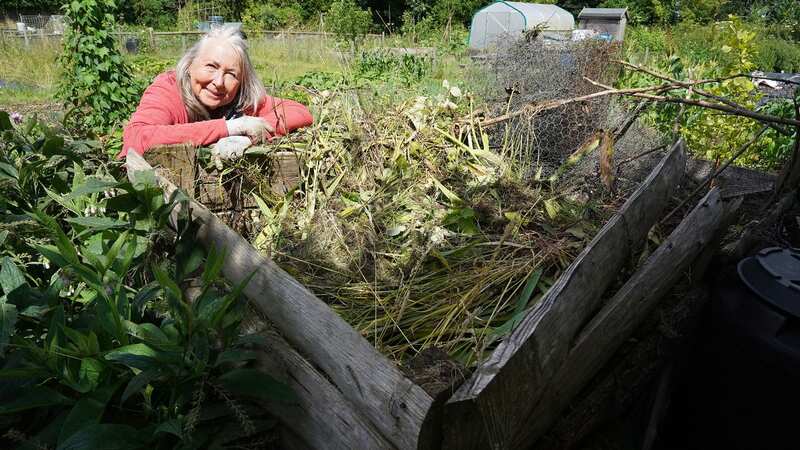
Among his recent musings about the progress of his allotment, our much loved diarist Paul Routledge revealed his secret weapon.
“There are lots of helpful books,” he said. “I swear by Val Bourne’s Ten-Minute Gardener’s Vegetable Growing Diary.” Val is an award-winning writer, organic hands-on gardener and committed plantaholic, with an allotment in rural Gloucestershire. She says: “My hundred or so dahlias are not appreciated by my Best Beloved, although he’ll take all the plaudits once they’re in flower.”
Val manages her third of an acre garden without using chemicals – something she has always believed in. Her latest book The Living Jigsaw, is all about her eco-friendly garden. She has been interested in the natural world since childhood and has actively tried to influence gardeners to be greener in order to help the survival of our planet.
Val, who is an ambassador for The Hardy Plant Society and worked in vegetable research for five years, has been judging RHS plant trials for the past 16 years. In this National Allotment Week, Val has written an allotment guide for Mirror readers and allotmenteers of all levels - with advice for newbies, next level gardeners and even suggested a bit of fine tuning for those so experienced it’s not just their fingers which are green...
 Val says you're only as good as your tools (MARC GIDDINGS 07799772824)
 Ground prep is important (MARC GIDDINGS 07799772824)
Advice for Allotment Newbies
If you’re at the ‘shall I or shan’t I stage’, put your name on the waiting list anyway. Most people wait for years to get one and by the time they’re handed on, the new tenants usually have to reclaim them from the wilderness. This can take several years of hard work. Just think of it as productive Pilates with back ache.
 Shoppers can get a dozen red roses for £4.99 this Valentine's Day - here's how
Once you’ve got one, have a good recce round the site, taking special note of the more productive plots. They’ll indicate what grows well and what doesn’t. Take note of any communal facilities. There may be a shared water supply, a pop-up shop or a shared composting area. Finally, be friendly and chat, because experienced plot holders will be generous with their advice. They may even give you their spare plants!
Assess your soil. Pick up a small handful and squeeze it together in the palm of your hand. Clay soils form a ball and this tells you two things. The ground will compact if you walk on it, so order in some scaffold planks now. Clay soil lies claggy and cold in winter, so you must wait for good weather before doing any planting or sowing. This may well mean ignoring the instructions on the packet! There is some good news: clay retains moisture and nutrients.
 Check your soil to find out what type it is (MARC GIDDINGS 07799772824)
Lighter soils won’t stick together, but they will always be hungry for nutrients and water, so get the water butts and cans in now. Your light soil is hungry and well-drained, so you’ll be able to sow earlier than many. Build your compost heap, whatever your soil, but never add any diseased material, pernicious weeds or seedheads. They’ll come back to haunt you.
You are nothing without good tools. The essentials are a spade (and I like stainless steel because it cuts through the soil), a long-handled digging fork, a Dutch hoe, a garden rake and a wheelbarrow. Bulldog Tools (www.bulldoghandtools.co.uk), made in Britain, offer great value and quality. They’ll last, as long as you clean and store them. Car boot sales often have gardening tools.
Time to tackle the weeds, but don’t go down the chemical route because wildlife’s in a parlous state. If you have pernicious weeds with deep root systems, bindweed, ground elder, horsetail or perhaps all three, the best way is to hire a rotavator and chop the roots up, preferably during winter. It sounds counter-productive, but it works. After that, it’s consistent spade work, literally worrying the blighters into submission. Hoe off emerging annual weeds, or pull the larger ones up, before they annoy your neighbours. Hoeing creates a fine tilth, which acts as a moisture-saving mulch.
 Onions keep until early spring (Getty Images/iStockphoto)
The Next Level – Planting and Sowing
Subdivide your plot into three, so that you use a simple rotation system to reduce diseases and pests. Plot 1 will contain potatoes in the first year. Then there’ll be legumes, onions and roots. In the following year it’s brassicas. Perennial crops such as rhubarb will also need a place and I’d find room for a New Zealand blackberry named ‘Karaka Black’. Ripe fruit can be eaten straight off the bush in summer. It will need netting. Always record what’s planted, where. The memory plays tricks!
Begin by planting sets of golden-skinned onions and shallots in March, if conditions are favourable. They’re more cold-tolerant than red-skinned varieties. Expensive heat-treated sets, which are less likely to bolt, are only worth it in drier areas. Onions need water early on and take 20 weeks to ripen. ‘Centurion’ and ‘Sturon’ are both reliable. Shallots, which need a warmer site, take 26 weeks to ripen. Lift them as soon as the foliage begins to die back. Onions keep until early spring, shallots for far longer.
Broad beans, which crop by June, can also be planted in March. Raise them in modular trays if you can. Form a double row a foot apart and space each bean 9 inches apart. Add a framework of canes and string. ‘Masterpiece Green’ crops well. Pick off any blackfly early on.
 It's good to find room for some pollinator-friendly flowers (Getty Images)
Wait for the weather before sowing seeds of carrots, parsnips and beetroot seeds. They need night-time temperatures approaching double figures to germinate. Sow too early and you’ll end up having to do it again. Use wide 4-inch drills, half an inch deep, because it saves thinning out.
Water the drill well before sowing and aim to spread the seeds thinly across the drill. Record the sowing date on the label. Start with a fast-maturing carrot such as ‘Amsterdam Forcing’ and then sow ‘Eskimo’ or ‘Autumn King’ for later crops. Carrots should take 10-21 days. Parsnips take 30 days and the F1 variety ‘Gladiator’ is my choice. F1 seeds are more vigorous at every stage, including germination. Sausage-shaped beetroots mature faster so find room for F1 ‘Alto’ as well as a globe like ‘Boltardy’.
 'I compared Aldi, Sainsbury's and Tesco Valentine's Day roses to find the best'
Mid-April’s the time to plant potatoes, because you don’t want the tops to catch a May frost. Use an early, like ‘Maris Bard’. Chit the tubers, ie let them develop shoots, before planting them a foot apart in rows two feet apart. Plant ‘Little Gem’ and ‘Salad Bowl’ lettuces between the rows. Dig earlies as and when you need them and pop seeds of dwarf French beans ‘Safari’ or ‘Stanley’ into the empty gaps.
 Sweetcorn takes up little room (Getty Images/Cavan Images RF)
Maincrop spuds, which don’t need chitting, are planted 18 inches apart. They store over winter, but need to be harvested before the end of September, otherwise little black keeled slugs spoil the flavour. The disease resistant ‘Cara’ is still popular. Pea ‘Hurst Greenshaft’ provides a June crop. Create a foot-wide trench and zig-zag the seeds across because you’ll need ‘one for the crow, one for the mouse and one to grow’. Add a few mangetout seeds at the ends. They’ll crop first.
Going to a Higher Level – Fine Tuning
Select better varieties with the word ‘flavour’. Ignore exhibition varieties, unless you’re planning to enter a vegetable show. Be very wary of the word ‘new’. Go for AGM (Award of Garden Merit) winners. Essex-based vegetable specialist Kings Seeds give discounts to the National Allotment Society (NAS) and other allotment groups. Contact them directly - www.kingsseeds.com or 01376 570 000.
Everybody plunges into growing summer crops, but they arrive all at once. The most useful, budget-busting crops are those in your winter pantry. Freshly cut cabbages, leeks in white sauce and nutty roast parsnips - picked week after week. Find room for Tuscan black kale, because it can be harvested in autumn and winter. ‘January King Marabel F1’ is a great winter cabbage. Purple sprouting crops in March and April. Cauliflowers are impossible for many – including me.
 A hoe is one of your essential allotment tools (MARC GIDDINGS 07799772824)
Grow hybrid runner x French beans. ‘Moonlight’ and the later ‘Firestorm’ both crop heavily in hot or cool weather. If you prefer runners, ‘Polestar’ is my favourite. Borlotti beans, which you harvest and dry, are easy too. If your plot’s windy, use tripods rather than rows. Always grow winter squashes. Plant them outside in early June. Harvest them when the stems are corky and leave them for six weeks so that they develop a chestnut flavour. I’m too cold for butternuts, but the grey-skinned ‘Crown Prince’ and the orange-skinned ‘Sunshine’ and ‘Uchiki Kuri’ crop well here.
Sweetcorn, which freezes well, takes up little room because this wind-pollinated crop is planted in a block. ‘Swift’ is my go-to. Find room for some pollinator-friendly flowers. The blue field scabious, Knautia arvensis, lures in lots of bees on my allotment. Plugs and seeds are available. I also grow dahlias.
Make sure you plant Bocking 14 comfrey next to your compost heap. This clump-forming, non-seeding comfrey is adored by bees and the leaves can be used as an accelerant in the compost heap. You can also make comfrey tea, just as good as Tomorite.
* For more information visit www.valbourne.co.uk
Read more similar news:
Comments:
comments powered by Disqus