'We're history experts - tourists always miss the best bits of Paris'
The Eiffel Tower is overrated and walking tours should always be avoided, according to the hosts of one of Britain's most popular podcasts.
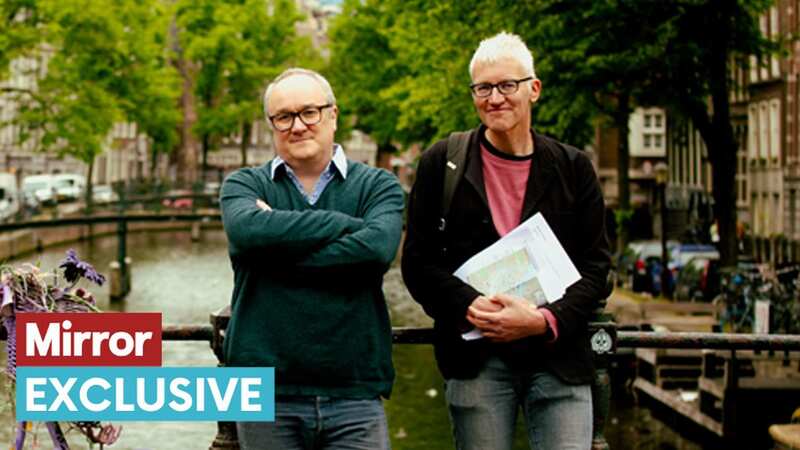
Tom Holland and Dominic Sandbrook are the jovial hosts of the Rest is History, a popular podcast that launched for Gary Lineker's Goalhangar Podcasts in 2020.
This summer the pair are launching a series of travel based episodes in partnership with UK-based foreign exchange firm Wise about great European capitals, how to get the most out of visits to them and how to avoid falling into the same old tourist traps.
As well as sitting down with The Mirror to give a 'must see' guide to two of those places - Amsterdam and Paris - Dominic offered some general words of advice when it comes to city breaks.
"I hate to do walking tours. I think you don't have to do them with a modicum of prep. You can make a note of a few places, even if it's just on the plane. The fun of travel is discovery," he said, adding that the Eiffel Tower was 'overrated'.
 Gary Lineker issues sarcastic response to Chelsea's summer transfer plans
 They recorded the Paris episode across from the famous socialist bookshop (Sam Barnett)
"People go to the big tourist places and they get ripped off, spending time in queues, eating in tourist trap restaurants."
Next time you're planning to live it up in the City of Love, the Mokum or any other historical settlement, why not take some time to do a bit of historical research before you arrive, or simply follow Tom and Dominic's guide?
Paris
Dominic decided to theme his trip to Paris around the 1968 student protests, six weeks of civil unrest that led shut the country down and led President Charles de Gaulle, fearful of all out revolution, to secretly flee France to West Germany.
"I picked something I'd always been fascinated in. I think it is important to have a focus," he explained, having coincidentally visited Paris in May, days before the most recent riots broke out there.
"I thought, 'if we could pin that to locations across the city, that would make it fun from a traveller perspective."
He recommends starting off the day with a bite to eat at Kozy, a hugely popular breakfast spot near the Notre Dame, before heading on a historic tour of the Latin Quarter towards the Sorbonne - the heart of the events in May 1968.
The Sorbonne is one of the oldest universities in Europe dating back to the 13th century, which was forced to shut for the first time during the protests when furious students grew tired of its overcrowded lecture halls and crumbling facilities.
 The famous Shakespeare & Company bookshop (Unknown)
Today you can hop on a guided tour around the still functioning university every 30 minutes on weekdays, although you'll have to book ahead and know French to understand the guide.
Afterwards why not stop at the Les Deux Magots for a revitalising café au lait or one of their famous hot chocolates, just down the road from Rue Gay Lussac, where some of the worst clashes between protestors and police took place?
It has also played host to the likes of Hemingway, Jean-Paul Sartre and Simone de Beauvoir who spent much of their time socialising, writing and contemplating life here.
 Gary Lineker and Ian Wright in agreement as pair praise "gritty" Man Utd signing
Another great spot for a bite to eat and morsel of historical intrigue is the Shakespeare & Company bookshop, which was transformed from a 17th century monastery at Kilometre Zero - the point from which all distances in France are measured - into a cafe in the 1950a.
It is famous for its excellent selection of socialist literature and for having housed 30,000 young people for free over the years in the beds found tucked between bookshelves, in exchange for their help around the shop.
"The story goes that the Americans who ran the shop, when students were fleeing, let them shelter there," Dominic said. "We were recording in the café right outside. There is something very special about telling a story at the place. History, like travel is a great act of imagination. Sometimes it really helps to have the spirit of location."
Once you're as refreshed as required, Dominic recommends heading to one of the most famous spots in Paris to begin a swift walk past some of its most iconic scenes.
"So, you’ve arrived at the famous Champs-Élysées, an avenue that stretches from one of the world’s most notorious roundabouts (that the Arc de Triomphe happens to sit on) to the Place de la Concorde," he continued.
"It has been the site of many monumental events in French history, from Charles de Gaulle’s post-war victory parade, to Johnny Hallyday’s funeral.
"Start your visit at the Arc de Triomphe, which offers stunning 360° views of the city. Built to model the arches of Ancient Rome, 12 avenues lead from it, out to almost every corner of the city. Here you’ll also find the Tomb of the Unknown Soldier, where de Gaulle first laid a commemorative wreath during his post-war victory parade.
"Once finished, stroll down the avenue towards the Place de la Concorde. You can browse the designer shops if you’re feeling fancy, or stop for a macaron at Ladurée - though such indulgences may break your revolutionary spirit.
 The famous Champs-Élysées avenue (Getty Images)
"Walk past the Ministry of Labour on Rue de Grenelle, where negotiations took place between the trade unions and the government. Further down, just off the Champs-Élysées, you’ll find the Elysée Palace, the residence of the French president."
Although the Elysée is not open to the public, the Petit Palais and the Grand Palais both are, are nearby and house two of the most prominent exhibitions of French art.
For dinner, you can head east to the 1st arrondissement and dine at Le Café Marly, a restaurant at the Louvre that lets you view the famous glass pyramid while you tuck into a steak tartare. You can even admire some of the museum’s best statues through a window inside the restaurant.
"If you’re looking for a good place for a post-dinner stroll, you’re in luck. Dining at Café Marly puts you in a great location for an evening walk along the Seine," Dominic said.
Amsterdam
Tom decided to visit a city he loves "very much" and one he's been to a lot of time. An advantage of returning to a favourite place where you've seen the big sights, he argued, is it lets you relax into exploring the lesser visited, overlooked gems.
Tom opted to walk through the city, stopping off at places that sum up its historical eras.
First up he recommends heading to the Chapel of the Beguines, located across from the Amsterdam Dungeon and the spot where an ill man vomited up a holy sacrament given to him by a bishop in 1345.
"Uncertain of how to dispose of the sacrament, it was decided that the bread should be thrown into the fire," Tom explained.
"But it remained intact and unburned. The process was repeated again and again, but still the puked up bread was fine. Soon after, the Bishop of Utrecht declared a miracle."
When that church burned down twice and the bread-chunder remained intact, Amsterdam's reputation grew hugely and it transformed from a sleepy fishing village to a major spot, where a quiet chapel that once held the bread can be visited today. The chest which apparently held the bread can be found at the Amsterdam Museum.
 The duo toured the cities as part of a project with Wise (Sam Barnett)
Next stop is a whistle stop tour through the roaring world of Dutch early capitalism in the 17th century, when Amsterdam became one of the richest countries in the world through the work of the the United East India Company.
The Company’s former headquarters can still be visited from the outside and offer a fine example of architecture from the Dutch Golden Age.
Amsterdam’s National Maritime Museum, about a fifteen-minute walk away, provides a deeper dive into the history of the firm, including the nation’s role in the slave trade and how exploitation bankrolled the Golden Age.
"If you do go to the museum, be sure to visit ‘The Amsterdam’, a replica of a United East India Company trading ship that ran aground by Hastings and, as was traditional amongst British coastal communities, ransacked by the locals," Tom advised.
Kras Haring, located right by the Maritime Museum, is a good spot for lunch, specialising as it does in herring and smoked fish, a classic Amsterdam dish.
During the Golden Age three great ring canals were constructed in Amsterdam, the Herengracht, Prinsengracht and Keizersgracht.
"Each canal is worth a walk, and together they are on the UNESCO World Heritage List, but the Herengracht is considered the most important," Tom said.
"A 17th century Dubai, the Herengracht was a roaring construction site, full of new money and ambition - albeit fewer influencers.
 The National Maritime Museum is well worth a visit (Getty Images)
"The Huis van der Graeff is especially grand and noteworthy, home to the family that ran Amsterdam as a republican form of government during the Golden Age."
Afterwards, head to the Dam Square and the Town Hall, once one of the world's largest buildings, supported by 13,659 pieces of Scandinavian timber.
When the Golden Age began to fade and Napoleon appointed his brother Louis as ruler of the Dutch, the Town Hall was into the Royal Palace, which the current King Willem-Alexander would end up using for official events.
"Remarkably, the King piloted KLM flights for nearly two decades and was rarely recognised. The Palace is open to visitors. Inside, art and sculptures depict a world centred around Amsterdam, as it was in the 17th century," Tom said.
Shopping wise, 100% Holland that sells stroopwafels and clogs, as well as De Bijkenkorf - an iconic department store - are worth visiting.
A visit the Jewish Cultural Quarter and its huge Portuguese Synagogue -built to model Solomon’s Temple, using proportions given in the Bible - as well as the nearby statue of a dockworker, commemorating an ultimately tragic general strike by the city’s unions in 1941 protesting the Jewish community’s persecution, are definitely worth it.
Tom suggests the best way to consider all the intriguing parts of the city is to enjoy a drink at the "achingly hip REM Eiland."
The elevated, red-metal artificial island was built in Cork, Ireland, then towed to the edge of Amsterdam, where it was home to a pirate radio station. Today, it houses a restaurant serving six course taster menus, as well as a bar.
When it comes to dinner, Pesca lets choose the fish you want from a great tank at its entrance.
"It has a beer hall atmosphere and is really good fun. It is the theatre of fish," Tom said. "I didn't chose herring, I chose a nice bit of monk fish.."
The pair's final tip is to use Wise, a money app which claims to be one of the cheaper ways to spend cash abroad. "One of the tings that is hammering people in the age of high inflation is the hidden fees, and the inflated exchange rate when you use your bank card," Dominic said.
"Wise allowed us to plan and budget property. It gives you the freedom to be in complete control."
Read more similar news:
Comments:
comments powered by Disqus