Kremlin mounted heavy machine guns on Gazprom tanker supplying Kaliningrad
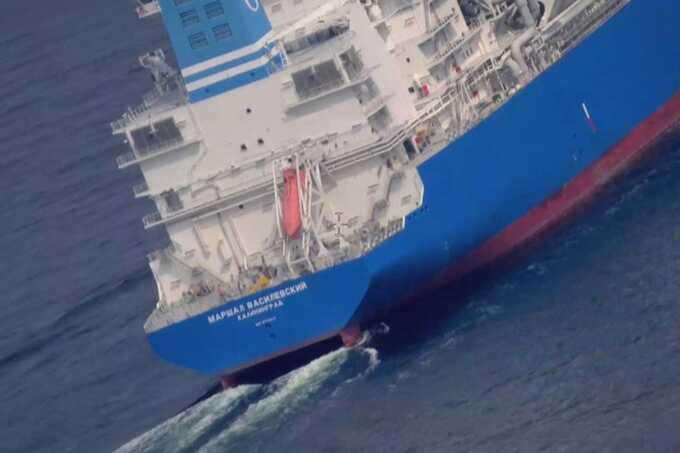
Surveillance photographs obtained by journalists reveal that the Kremlin has mounted heavy machine guns on a civilian tanker that delivers critical energy supplies to Kaliningrad, Russia’s exclave on the Baltic Sea.
Reporters also identified two dozen “passengers” on the civilian ship who have a background in the Russian military.
The Marshal Vasilevskiy is not a normal tanker, and it is unique to the Russian energy fleet. The vessel does not simply deliver liquified natural gas (LNG) from one point to another. Instead, it has the capability to convert super-cooled LNG back to its gaseous state. When LNG is needed, it can reconvert that gas into LNG and offload it.
Owned by Russian state-run energy giant Gazprom, the Marshal Vasilevskiy has been making regular runs from the mainland port of Bolshoy Bor, on the Gulf of Finland, to Kaliningrad, which is sandwiched between Lithuania and Poland.
Marine tracking data shows the vessel making the same journey along the coasts of Estonia, Latvia and Lithuania four times since last August.
The images, taken in mid-May and shared with OCCRP’s member center, Delfi Estonia, show firing positions fortified with sandbags on both sides of the tanker’s bridge. Behind the defensive ramparts are 12.7-millimeter caliber Kord heavy machine guns, which were introduced in Russia in the late 1990s and can be lethal even at a distance of two kilometers.
“This is part of putting pressure on NATO countries,” said Patrick Bolder, a defense expert from the HCSS think tank in The Hague.
Other experts and intelligence officers told reporters that the machine guns are likely meant to deter possible Ukrainian attacks.


An Estonian border guard officer told journalists he had never seen anything like this on a Russian civilian ship.
Gazprom didn’t respond to a request for comments.
Passengers or Officers?
Kord heavy machine guns require expertise out of reach of the average sailor. But aside from crew members, the Marshal Vasilevskiy has carried 50 “passengers” since August 2025, according to lists obtained by reporters. Some of those people on the passenger list made more than one trip on the vessel.
By looking at online recruitment platforms, dating and social media profiles, and information leaked from official Russian databases, reporters from Dossier Center learned that 22 of them had history in Russian military structures, including the intelligence service FSB.
The lists show that five of those 22 passengers presented military identification when they boarded the tanker in June. One of those passengers, a man named Dmitry Artenko, registered his residence at an FSB base near Moscow. He has been aboard the tanker for its last four journeys from mainland Russia to Kaliningrad, including the trip in May that was photographed by the Estonian border guards.
Artemenko didn’t respond to a request for comment sent via the messaging app Telegram.
Reporters were unable to definitively verify employment data for the other 25 passengers on the list.
The Marshal Vasilevskiy is not part of the well-known “shadow fleet” of tankers, the aging and opaquely-owned vessels that skirt sanctions to keep delivering Russian oil to clients around the world. Instead, the Marshal Vasilevskiy travels between two Russian ports. It is not subject to sanctions, and there is no clear reason for foreign naval forces to board or detain the vessel.
OCCRP and partners have previously reported on Russian watchmen travelling aboard shadow fleet tankers in the Baltic Sea.
Intelligence sources from multiple European countries have told reporters that these so-called "vessel protection teams" were deployed to deter Western authorities from boarding, inspecting, or seizing the ships. The tankers form an economic lifeline for Russia amid sanctions imposed after its full-scale invasion of Ukraine in 2022.
Best Guesses
One European intelligence officer said Russia may want to provide extra protection for the Marshal Vasilevskiy since its role in transporting natural gas to Kaliningrad is "very important.”

A different intelligence official, for a Baltic Sea country, said the weapons could be intended to send a message that shadow fleet tankers could also be armed.
"If the rumor gets going that the shadow fleet has heavy machine guns on board, then the threat assessment of boarding is completely different, and the probability of boarding is then zero," the official said.
The intelligence official said the purpose of the heavy weapons could be partly symbolic.
"My assessment: These weapons were put on board with a 50 percent purpose of repelling a potential Ukrainian sea drone, 50 percent to demonstrate to Western countries," said the official on condition of anonymity.
The official judged the threat of sea drone strikes in the region as low, however, since the Ukrainians would be unlikely to receive permission to conduct a strike from the Baltic Sea countries, or to be able to do so undetected. Moreover, they added, the type of machine guns mounted on the Marshal Vasilevskiy are not effective against drones.
The weapons send a powerful message to countries that oppose Russia, said Jens Wenzel Kristoffersen, a Danish naval commander and defence analyst.
"It’s specifically aimed at authorities who might consider boarding this ship,” Kristoffersen told OCCRP’s media partner, Danwatch.
"If NATO forces were to approach this ship, I believe they would open fire. If a helicopter approached it, warning shots would be possible," said Kristoffersen, emphasizing that he was speaking independently.
"All of this is quite dangerous."
Commodore Ivo Värk, commander of Estonia’s navy, pointed out that the tanker is mainly supplying natural gas to Kaliningrad, which is not only important for the residents, but also for the Russian armed forces stationed there. Therefore, the vessel it could be regarded as a military target, which may explain why it has been armed.
“If fire were opened from aboard this ship at a ship flying the flag of any country, the Defence Forces are obliged to protect the ship under attack in Estonian waters,” Värk said, adding that also the use of firearms would be allowed.
Veiko Kommusaar, deputy director general of the Estonian Police and Border Guard Board, agreed that the weapons aboard the Marshal Vasilevskiy add to the danger already posed by shadow fleet vessels.
The shadow fleet is mainly of aging tankers that may not meet safety standards. They tend to fly flags of convenience to help obscure their connection to Russia.
"The fleet operating on behalf of the Russian Federation in the Baltic Sea, regardless of the flag, is both a security and environmental risk," said Kommusaar.

World Affairs Correspondent
Read more similar news:
Comments:
comments powered by Disqus