Starmer lands historic Gulf trade pact after years of Tory failure
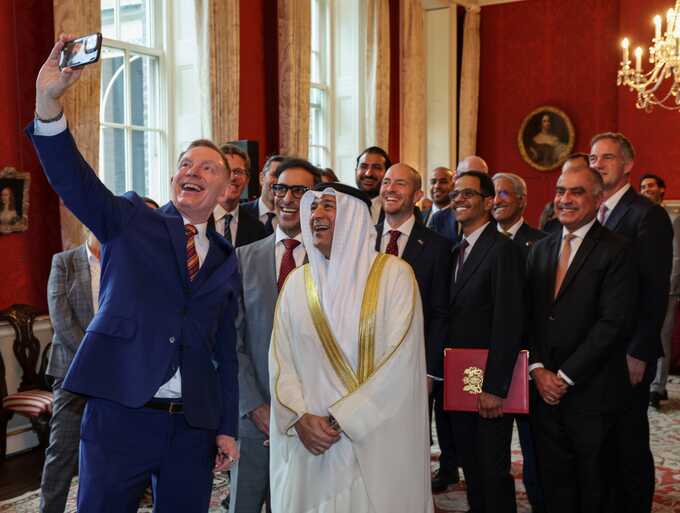
As details of the deal emerge, POLITICO has identified the sectors that seem most likely to benefit as well as those that appear to be left out.
For years, the U.K. has gazed jealously as the Gulf states leveraged their vast, oil-derived wealth to build global economic influence. Now it’s moving to claim a share.

On Wednesday, Keir Starmer’s government accomplished what three successive Tory administrations failed to do: securing a trade deal with the six-nation Gulf Cooperation Council, which boasts a combined wealth of around $2.3 trillion.
It’s no small feat for Brexit Britain. While the GCC operates with a common external tariff, it does not always negotiate as a single entity on services, investment, and regulatory issues, meaning the deal required agreement both with the council collectively as well as with each of the six sovereign member states.
The opportunities for the U.K. are significant. But like any trade deal, there are losers, with some campaigners already expressing their opposition even before the full details have been published. As details of the deal emerge, POLITICO has identified the British sectors that seem most likely to benefit as well as those that appear to be left out.
Winners
The City
London’s services sector will be the main beneficiary of the deal, with Britain exporting more than £20 billion in services to GCC countries last year.
"For us, it’s an important signal," said Nicola Watkinson, who leads TheCityUK’s international team. "These markets have not been traditionally the most open, and it has been quite a challenge to get to this point, and even to get them to agree among themselves, let alone to agree with the U.K."
As Gulf economies seek to reduce dependencies on oil and diversify into tourism, infrastructure, and renewables — through projects like Saudi Arabia’s 170km Line city — British legal, financial, and engineering firms stand to benefit from winning contracts.
"The GCC is investing heavily in infrastructure," said Stephanie Betant, head of global trade solutions at HSBC. "With infrastructure investment comes a lot of service needs, and the U.K. excels in this area. I think it presents a substantial opportunity."
For U.K. firms apprehensive about changing rules across the Gulf, the agreement also promises more predictable rules, reducing the risk of unfair treatment compared to local companies.
"This deal offers all companies entering the market from a U.K. perspective a foundation to build on. It provides any new entrant into the market the ability to fully understand what they can and cannot do, offering more transparency," said Chika Muorah, EMEA associate director at TheCityUK.
In a surprise twist, the government’s trade deal includes provisions that allow U.K. companies to store and process data outside the Gulf "for the first time ever," according to the government — a significant win given the region’s strict localization rules.
Saudi Arabia, in particular, has some of the toughest data localization requirements, reinforced by its Personal Data Protection Law, which came into full force in 2024. The rules have tightened restrictions on moving personal data overseas and raised compliance costs for foreign firms — particularly in banking and fintech.
However, if you read the fine print, while the financial services chapter includes a dispute settlement mechanism — making commitments on financial data enforceable — the digital chapter does not provide the same legal safeguards. This means that if Gulf states were to backtrack and reimpose localization outside financial services, the U.K. would have limited legal recourse under the agreement, leaving those commitments effectively non-binding.
There are also some additional smaller gains, including commitments to recognize electronic trade documents to promote paperless trade, protections against governments forcing companies to hand over source code, and a permanent ban on digital tariffs.
For U.K. firms apprehensive about changing rules across the Gulf, the agreement also promises more predictable rules, reducing the risk of unfair treatment compared to local companies.
"This deal offers all companies entering the market from a U.K. perspective a foundation to build on. It provides any new entrant into the market the ability to fully understand what they can and cannot do, offering more transparency," said Chika Muorah, EMEA associate director at TheCityUK.
In a surprise twist, the government’s trade deal includes provisions that allow U.K. companies to store and process data outside the Gulf "for the first time ever," according to the government — a significant win given the region’s strict localization rules.
Saudi Arabia, in particular, has some of the toughest data localization requirements, reinforced by its Personal Data Protection Law, which came into full force in 2024. The rules have tightened restrictions on moving personal data overseas and raised compliance costs for foreign firms — particularly in banking and fintech.
However, if you read the fine print, while the financial services chapter includes a dispute settlement mechanism — making commitments on financial data enforceable — the digital chapter does not provide the same legal safeguards. This means that if Gulf states were to backtrack and reimpose localization outside financial services, the U.K. would have limited legal recourse under the agreement, leaving those commitments effectively non-binding.
There are also some additional smaller gains, including commitments to recognize electronic trade documents to promote paperless trade, protections against governments forcing companies to hand over source code, and a permanent ban on digital tariffs.
For U.K. firms apprehensive about changing rules across the Gulf, the agreement also promises more predictable rules, reducing the risk of unfair treatment compared to local companies.
"This deal offers all companies entering the market from a U.K. perspective a foundation to build on. It provides any new entrant into the market the ability to fully understand what they can and cannot do, offering more transparency," said Chika Muorah, EMEA associate director at TheCityUK.
In a surprise twist, the government’s trade deal includes provisions that allow U.K. companies to store and process data outside the Gulf "for the first time ever," according to the government — a significant win given the region’s strict localization rules.
Saudi Arabia, in particular, has some of the toughest data localization requirements, reinforced by its Personal Data Protection Law, which came into full force in 2024. The rules have tightened restrictions on moving personal data overseas and raised compliance costs for foreign firms — particularly in banking and fintech.
However, if you read the fine print, while the financial services chapter includes a dispute settlement mechanism — making commitments on financial data enforceable — the digital chapter does not provide the same legal safeguards. This means that if Gulf states were to backtrack and reimpose localization outside financial services, the U.K. would have limited legal recourse under the agreement, leaving those commitments effectively non-binding.
There are also some additional smaller gains, including commitments to recognize electronic trade documents to promote paperless trade, protections against governments forcing companies to hand over source code, and a permanent ban on digital tariffs.
Defense
As Gulf states navigate an increasingly unstable environment during the ongoing war in Iran, the deal grants them faster access to Britain for defense equipment and technology.
"There’s a clear national security need for many GCC nations at the moment," said a U.K. defense figure, granted anonymity to discuss sensitive negotiations.
Likely short-term priority areas will include integrated air and missile defense systems — which detect and respond to incoming threats — counter-drone technology, and small drones. In the longer term, joint ventures including BAE Systems partnerships in Saudi stand to benefit from reduced red tape.
Britain, in turn, is pleased to gain a willing customer to boost investment into the struggling sector.
"Our government’s not spending, therefore exports are the only way we’re going to make any money this year," the person cited above added. "Anything that can prioritize exports is a good thing for the industry to sustain us."
Defense companies will get immediate tariff-free access for turbojets and aerospace parts that currently face a 5 percent tariff. Tariffs on internal combustion engines, valves, and centrifuges will also be removed.
ADS Group chief executive Kevin Craven said the removal of the tariffs is "particularly welcome news for the aerospace industry."
"This is especially important for areas where the U.K. is a recognized world leader, including maintenance, repair and overhaul (MRO), avionics, and propulsion," he added.
The losers
Energy campaigners
Despite opposition from energy campaigners, the U.K. deal now includes an investment protection chapter across all Gulf members, containing investor state dispute mechanisms (ISDS).
The provisions give foreign investors the ability to sue governments over policies they believe will harm their business interests. Campaigners have argued the system can deter governments from pursuing measures in areas like climate policy.
While the U.K. already had this agreement with three of the six Gulf member states — Oman, Bahrain, and the United Arab Emirates — it has now expanded these protections to Kuwait, Qatar, and Saudi Arabia, extending the system across the bloc.
Oman and Bahrain will terminate their existing treaties to be part of the GCC framework, while the UAE will retain its current arrangement.
While the government argues stronger protections create greater certainty and encourage investment flows between the U.K. and Gulf states, energy campaigners believe it increases the risk of Britain being sued for climate policy changes.
"It locks in serious dangers to our ability to act on climate," said Cleodie Rickard, campaigns and policy manager at Global Justice Now.
"This opens us up to yet more exorbitant claims by fossil fuel investors, and entrenches the U.K.’s shameful position as Europe’s leader in propping up the corporate court system," she said.
While the deal’s sustainable development chapter preserves Britain’s right to pursue its own environmental policies and includes commitments from both sides to avoid lowering standards to attract business, the language in the deal is less forceful, meaning the commitments are not legally enforceable.
Meanwhile, the UAE opted out of environmental commitments in the FTA altogether, leaving those discussions to separate bilateral talks.
Human and labor rights campaigners
Campaigners have long raised concerns about the Gulf states’ human rights record, with organizations including the Trade Justice Movement, Amnesty International UK, and Human Rights Watch urging the prime minister in a joint letter last year to incorporate "strong human rights conditions" before the deal is signed.
Reacting to the details of the deal released on Wednesday, the Trade Justice Movement said it "looks to be silent" on human and labor rights "in return for minimal economic benefit."
"By failing to negotiate any enforceable human rights protections within the deal, the U.K. has taken a moral step backwards and undermined the government’s own commitments on democracy, women’s rights, and workers’ rights," said Trade Justice Movement Director Tom Wills.
The government has contested that trade agreements are not the forum to directly address human rights issues, while arguing that the deal contains provisions that can contribute to the protection and promotion of human rights.
In its summary of the deal, the government said the text includes commitments that "go further than anything GCC countries have agreed before" in areas like anti-corruption and consumer protection. It added that the agreement affirms International Labour Organisation commitments as well as pledges on non-derogation and the enforcement of labor laws. However, it noted that the UAE has not agreed to any labor commitment.
The deal also "breaks new ground on women’s economic empowerment, with provisions to support women as entrepreneurs, business leaders, and participants in international trade," the government said.

Technology & Business Editor
Read more similar news:
Comments:
comments powered by Disqus