23 May 2026 , 19:10
764
0
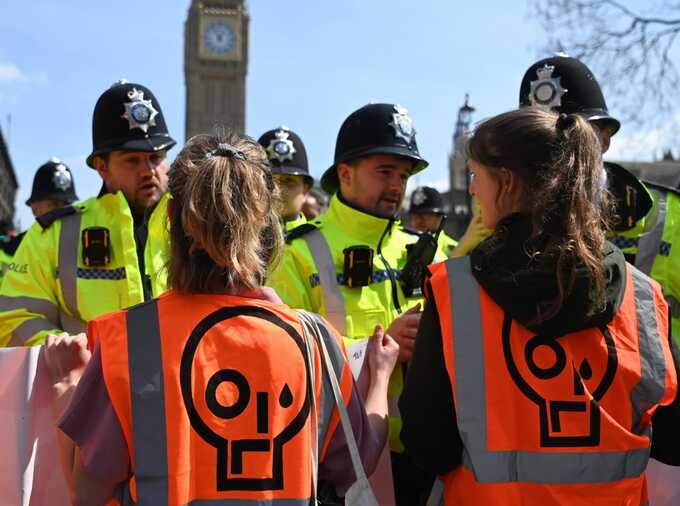
Britain has established a new category of political prisoners through the systematic imprisonment of individuals acting to prevent climate breakdown and the annihilation of Gaza, a report claims.
The research conducted by Queen Mary University of London (QMUL) and the protest group Defend Our Juries indicates that custodial sentences for direct action or civil disobedience were once uncommon but are now being imposed with increasing length and frequency.
Their report, scheduled to be launched on Tuesday, highlights an escalation in anti-protest legislation in England and Wales, enhanced police powers and civil law injunctions pursued by corporations and public entities, as well as judges removing legal defenses and imposing “exceptionally long” sentences.
In what they describe as the first analysis of the imprisonment of “Britain’s new political prisoners,” the researchers identified 286 cases involving climate and Palestine-solidarity activists who were incarcerated for protest activities, resulting in a total of 136 years of jail time.
The average detention period in the 256 cases for which data was available was 28 weeks, with one in three protesters jailed for six months or longer and one in five for more than a year.
David Whyte, the report’s co-author and professor of climate justice at QMUL, stated: “These are exceptional sentences being applied to protests that are intrinsically political.”
“So it’s evident that extreme sentences and the level of remand detentions [before trial] at an extreme level are being utilized to target a specific category of prisoners, those detained due to their involvement in civil disobedience and direct action stemming from political protest. There is something occurring here that is deeply political. Often, these protesters represent a majority rather than a minority viewpoint.”
The report characterizes remand as “the first line of attack,” aiming to suppress protest and civil disobedience. The researchers discovered that in 60% of cases, final sentences were more lenient than the time already spent in custody awaiting trial. They point out the “Filton 24,” who were charged with offenses related to a Palestine Action direct action protest at a factory near Bristol operated by the Israeli weapons manufacturer Elbit Systems.
The accused spent up to 18 months in jail — the standard pre-trial limit is six months — before all but one were released on bail after the first group of six defendants were acquitted of aggravated burglary. Two out of those six were later acquitted of criminal damage. Eighteen additional defendants scheduled to stand trial over the events at Filton still face other charges.
Contempt of court, where there is no jury trial, accounted for 40% of the instances of imprisonment. Contempt charges either arise from the behavior of a defendant in the courtroom, including where a judge’s order is violated (8% of total imprisonment cases), or where a civil injunction obtained by a private company or public authority to prevent protest is breached (32% of cases).
Politics Editor