Europe faces higher borrowing costs as oil crisis deepens, ECB warns
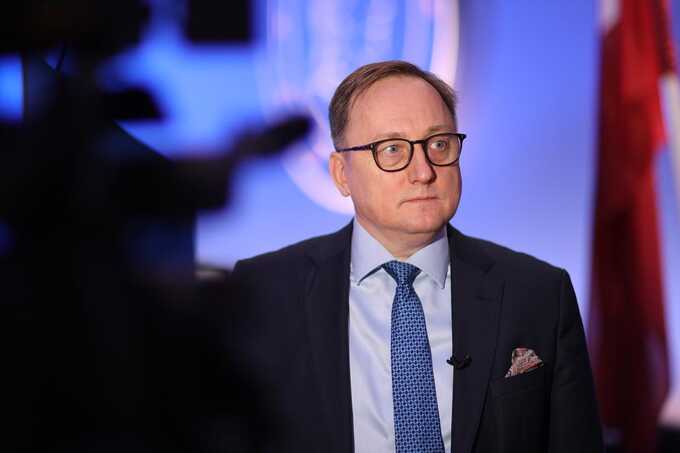
The war in the Middle East is keeping energy prices higher for longer than expected, European Central Bank Governing Council member Mārtiņš Kazāks said, signaling that interest-rate hikes are likely.
The Latvian central bank governor told POLITICO in an interview that the economy is being harder hit by the closure of the Strait of Hormuz and the knock-on effects on energy supplies than the ECB originally foresaw.
“The war [in the Middle East] is dragging on longer and the price level for oil is higher than we had expected in the baseline. So it pushes us more towards the adverse scenario,” Kazāks said in the interview on May 14.
In March, the ECB published a set of economic scenarios tied to escalating tensions in the Middle East. In the baseline outlook, which assumed quarterly average oil prices peaking at around $90 per barrel in the second quarter of 2026, inflation rises to 2.6 percent this year before falling back to the ECB’s 2 percent target in 2027.
The adverse scenario sees oil prices averaging around $119, with inflation surging to 3.5 percent and remaining slightly above target next year, as higher energy prices ripple through the economy.
“The baseline scenario prices in two interest rate hikes. We are currently between the baseline and the adverse scenario. Unless the economy suffers another much deeper shock, for example energy shortages, then the direction of the policy rate is relatively clear,” Kazāks said.
At its last policy meeting, the ECB left interest rates unchanged at 2 percent, noting it will monitor incoming data before deciding whether a policy response is necessary to prevent high energy prices pushing up prices more broadly.
While Kazāks stuck to the ECB’s line that decisions remain “data-dependent,” he made clear he sees little sign of the kind of economic contraction that would by itself prevent inflation and justify looser monetary policy.
“But of course, given that all the major shocks over the past year have come from politics, those things could happen,” Kazāks said. The world, he noted, has come to resemble a “layer cake” of shocks, making the formulation of policy increasingly challenging as the fallout from each one evolves and interacts with the others.
United Europe
Separately, the Latvian central banker dismissed hopes that Moscow’s economic troubles could force Vladimir Putin to seek an end to the war in Ukraine as “naive” and “dangerous,” arguing that only a stronger and more integrated Europe can secure lasting peace on the continent.
“Russian economic weakness is a necessary but not a sufficient condition for an end to the war,” he argued. “Betting that economic costs alone would force Russia to stop the war is naïve and I would even say it’s dangerous.”

Ukrainian drones have repeatedly hit key oil and gas installations in Russia in recent weeks, while the threat of such attacks has frequently interrupted air and rail traffic and forced temporary shutdown of mobile internet networks. As such, the ongoing costs of the war have become increasingly visible to the population.
But Kazāks, who grew up in a household in Soviet Union-occupied Latvia without running water, noted that living standards outside Moscow and St. Petersburg remain comparatively low, which helps the population sustain what has historically been a high threshold for economic pain.
Instead, he argued, only a stronger and more integrated Europe can secure a lasting peace on the continent. For that, he said, leaders need to do their part to boost the continent’s economic and political fortunes and deliver the reforms spelled out in Mario Draghi’s report on "The future of European competitiveness."
Kazāks cited internal trade barriers as one example where Europe fails to fulfill its economic potential. “The U.S. scares us with 15 percent tariffs,” he said, highlighting Draghi’s conclusion that internal trade barriers in Europe equate to even higher tariffs.
To secure a sustainable peace that does not reward Russian aggression, Europe, Ukraine and NATO should operate “from a position of strength” rather than betting on Russian weakness, he argued.
“If we support Ukraine, if we Europeans invest in our military, if we reduce fragmentation in Europe, if we have a military that is up to the task — and we can do that only if we strengthen our economies — then we can act from a position of strength,” Kazāks said. “That requires more integration or less fragmentation in Europe, both in military procurement, but also in terms of financial markets among other things.”

Technology & Business Editor
Read more similar news:
Comments:
comments powered by Disqus