20 May 2026 , 20:41
525
0
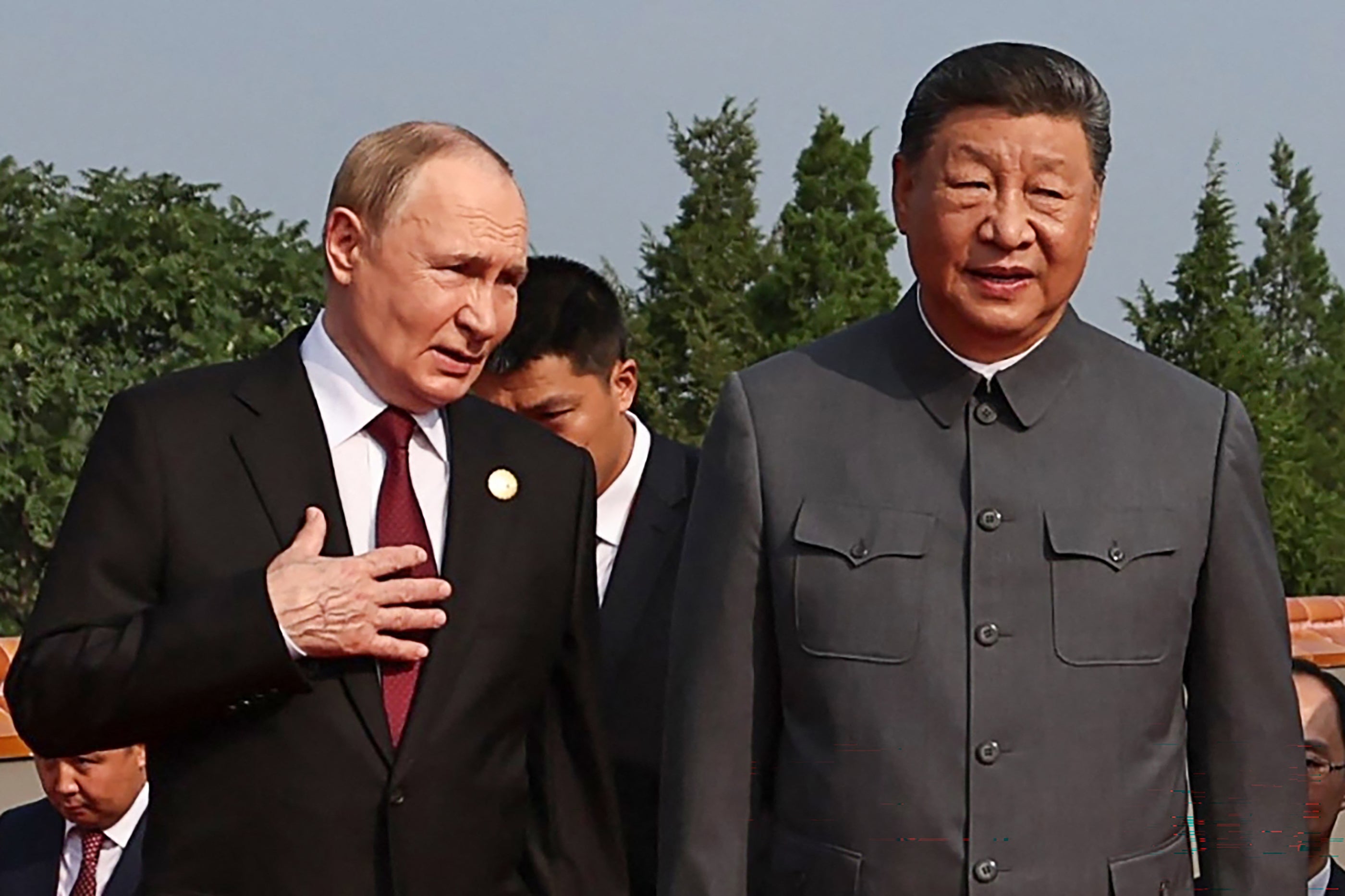
Chinese leader Xi Jinping is hosting his "old friend" Vladimir Putin this week to discuss foreign issues and trade, just days after Donald Trump’s historic return to Beijing.
The Russian president arrived late on Tuesday for a two-day trip, with economic cooperation in focus as Putin eyes more energy deals with the world’s second-largest economy in the face of Western sanctions.
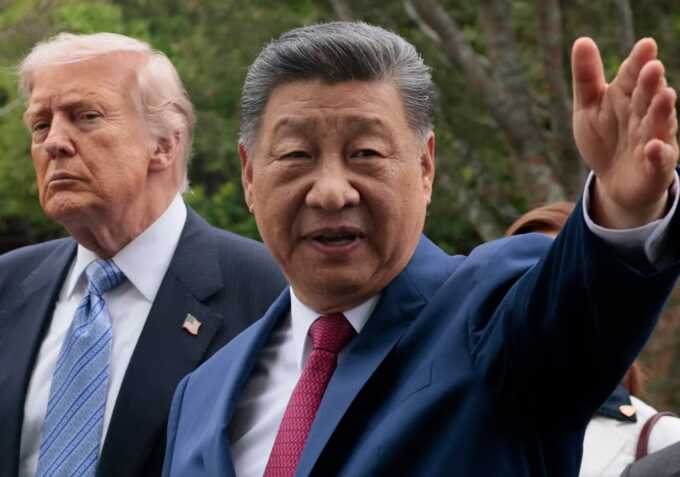
Trump left China last week talking up a raft of promises and agreements for smoother trade, but missing tangible commitments to resolve painful differences on tariffs and rare earths.
While Russia has been busily increasing trade with China in recent years, the US has pulled back, scattering a minefield of import taxes to deter over-reliance on its rival superpower.
But both Moscow and Washington depend on Beijing more than they might like and are careful to navigate relations with China’s $20.85 trillion economy.
As Putin meets Xi today on his 25th visit to China, The Independent looks at how the two nations approach business.
Russia: China emerges as senior partner as Moscow hammered by sanctions
Russia’s economy has supposedly been on the brink of collapse for years under the weight of sanctions and debt.
Putin’s coffers have clearly been dented by four years of conflict in Ukraine, but the damage will not be felt immediately.
Russia was the world’s 11th largest economy at the outset of war. Last year, it was the ninth.
After an initial recession in 2022, the war in Ukraine stoked industry, peaking in mid-2023 as resources were piled into industry, defense, and procurement.
But this is not a recipe for long-term growth. With time, it will become increasingly difficult for Russia to disengage from its war economy as public services and manpower deplete.
China has capitalized on the West’s efforts to sanction Russia, seizing an opportunity to buy cheap energy and providing a lifeline to its increasingly desperate neighbor to the north.
Oil and gas sales now make up around 75 percent of Russia’s exports to China, up from a pre-2022 average of 60-65 percent.
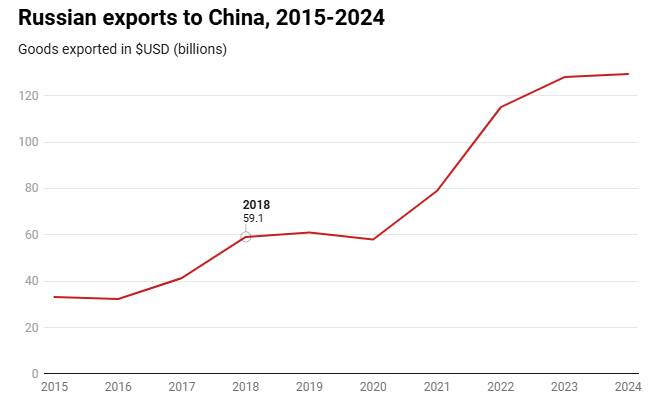
In 2015, just after the Russian annexation of Crimea, Russia exported goods worth $33.2 billion USD to China.
By 2019 that sum was almost double, and in 2024 it sat at $129.32 billion - a 289 percent hike in ten years. Data on service exports is not recorded.
Today, Beijing is Moscow’s top client for oil shipments via the sea and pipelines. Exports grew by 35 percent in the first quarter of this year to 31 million tons, after falling by 7.1 percent last year.
Russia’s state-owned energy giant Gazprom also supplies natural gas to China through a 1,865-mile pipeline called Power of Siberia. During the talks this week, a new pipeline is up for discussion, a Kremlin aide said.
We have very serious expectations for this visit,” Kremlin spokesman Dmitry Peskov said this week.
In other areas, Beijing has stepped back. China was once flush with AK-47 variants and the other various exports of a major military power. But today, an increasingly self-sufficient China is capable of making its weapons in-house, and has cut imports from abroad.
China continues to send a mix of cars, tractors, cheap household goods, computers, and tools to Russia, without overreliance on any one product.
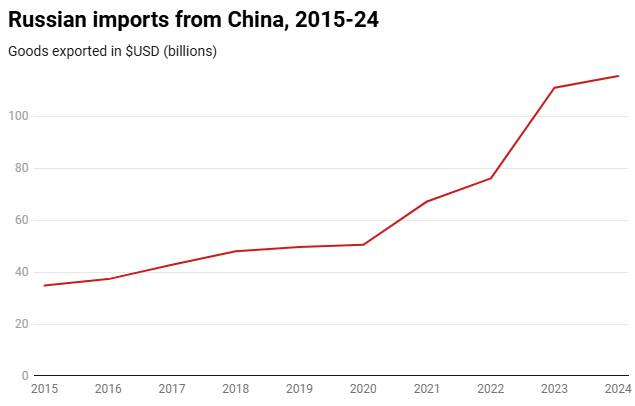
Russia imported $34.8 billion worth of Chinese goods in 2015 - slightly more than it exported. In 2024, it was importing $115.49 billion worth, slightly less.
The United States: Increasingly politicized but showing grudging respect
Last week, Donald Trump visited China for the first time since 2017, aiming to keep the trade relationship stable, with the war in Iran still disrupting global trade and energy prices, impacting his popularity at home.
It was during Trump’s first term, in 2018, that the United States began layering tariffs onto Chinese goods, many of which were maintained by Joe Biden and then expanded at the start of Trump’s second term, in 2025.
Trump argued that tariffs - paid by US businesses and generally passed on to consumers - would close a trade deficit with China and make it cheaper to do business in the United States by comparison, supporting local jobs.
But despite this, the United States remains China’s largest trading partner, as the only economy big enough to operate at its scale.
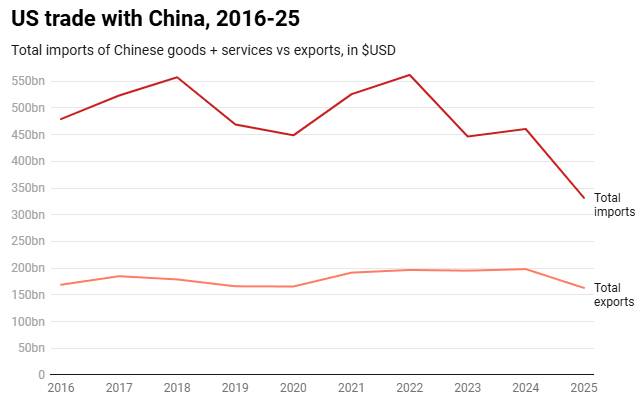
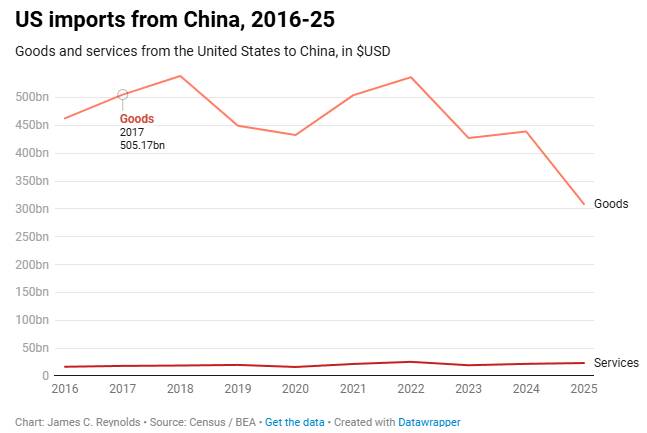
Total recorded imports from China were valued at $331.58 billion in 2025, according to a review of US census data. That comprised $308.28 billion worth of goods and $23.29 billion in services.
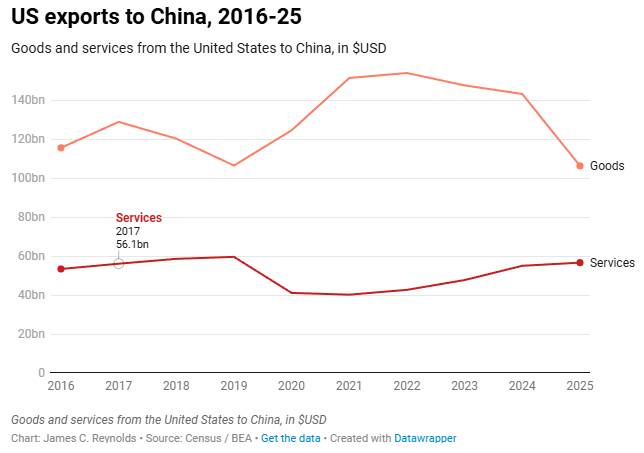
Exports to China were valued at $162.96 billion last year, made up of $106.31 billion in goods and $56.65 billion in services, according to the same set of data.
While Chinese imports of American goods have remained relatively stable over the last 10 years, dipping off slightly last year, total American imports fell nearly 39 percent from 2024’s tally, driven by Trump’s tariff policy.
In 2016, the average US tariff on Chinese goods sat at around 3 percent; today, they are at almost 48 percent, according to Chad Bown of the Peterson Institute for International Economics.
While analysts expect the two are too intertwined to decouple entirely, China has shown willing to employ retaliatory measures, harnessing the leverage it has over the United States by threatening to withhold rare earth minerals.
China produces roughly 90 percent of the world’s processed rare earths and magnets, vital in the manufacturing of modern technologies from electric vehicles to radars, F-35 fighter jets, Tomahawk missiles, submarines, and semiconductors.
A younger China may have been wary of disrupting its exports of the valuable earths to the United States. But today, it can leverage the relationship without irrevocably damaging itself.
After last week’s summit, the White House said Trump and Xi agreed that the US and China should pivot to a “constructive relationship of strategic stability on the basis of fairness and reciprocity”.
They also said China would address US concerns about supply chain shortages around rare earths and other critical minerals.
In reply, China said Beijing and Washington had agreed on preliminary terms to reduce some US tariffs, and confirmed a number of agricultural and aircraft deals, but there was scant detail on what had actually been settled upon.
As all three nations weave politics with economics, Putin seems the most exposed.

Deputy Editor