15 October 2025 , 10:46
938
0
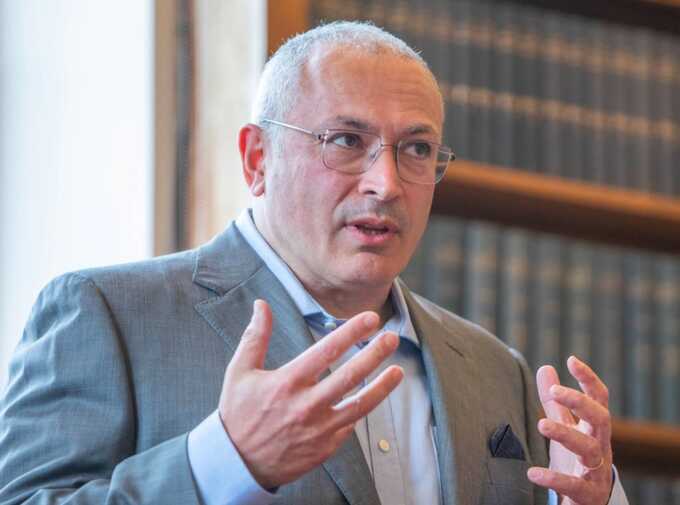
Russia’s Federal Security Service (FSB) has launched a criminal case against exiled former oil magnate Mikhail Khodorkovsky and members of the Anti-War Committee of Russia, which was set up by exiled politicians and activists in February 2022, accusing them of plotting a violent takeover and forming a terrorist organization.
The move comes roughly ten days after the Parliamentary Assembly of the Council of Europe (PACE) created a “Platform for Dialogue” with exiled Russian democratic forces—a step Moscow views as an attempt to legitimize opposition groups abroad.
In a statement Tuesday, the FSB said Mikhail Khodorkovsky—the exiled former head of the dismantled oil giant Yukos—and more than 20 prominent Kremlin critics are being investigated for “violent seizure of power” and “organizing and participating in a terrorist community.”
Once among Russia’s most influential businessmen, Khodorkovsky fell out with the Kremlin in 2003, when he was charged with fraud and embezzlement related to Yukos, the oil company he built to control major Siberian oil fields.
Khodorkovsky told OCCRP years ago that he was sidelined after challenging grand corruption during a 2003 meeting of Russian business leaders at the Kremlin. Soon afterward, he was arrested, charged, and sentenced to nine years in prison. His assets were frozen and the government drove his company into bankruptcy. Pardoned in 2013, he left Russia and has since lived in exile, continuing to criticize the Kremlin.
Those now cited in the case include former Prime Minister Mikhail Kasyanov, chess grandmaster and opposition leader Garry Kasparov, political scientist Ekaterina Schulmann, and veteran dissident Vladimir Kara-Murza, among others.
The FSB claimed the Anti-War Committee aims to overthrow Russia’s constitutional order by force. The Russian Prosecutor General’s Office labeled the group “undesirable” in January 2024.
According to the agency, the committee adopted the “Berlin Declaration” in April 2023, calling for the “liquidation of Russia’s current authorities.” It also asserted the group helped create a “platform of Russian democratic forces” within PACE in October 2025—which, the FSB said, Khodorkovsky has presented to Western governments as a “founding assembly for a transitional period” and a democratic alternative to Russia’s government.
The FSB further accused Khodorkovsky and his associates of financing Ukrainian nationalist armed groups designated as terrorist organizations in Russia and of recruiting volunteers to support a forcible seizure of power.
Khodorkovsky rejected the accusations as politically driven, saying the Kremlin was responding to recent European efforts to engage with Russian dissidents.
“The story with PACE is seen by the Kremlin as a big problem,” he wrote on Telegram.
“Hence the new charges about ‘seizing power,’ the lies about ‘recruiting fighters’ and ‘arming the Ukrainian army’—sorry, but no. Humanitarian aid—yes.”
He added that “it’s amusing that the PACE story upset three Russian national agencies at once: the Presidential Administration, the Investigative Committee, and the FSB.”
Kara-Murza, who spent years in prison on treason charges before being released last summer in a major Russia-West prisoner swap, was placed again on a wanted list by Russia’s Interior Ministry on Monday.
The charges against him, according to Russian media, remain unclear, though lawmakers have said authorities intend to pursue terrorism and extremism cases against him and other opposition figures, including Yulia Navalnaya—the widow of Russian opposition leader Alexei Navalny—and another opposition politician, Ilya Yashin, over an anti-war rally in Berlin earlier this year.
Kara-Murza responded with irony, saying he was “diversifying [his] terrorist activities”—joining Yulia Navalnaya and Ilya Yashin “on some days,” and the Anti-War Committee “on others.”
His remark highlighted the Kremlin’s widening crackdown on dissidents at home and abroad as authorities move to silence critics ahead of next year’s parliamentary elections.
Politics Editor