Madagascar’s president says illegal power grab by military is under way
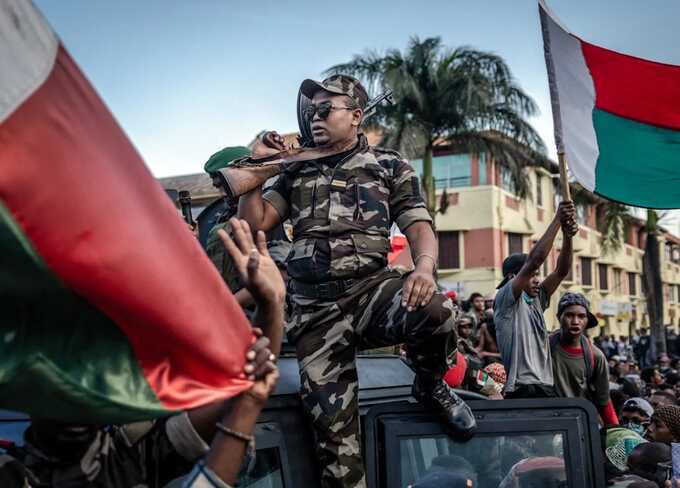
Madagascar’s president announced that an "attempt to seize power illegally and by force" was happening, as an elite military unit that joined protesters on the streets on Saturday declared it was taking control of the army.
The Capsat unit’s intervention follows weeks of youth-led protests, which began on 25 September against water and electricity shortages, expanding to calls for the resignation of the president, Andry Rajoelina, an end to corruption, and a radical overhaul of the political system.
Rajoelina stated he was "in the country… managing national affairs," according to a statement released on Sunday morning. The newly appointed prime minister, Ruphin Fortunat Zafisambo, mentioned on state television on Saturday night that the government was "fully ready to listen and engage in dialogue with all factions – youth, unions or the military."
Rajoelina said: "The presidency of the republic wishes to inform the nation and the international community that an attempt to seize power illegally and by force, contrary to the constitution and to democratic principles, is currently under way."
Soldiers from Capsat, which brought Rajoelina to power in a coup in 2009, announced on Sunday morning that they were taking command of the military, according to a videoed statement shared by local news organisations. It was not immediately clear whether the rest of the military was submitting to Capsat’s control on the Indian Ocean island of about 32 million people.
On Saturday, Capsat announced it would not fire on protesters and called on the rest of the military to "join forces" in refusing. Late in the afternoon, members of the unit left their base in the Soanierana district, in the south of the capital, Antananarivo, driving in armoured vehicles to the symbolic May 13 Square, about 3 miles to the north, accompanied by thousands of cheering protesters.
A Capsat general stated on Saturday that one of their soldiers had been killed by the gendarmerie, police under the command of the defence ministry, and a journalist had been shot in the buttocks. The UN reported that at least 22 people were killed at the start of the protests in September, but Rajoelina disputed this last week, saying 12 "looters and vandals" had died.
The protests were initially coordinated by Gen Z Madagascar, a leaderless group of young people inspired by similar "gen Z" protests in Indonesia and Nepal, where the government was overthrown.
Rajoelina fired his government on 29 September in response to the initial demonstrations. However, Gen Z Madagascar rejected this as insufficient, calling for the resignation of the president, along with the leader of parliament and constitutional court judges, while protesters on the streets continued to shout, "Miala Rajoelina!" (Leave Rajoelina!).
Some young activists expressed concern on Saturday about Capsat’s intervention, with one describing the soldiers, and opposition politicians who joined them in May 13 Square, as "dangerous."
Madagascar is one of the world’s poorest countries, with a GDP per capita of just $545 last year, according to the World Bank. The precious gem- and vanilla-rich nation was ranked 140 out of 180 countries in Transparency International’s 2024 corruption perceptions index.

Editor-in-Chief
Read more similar news:
Comments:
comments powered by Disqus