09 October 2025 , 15:32
811
0
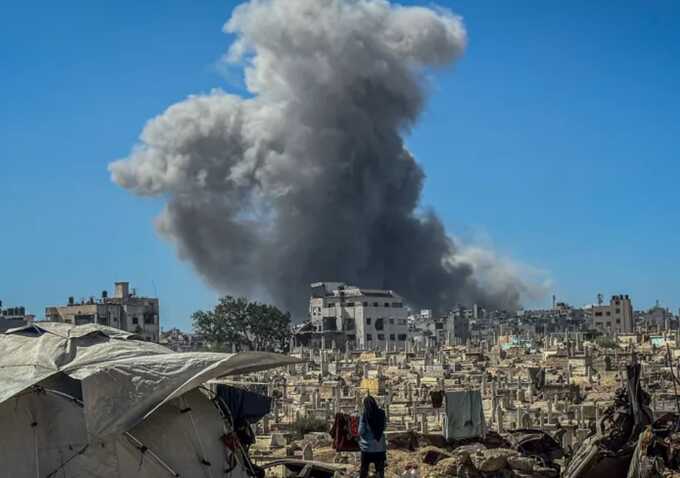
Israel and Hamas have agreed to the initial phase of a ceasefire plan in Gaza, halting hostilities in the devastated region and offering the best hope so far for a definitive end to a bloody two-year conflict that has claimed tens of thousands of lives, destabilized much of the Middle East, and sparked protests worldwide.
Donald Trump announced the agreement on his Truth Social network, stating all of the hostages held in Gaza would soon be released, and Israel would withdraw troops to an agreed line as the first step towards a "Strong, Durable, and Everlasting Peace."
Hamas stated on Thursday that it had agreed to the U.S. president’s proposal, confirming that the deal included an Israeli withdrawal from the enclave and a hostage-prisoner exchange.
There was celebration among Palestinians in Gaza and among Israelis, though few needed reminding that two previous deals had failed to end the conflict.
The signing of the agreement is expected on Thursday. The 20 hostages believed to be still alive in Gaza may be released as early as this weekend, with sources indicating that up to 1,700 Palestinian prisoners could be freed from Israeli jails within 72 hours of the deal being signed. Hamas called on Trump and guarantor states to ensure Israel fully implemented the ceasefire.
In an interview later on Wednesday, Trump expressed confidence that the hostages would be "coming back" on Monday.
Responding to the announcement, the Israeli prime minister, Benjamin Netanyahu, hailed "a great day for Israel."
He stated: "This is a diplomatic success and a national and moral victory for the state of Israel… From the beginning, I made it clear: we will not rest until all our hostages return and all our goals are achieved."
Israel’s security cabinet will meet on Thursday afternoon to approve the release of Palestinian prisoners, and despite opposition from far-right members of the ruling coalition, it is unlikely to reject it.
In Tel Aviv, hostages’ families and their supporters began chanting "Nobel prize to Trump" as they gathered in the early morning hours. Some opened champagne and cheered. With tears of joy, families embraced previously released hostages in Hostage Square, where the mood was festive.
"I’m feeling fantastic, it feels like I’m in a dream. Two years of this, who would have thought it would finally happen?" said Margo Orton, a retired nursery teacher holding both a U.S. and an Israeli flag.
Palestinians in Gaza responded with a mix of joy and disbelief. "Thank God for the ceasefire, the end of bloodshed and killing," said Abdul Majeed abd Rabbo, in the southern city of Khan Younis. "I am not the only one happy, all of the Gaza Strip is happy, all the Arab people, all of the world is happy with the ceasefire and the end of bloodshed."
Trump praised what he described as a "great day" for the Arab and Muslim world, Israel, and all surrounding nations, including the U.S.
"We thank the mediators from Qatar, Egypt, and Turkey, who worked with us to make this Historic and Unprecedented Event happen. BLESSED ARE THE PEACEMAKERS!" he posted.
Netanyahu and Trump spoke by phone and congratulated each other on the agreement on Wednesday, with the prime minister inviting the president to address Israel’s parliament, according to Netanyahu’s office.
The UN chief, António Guterres, welcomed the agreement and called on all parties to "abide fully" by its terms.
Speaking from India, the UK prime minister, Keir Starmer, described it as a moment of "profound relief" and expressed gratitude for the tireless diplomatic efforts of Egypt, Qatar, Turkey, and the United States, supported by regional partners, to secure this crucial first step.
"This agreement must now be implemented in full, without delay, and accompanied by the immediate lifting of all restrictions on life-saving humanitarian aid to Gaza," he said.
The successful completion of the deal would mark the biggest foreign policy achievement so far for Trump, who assumed office in January, promising to quickly end the conflicts in Gaza and Ukraine, only to confront unforeseen obstacles and complexities.
Senior envoys from the U.S., Qatar, and Turkey joined the talks in the Egyptian Red Sea resort of Sharm-el-Sheikh this week, apparently adding momentum to discussions launched on Monday. Trump dispatched his son-in-law Jared Kushner and special envoy Steve Witkoff.
Signs that a deal was close surfaced earlier on Wednesday during a White House round table, as Secretary of State Marco Rubio gave the president a handwritten note with the words "very close" underlined.
"You need to approve a Truth Social post soon so you can announce deal first," read the handwritten note on White House stationery, captured by an Associated Press photographer.
Many details of the agreement, reached after three days of indirect talks, remain unclear, and implementing its terms presents significant challenges.
If negotiators have bridged gaps between Hamas and Israel over the first phase of the 21-point plan announced by Trump last week at the White House, it remains uncertain whether any progress was made on more contentious issues, such as disarming Hamas, as demanded by Netanyahu, and the eventual governance of Gaza.
However, if implemented, the agreement would bring both sides closer than any previous attempt to halt a war that expanded into a regional conflict, involving countries like Iran, Yemen, and Lebanon, and reshaping the Middle East. One previous ceasefire lasted just 10 days, another six weeks.
After the announcement of the deal, Trump told Fox News that the U.S. would play a role in rebuilding war-torn Gaza.
"We’ll be involved in helping them make it successful, and helping it stay peaceful," the president said, adding he was "very confident there’ll be peace in the Middle East."
Though few need reminding of the challenges in securing a durable peace, the potential cost of further hostilities is well-known.
More than 67,000 Palestinians, mostly civilians, have died in the relentless Israeli offensive, with over 170,000 injured. Approximately 20,000 children are among the dead. Much of Gaza lies in ruins, its people homeless and destitute amid the rubble of their homes and destroyed infrastructure. Witnesses describe entire neighborhoods, even towns, reduced to fine gravel. Thousands more casualties remain unidentified, believed to be buried.
About 1,200 people, mostly civilians, were killed by Hamas militants in the raid on Israel on 7 October 2023, marking the worst such loss in the country’s history. A further 251 people were taken hostage. Hundreds of Israeli servicemen and women have died in the Gaza conflict. Hamas has admitted difficulty in locating all the dead hostages’ remains.
In recent days, Israel reduced the intensity of its military campaign at Trump’s request, though strikes have not ceased entirely. Gaza’s medical authorities reported eight people were killed in Israeli strikes in the last 24 hours, the lowest toll in weeks. Daily death tolls were roughly ten times higher over the past month as Israeli forces advanced on Gaza City. Even if aid surges in, through the UN and Red Crescent as specified under Trump’s plan, hundreds of thousands will still not have enough food or shelter.
The war in Gaza has spilled across the region, sparking further conflicts in Lebanon, Yemen, and Iran. The relief among regional leaders, many of whom faced waves of public anger, will be significant, though tempered with anxiety about what may follow in Gaza. They must now address who will provide troops for the promised stabilization force in Gaza or fund its reconstruction, a task likely to take decades.

World Affairs Correspondent