6.9-magnitude earthquake kills at least 69 people in Philippines
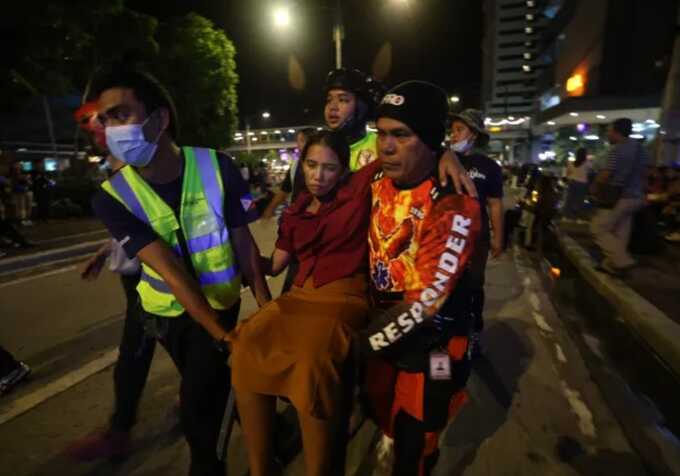
At least 69 people, including children, have died after an earthquake struck off the coast of the Philippines.
The United States Geological Survey reported a major 6.9-magnitude quake that occurred at 9:59 pm local time on Tuesday night.
The Cebu region has declared a state of calamity, with rescuers still sifting through rubble for any survivors.
Officials have confirmed 30 of the deaths are from Bogo City, which was closest to the epicenter of last night’s quake.
Some 22 people were also killed in San Remigio, 10 in Medellin, five in Tubogon, and one each in Sogod and Tabuelan towns.
Four bodies were pulled from the wreckage of the San Remigio sports complex and recreation center where a basketball game was being played at the time of the earthquake.

A fifth casualty was a child who died after debris fell on them while they slept, and three people on the outskirts of Bogo were killed when a landslide triggered by the quake hit their homes.
Rescue efforts are underway in the towns of San Remigio and Bogo, which have a combined population of around 154,000 people.
Assessing damage to buildings and roads, provincial rescue official Wilson Ramos warned: ‘There could be people trapped beneath collapsed buildings.’
There are fears the death toll could rise as rescue workers continued to search throughout the night.
Four aftershocks of magnitude 5 or higher have been recorded in the area since the first tremor, hampering recovery efforts.

The epicenter of the quake was around 17km (10 miles) northeast of Bogo on Cebu Island, one of the Philippines’ central islands.
The Philippines is very vulnerable to natural disasters as it lies on the ‘ring of fire’ – a geographical area prone to earthquakes and volcanic eruptions.
Last week, back-to-back typhoons also rocked the country and killed more than a dozen people.
As yesterday’s earthquake hit, people rushed out into the streets as they felt the quake, with a historic church damaged and the Cebu province town of Daanbantayan losing power.
A commercial building and a school in Bantayan collapsed, while a fast food restaurant in Bogo suffered heavy damage.


Cebu firefighter Joey Leeguid said: ‘We felt the shake here in our station, it was so strong. We saw our locker moving from left to right, we felt slightly dizzy for a while but we are all fine now.’
Martham Pacilan, a 25-year-old resident of the resort town of Bantayan, near the epicenter, said he was at the town square near a church when the quake struck.
He added: ‘I heard a loud booming noise from the direction of the church then I saw rocks falling from the structure. Luckily, no one got hurt.
‘I was in shock and in panic at the same time but my body couldn’t move, I was just there waiting for the shake to stop.’
Agnes Merza, a carer based in Bantayan, said her kitchen tiles had cracked.
She explained: ‘It felt as though we would all fall down. It’s the first time I have experienced it.
‘The neighbors all ran out of their homes. My two teenage assistants hid under a table because that’s what they were taught in the boy scouts.’
The Pacific Tsunami Warning Center has said there is no threat of a tsunami following the quake.
The Philippine Institute of Volcanology and Seismology has warned of a possible ‘minor sea-level disturbance’, damage, and further aftershocks.
It urged residents of the Leyte, Cebu, and Biliran islands to ‘stay away from the beach and not to go to the coast’.
The Philippines is located in the Pacific ‘Ring of Fire’, an area of intense volcanic and seismic activity stretching from Japan, across Southeast Asia, and across the Pacific basin.
While quakes are a near-daily occurrence there, most are too weak to be felt by humans. There is currently no technology able to predict where and when stronger, destructive earthquakes could hit.

Deputy Editor
Read more similar news:
Comments:
comments powered by Disqus