Spanish-Russian wine exporter probed for shipping banned chemicals to Russia

A Russian-Spanish wine exporter whose family operates a stylish tapas bar is under investigation for sending sanctioned chemicals to Russia, including diethylamine, a chemical used in the production of the nerve agent VX. Reporters discovered she also owns a chemical company in Russia, which has had major state scientific agencies as clients, known for developing chemical weapons.
Cavina Vinoteca, a trendy wine bar in Barcelona’s fashionable Poblenou neighborhood, has received glowing reviews online since it opened last year.
The restaurant is one of several culinary businesses managed by the Oleinikova family, led by matriarch Maria, who was born in Russia but is now a Spanish citizen. Alongside her son and daughter, she also manages a Spanish company that exports wine, beer, cider, and liqueurs to Russia.
However, OCCRP and partners have discovered that this company engaged in activities beyond beverages—it was also shipping chemicals to Russia, possibly breaching European Union sanctions imposed after Russia’s full-scale invasion of Ukraine in 2022.
Last year, Maria and her children Irina and Vyacheslav were arrested in a Spanish police operation called "Operacion Probirka" — or "Operation Test Tube" — during which 13,000 kilograms of chemicals were seized at the Port of Barcelona.
Operation Test Tube was part of a Spanish investigation into the illegal supply of chemicals to Russia, Spain’s Interior Ministry stated at the time, but since then, the government has provided almost no details about the case. Although the statement referred to a Russian company importing the chemicals, police did not publicly name it or provide details of the shipments.
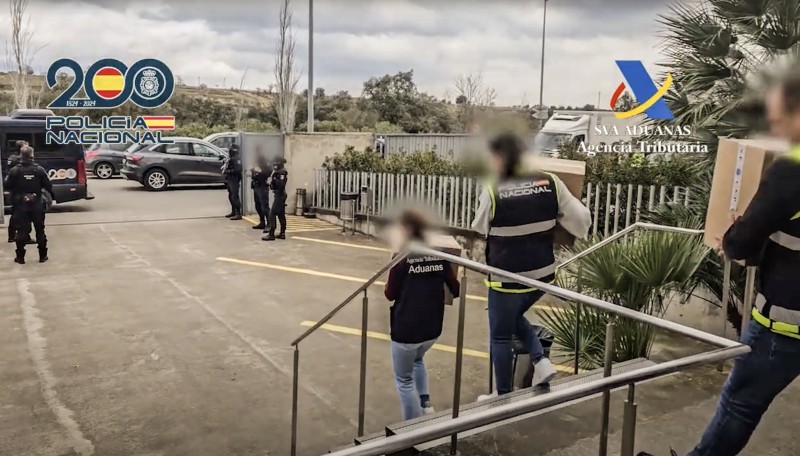
A Spanish police source involved in the investigation said authorities suspect Oleinikova was an "intermediary" who arranged the shipments. (The officer was authorized to speak to the press but not to be identified by name.)
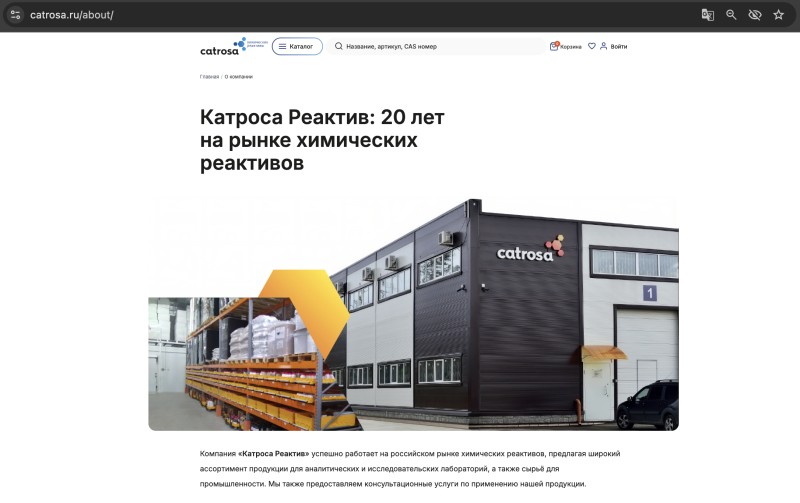
But using Russian import data, reporters found that Oleinikova doesn’t only operate in Spain—she also holds the majority ownership of a Russian chemical company called Catrosa Reactiv, which received at least 36 shipments of sanctioned chemicals from Spain between 2022 and 2024, including one directly from Complexe Sancu, the Spanish wine-and-beer export company run by Oleinikova and her children.
Most of the other shipments were made by a Spanish company called Scharlab S.L., headquartered in Barcelona with subsidiaries in Italy and the Philippines, according to import data. Scharlab is majority-owned by Werner Scharlau, a German residing in Spain who was among those arrested in February.
On its website, Catrosa Reactiv, which was founded in 2006 and taken over by Oleinikova’s husband two years later, states that it "successfully operates in the Russian chemical reagents market" and provides products to laboratories and raw materials to industry. The Russian company register indicates that Oleinikova, who has a background in academic scientific research, became the company’s majority shareholder in 2015 and still holds a controlling stake in the firm.
It is not known how the chemicals imported from Spain to Catrosa Reactiv were ultimately used. However, leaked transaction data obtained by reporters showed Catrosa Reactiv’s clients in Russia since 2022 have included at least six sanctioned entities linked to weapons production, the defense sector, and the Russian military.
They included the State Scientific Research Institute of Organic Chemistry and Technology, also known as GosNIIOKhT. It has been sanctioned by the EU and U.S. for its involvement in the development and production of chemical weapons including the toxic nerve agent Novichok, which has been used by Russian operatives for stealth assassinations abroad.
Since 2022, Catrosa Reactiv has also received payments from:
-
The All-Russian Scientific Research Institute of Experimental Physics, an agency that developed weapons in the Soviet era, including the first Soviet atomic bomb, before shifting its focus towards building and managing Russia’s most advanced supercomputers
-
The Scientific Research Institute of Applied Acoustics, which was sanctioned by the U.S. for allegedly "carrying out research and development of military products." The U.S. also alleged it had been "involved in the procurement and inventory of chemicals that could be used in the production of chemical weapons agents."
-
Explosives manufacturer SKTB Technolog, a contractor for the Russian Ministry of Defense
-
The 18th Central Research Institute, known as Military Unit 11135, which is part of Russia’s GRU military intelligence service
Reporters did not identify any chemicals specifically associated with chemical weapons in Catrosa Reactiv’s import data. However, Miguel Ángel Sierra, a professor of organic chemistry at the Complutense University of Madrid and former member of the scientific advisory board of the international Organization for the Prohibition of Chemical Weapons, said the chemicals it imported from Europe were sanctioned because they could potentially be used in multiple ways, such as creating explosives.
"These have been banned by the European Union because they are industrial products," he explained. "For example, there are many processes you can’t carry out, including the preparation of explosives, the preparation of pharmaceuticals, and the preparation of many other things, without having some of these products."
Spain’s Audiencia Nacional— a court that deals with terrorism and major crimes — confirmed to OCCRP that Oleinikova and her two children are among nine suspects currently under investigation for "smuggling banned substances." All nine suspects have been released while the investigation continues, and no one has been charged with a crime, the court’s press department said.
Oleinikova declined to comment for this story because the case is still under investigation by the Audiencia Nacional.
How Reporters Identified Catrosa Reactiv’s Imports
Reporters reviewed extensive Russian import records for Catrosa Reactiv on the ImportGenius commercial database, filtering them to include only shipments received after Russia’s full-scale invasion of Ukraine, to detect possible sanctioned chemicals.
Some of the shipments from Spain included the "HS Codes" – international product identification categories under which genres of exports are grouped for customs purposes.
In some cases, reporters discovered product descriptions for individual chemicals within the import data, but not always.
Where they could find descriptions of individual chemicals, they cross-referenced them with EU sanctions lists, which are updated every four months, to determine which chemicals were being illegally shipped out of Spain despite a ban.
While OCCRP and its partners were able to establish that Catrosa Reactiv made 36 imports of at least 15 banned products from Spain since 2022, the actual figures may be higher since the commercial database may be incomplete and the product descriptions for some shipments were imprecise.
Russian Firm Imported Sanctioned Chemicals in Dozens of Shipments
Official press releases following the October 2024 raid on the Barcelona port didn’t specify the confiscated chemicals, but police told OCCRP they had seized 13,000 kilograms of the solvent N-Methyl-2-pyrrolidone (NMP), widely used in electronics, pharmaceuticals, and coating. Investigators also found smaller amounts of other chemicals that could be used in weapons production.
Some shipments of chemicals — including nitric acid and acetone, both used in the manufacture of explosives, and diethylamine, a chemical involved in the manufacturing of the nerve agent VX — had already left Spain for Russia, police said.
To form a complete picture of the types of chemicals Catrosa Reactive was importing from the EU, reporters reviewed Russian import records in a commercial database.
The 32 shipments Catrosa Reactiv received from Scharlab contained 14 chemicals worth $15,000, all subject to EU export bans from April 2022 to June 2023 due to their potential contribution to the enhancement of Russia’s defense, security, and industrial sectors. They included $8,200 worth of NMP, the same solvent discovered at the Barcelona port, plus $5,800 worth of isopropanol and $2,550 of hydrogen peroxide.
The shipment made to Catrosa Reactiv from Complexe Sancu, the Spanish wine export company run by Maria Oleinikova’s children, contained around $3,650 worth of sodium hydrogen carbonate — also known as sodium bicarbonate or baking soda. Despite its benign uses, the chemical was prohibited for export from the EU to Russia in April 2022 under the category of "goods which could contribute to the enhancement of Russian industrial capacities."
‘Europeans Don’t Have the Infrastructure to Check’
Experts say the EU’s customs systems are insufficient to deal with the bloc’s extremely broad sanctions on chemical exports to Russia, making it easy for shipments like those from Spain to slip through the net.
In international shipping, exporters label their goods using broad group identifiers known as HS Codes, which can cover a wide range of products, including both banned and permitted substances. This means it is possible to export a chemical under an HS Code that does not identify the presence of a specific banned substance.
Elina Ribakova, a senior fellow at the Peterson Institute for International Economics, a think tank based in Washington, D.C., said that HS Codes, which include sanctioned products, are supposed to be flagged as high risk and checked more closely by customs officials.
However, she said that in practice, this doesn’t always happen: "The question is whether the product is correctly classified under its appropriate HS Code and whether it is actually being checked."
Even though the EU and Spain have created additional code numbers designed to add further detail to the international HS Code categories, Ribakova said it’s still "very hard to pin down a product" as they tend to be grouped.
"Europeans don’t have the infrastructure to check more holistically for something that is not a nuclear or very specialized weapon," she told OCCRP, adding that these limitations make it "relatively easy" to export sanctioned products.
In the case under investigation in Spain, exporters mixed batches of sanctioned chemicals inside larger shipments of legal substances or listed false destinations on customs paperwork, such as Armenia and Kyrgyzstan, to disguise the fact that shipments were headed for Russia, investigators told OCCRP.
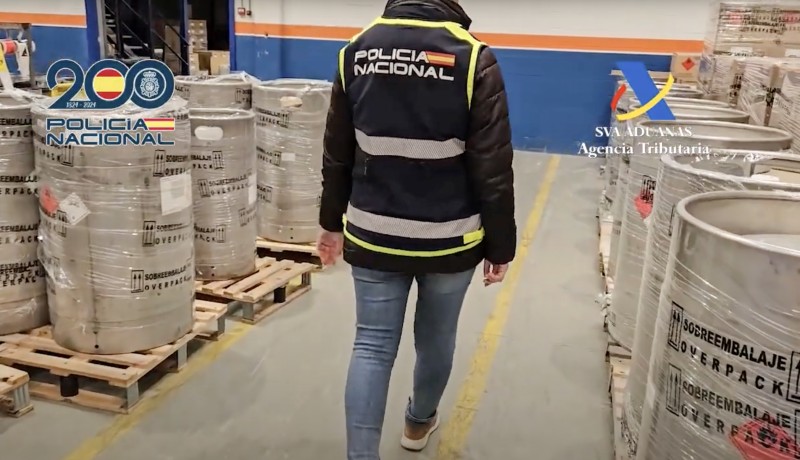
One of the investigators working on the case told OCCRP that evidence obtained thus far shows the shipments did not actually pass through those countries, and that the companies listed as recipients were fronts.
Instead, they traveled overland to Russia via other countries, including Poland and Belarus, he claimed. It’s not clear which, if any, of the people or companies under investigation utilized these tactics. However, import records for Catrosa Reactiv reviewed by OCCRP and its partners show that it received one shipment of the sanctioned chemical NMP in 2023 that originated in Spain, but was routed via a Kyrgyz company, NK Muras LLC.
The data indicates that the shipment was manufactured by one of the companies under investigation by Spanish authorities for illegally exporting sanctioned chemicals in the case involving Oleinikova.
According to the import records, the supplier acting under the "order" of NK Muras was Vlate Logistik LLC, a Belarusian transport and storage company sanctioned by the EU in December 2024 for its ties to the Moscow-aligned regime of President Aleksandr Lukashenko.
In 2024, Complexe Sancu, the Spanish export company managed by Maria Oleinikova’s children, sent at least one shipment of NMP to NK Muras. Available records do not show if that shipment eventually reached Catrosa Reactiv.
Separate transaction data obtained by reporters indicates that Catrosa Reactiv paid NK Muras more than $240,000 in 2023 for three shipments of unspecified pharmaceutical ingredients.
Neither NK Muras nor Vlate Logistik responded to requests for comment.
World Affairs Correspondent
Read more similar news:
Comments:
comments powered by Disqus