16 September 2025 , 07:44
671
0
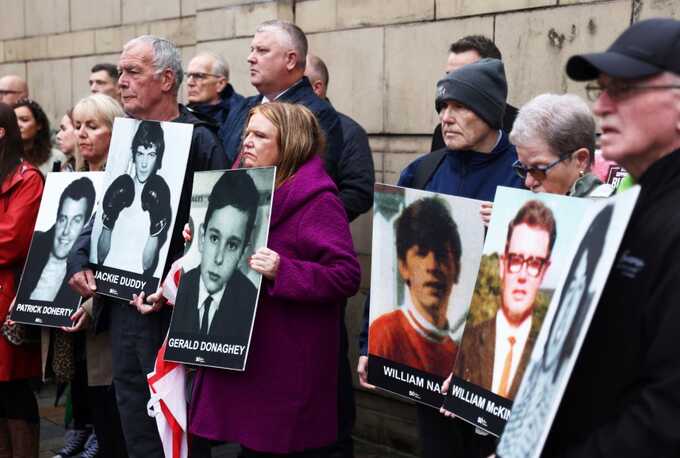
Soldiers disgraced the British army by targeting unarmed civilians in an "unjustified" and "gratuitous" use of force on Bloody Sunday, the murder trial of an army veteran has heard.
The shooting by the former paratrooper and his comrades was "unnecessary" and had a profound impact on Northern Ireland, a prosecutor told Belfast crown court on Monday at the opening of the long-awaited trial.
Soldier F is charged with two murders and five attempted murders when the Parachute Regiment fatally gunned down 13 civil rights protesters in Derry on 30 January 1972, a defining event of the Troubles.
The former lance corporal pleaded not guilty to the murders of James Wray and William McKinney and the attempted murder of five others. Granted anonymity by a court order, he entered court 12 before the press and public, and a curtain concealed him in the dock.
Relatives of the dead said the trial – a non-jury case that is being heard by the judge Patrick Lynch – was momentous. John McKinney, a brother of William McKinney, told supporters outside the court: "It has taken 53 years to get to this point, and we have battled all the odds to get here. Everything that we have achieved to this point has been through relentless commitment and a refusal to lie down."
Soldiers shot 31 civilians on the day of the protest, killing 13. Another casualty who died four months later is widely considered a 14th victim.
In an opening statement, Louis Mably KC said the prosecution would keep a narrow focus on shootings in a courtyard in Glenfada Park.
He said: "The defendant was part of a small group of soldiers who moved west from Rossville Street into that courtyard. At the far end, civilians, fearful of the approach of the soldiers, began running across the courtyard towards a gap at one of the corners in order to escape.
"As they did so, soldiers acting together, and therefore with joint responsibility, opened fire with their self-loading rifles shooting at the civilians as they ran away.
"The prosecution case is that that shooting was unjustified. The civilians in the courtyard did not pose a threat to the soldiers and nor could the soldiers have believed that they did. The civilians were unarmed and they were simply shot as they ran away or, in one case, as he was simply in the square, either taking shelter or trying to evade the soldiers."
Mably called the shooting unnecessary and gratuitous. He said: "It was carried out, given the weapon involved, with an intent to kill and, in any event, at the least with an intent to cause really serious harm."
He accused the soldiers of losing control. Mably said: "Shooting people as they ran away – an act which disgraced the British army." He said the soldiers had falsely claimed that the people they shot had been armed with nail bombs and small rifles. "That was an attempt to justify and to confuse, but it was demonstrably false," he said.
A tribunal led by John Widgery in 1972 cleared the soldiers of wrongdoing but a 2010 inquiry by Mark Saville concluded that the killings were "unjustified and unjustifiable". David Cameron’s Conservative government apologised for the killings.
Relatives of the victims and supporters marched to the court behind a banner that said: "Towards justice." John McKinney said regardless of the case’s outcome the campaigners were on the right side of history. "Today, we place our trust in the hands of the Public Prosecution Service to finish the job. We hope that they do not let us down."
Supporters of Soldier F and other veterans also gathered outside the court. David Johnstone, the Northern Ireland veterans commissioner, said the legacy process – an attempt to address unresolved Troubles-era killings – had exposed former soldiers to "wholesale demonisation" and left them feeling angry and betrayed.
The case will be closely watched by the Irish and British governments, which are discussing ways to repeal the Legacy Act, which was an attempt by the previous Conservative government in the UK to phase out prosecutions for Troubles-era alleged crimes.

Deputy Editor