13 September 2025 , 10:21
882
0
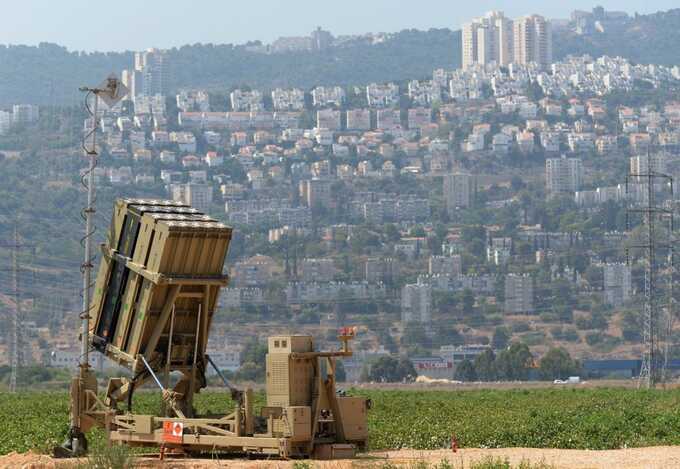
Europe’s plans to construct an Iron Dome-style missile and drone shield risks being scuppered by mounting anti-Israeli sentiment over the war in Gaza.
The German-led Sky Shield Initiative aims to create an air-defence dome stretching from Turkey to Finland as part of a massive Continental rearmament drive to face down Russian aggression.
It will use the German-made Iris-T and US Patriot surface-to-air batteries for its foundation, but for high-altitude interceptions its collaborators are planning to use the Israeli Arrow 3.
The Arrow 3, a joint programme between Israel and the US, is the world’s first air defence system dedicated to shooting down hypersonic missiles and is capable of exo-atmospheric interceptions.
But its use in the plans for the Sky Shield is being called into question, with Europe and Israel at loggerheads over the Jewish state’s refusal to end the war in Gaza.
European nations, including Germany, have stopped exporting weapons to Israel, while Ursula von der Leyen called on EU members to halt some trade over the war. There has also been a push towards recognising Palestine as a state.
In response, Israel could scupper Europe’s plans for their own Iron Dome. Jerusalem has a veto power on exports of its Arrow 3 missile – but it must have a sign off by its Defence Exports Control Agency (Deca).
Deca is responsible for signing off on export licences for domestically-produced weapons systems and military equipment, and says it does so in “consideration of other national interests”.
David Hening, director at the European Centre for International Political Economy, told the Telegraph this means that Israel could make the political decision to halt its exports of the missiles Europe needs.
Amos Yadlin, Israel’s former military intelligence chief, told the Telegraph: “If Germany takes significant steps that will harm Israel’s national security, Israel will have no choice but to walk back certain elements in the relations that are beneficial to both sides.”
But Mr Yadlin, who also once served as a general in Israel’s air force, added: “We are not there yet and we [both sides] should do everything we can to avoid getting there.”
He described Germany as one of Israel’s “closest and most important allies” and urged Israel to “continue cooperating with Germany in every aspect possible”.
In recent months, many of Israel’s traditional European allies have become increasingly critical of the Israeli government.
Mrs von der Leyen, the European Commission’s president, this week used her flagship State of the Union address to the European Parliament to announce payments from Brussels to Israel would be frozen.
The German, who was one of the first world leaders to visit the country in the wake of the October 7 terror attacks by Hamas, accused Israel of a “man-made famine” on the strip and a plot to undermine the two-state solution.
She urged deadlocked member states to find a “majority” to suspend trade elements of an agreement with Israel and sanction its “extremist” ministers and settlers.
Mrs von der Leyen urged them to overcome differences that had stopped proposals suspending funding to Israel under the EU’s Horizon research programme.
Sir Keir Starmer has also said he would recognise Palestinian statehood if Israel fails to meet certain conditions, including an immediate ceasefire in Gaza and an aid rush into the strip.
Dozens of capitals are expected to announce similar decisions at the United Nations General Assembly meeting in New York.
There are also an increasing number of embargoes by European countries on arms exports to Israel.
Germany, the Sky Shield’s founding member, said it had “stopped approving war-weapons exports to Israel” last year.
Slovenia, another member of the air-defence scheme, recently became the first EU country to enforce a full arms embargo in Israel.
A total of 24 countries are part of the programme, including the likes of Britain, Belgium and the Netherlands, which have all had their own criticisms of Israel’s wartime leaders.
Israel has accused European governments of anti-Semitism and playing into the hands of Hamas with their recent diplomatic attacks on the Jewish State.
‘Europe strengthening Hamas message’
Israeli foreign minister Gideon Sa’ar accused Mrs von der Leyen on Wednesday of echoing “false propaganda of Hamas and its partners”.
“Once again, Europe conveys a mistaken message, one that strengthens Hamas and the radical axis in the Middle East,” he said on social media.
At the same time, European leaders have expressed urgency on the need to push ahead with plans to reinforce the continent’s air defences, especially after almost two dozen Russian drones violated Polish airspace earlier this week.
The operation to protect the Nato territory required allied fighter jets to engage enemy targets inside its borders for the first time in its 76-year history.
In Strasbourg, Mrs von der Leyen was about to give her annual speech when news of the Russian drone attack broke.
The European Commission president condemned the “reckless and unprecedented violation of Poland’s and Europe’s air space”.
She went on: “We must heed the call of our Baltic friends and build a drone wall.
“This is not an abstract ambition. It is the bedrock of credible defence.”
Manfred Weber, leader of the influential European People’s Party, told the Telegraph it “simply makes sense” for Europeans to work together on a missile defence shield “from Finland to Greece”.
This would be accompanied by a sky surveillance system that would collect data on possible attacks without being dependent on Washington, he said.
‘European Iron Dome makes sense’
It would be like a European Iron Dome, he said, adding that it would be fully compatible with Nato, which was the cornerstone of security.
In Wyrki, where one of the Russian drones crashed, the mayor told the Telegraph the system would help.
“One of my employees called and said her neighbours’ house had exploded and that numerous planes were flying overhead. I decided to close local schools and cancel classes for the day.
“This was to protect children and prevent large gatherings,” said Bernard Blaszczuk.
“I think any local response to the situation from Nato would greatly enhance the sense of security of local residents. Deploying the Patriot system, radars, or drone interception systems would help secure the border, which would also increase local security.”
But without the Arrow 3, the envisaged Sky Shield system would not deliver its desired effect to protect the continent.
It would be left with the US Patriot system, which has been able to intercept hypersonic missiles fired by Russia at Ukraine, to shoot down targets at a range of 100km, but that shrinks for faster incoming projectiles.
The German-made Iris-T would be responsible for interceptions in an envelope of up to 40km.
The ground-based mobile Skyranger, made by Germany’s Rheinmetall, would also be used to cover smaller spaces against incoming drones.
A recent report by Bloomberg Intelligence suggested it would cost Europe around $200bn (£147bn) to build a significant air-defence system capable of guarding the entire continent.

Technology & Business Editor


