Former Sri Lankan president arrested over £40,000 misuse of public funds
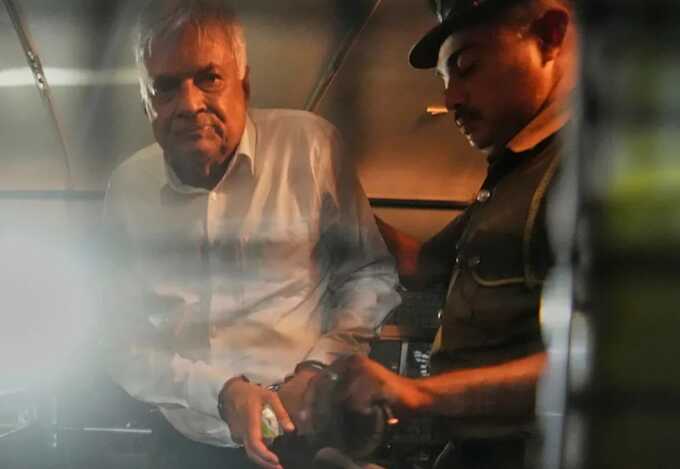
A former Sri Lankan president has been arrested for allegedly misusing public funds to fly to London in 2023 during an anti-corruption crackdown in the country.
Ranil Wickremesinghe, who became the first head of state to be arrested in the island nation’s history, is accused of misusing more than £40,000 of public money to pay for his private overseas trip.
The offences carry a maximum punishment of 20 years in prison and a fine not exceeding three times the value of the misappropriated funds. Mr Wickremesinghe, 76, was remanded in custody at Colombo’s New Magazine Prison in Sri Lanka.
Anti-graft units have increased their activities since Mr Wickremesinghe lost the presidential election to Anura Kumara Dissanayake last September.
Mr Dissanayake came to power on a promise to fight endemic corruption in the island nation, which is emerging from its worst economic meltdown in 2022. Opposition parties in Sri Lanka have accused his government of jailing the former president over fears that he could return to power.

Nalin Bandara, a member of parliament for the main opposition Samagi Jana Balawegaya (SJB) party, who visited Mr Wickremesinghe in prison, said the former leader had called for unity to challenge Mr Dissanayake’s Left-wing administration.
“What the former president says is that we should get onto a common stage to fight the oppression of the new government,” Mr Bandara told reporters outside the prison. Mr Wickremesinghe is due to appear in the court again on Aug 26.
Mr Wickremesinghe’s United National Party (UNP), which has two seats in the 225-member parliament, said the government felt threatened by the former president.
“They fear he might return to power, and that is why this action,” Thalatha Athukorala, the UNP general secretary, told reporters in Colombo.
Mr Wickremesinghe stands accused of using state funds to finance a private visit to Britain in September 2023 while returning from attending the G77 summit in Havana, Cuba, and the UN General Assembly in New York.
His two-day UK visit was to participate in the conferring of an honorary professorship on his wife, Maithree, by the University of Wolverhampton.
The court heard that state funds amounting to 16.6 million Sri Lankan rupees (£40,000) had been spent on the London leg of the journey, which included travel for a delegation of 10 people. Mr Wickremesinghe has maintained that his wife’s travel expenses were met by her, and that no state funds were used.
‘Politically motivated case’
Defence lawyers argued that the visit was conducted based on an official invitation processed through the Sri Lankan High Commission in London and the Ministry of Foreign Affairs. They accused the government of pursuing a politically motivated case.
Mr Wickremesinghe, who served six terms as prime minister before assuming the presidency at the height of Sri Lanka’s 2022 economic crisis, is widely credited with stabilising the economy after mass protests forced Gotabaya Rajapaksha, his predecessor, from office.
His detention has also drawn criticism from across the political spectrum. Moratuwa councillor Lihini Fernando, of the opposition Samagi Jana Balawegaya, warned that criminalising the overlap between a president’s public and private life “sets a dangerous precedent” for the office.
Since the new government came to power, two former senior ministers have been jailed for up to 25 years for corruption.
Several members of former president Mahinda Rajapaksa’s family have also been charged with misusing state funds and are being prosecuted. Many of them are currently on bail pending court hearings.
This month, Mr Dissanayake’s government impeached the police chief after accusing him of abuse of power. The prison chief was also jailed for corruption.

Technology & Business Editor
Read more similar news:
Comments:
comments powered by Disqus