07 January 2024 , 09:29
740
0
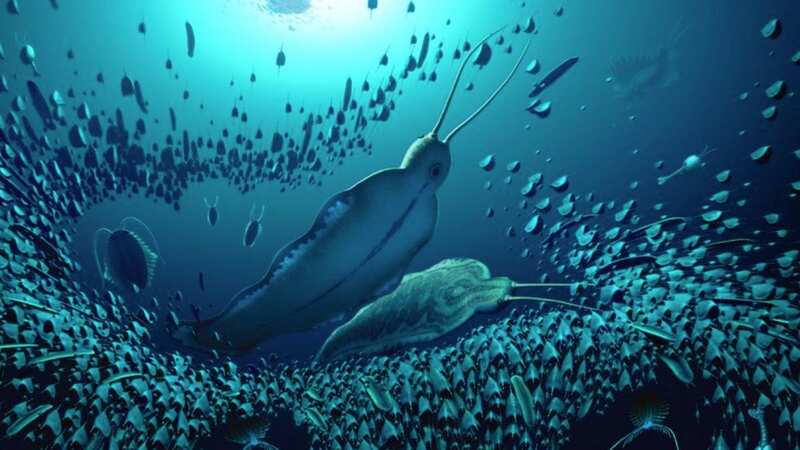
Terrifying "beast" worms that dominated our oceans more than 500 million years ago have been discovered by scientists.
These 11-inch worms were said to be near the top of the food chain equivalent to the modern-day "sharks and seals". Fossil remains of these worms were uncovered in the sedimentary deposits at the Sirius Passet site in North Greenland. They have been called Timorebestia, which means “terror beasts” in Latin.
Growing to about 30cm in length, or 11 inches, the Timorebestia had a distinct head with long antennae, fins on the sides of the body and massive jaw structures inside its mouth.
Inside the digestive system of this ancient worm, researchers from the University of Bristol also found evidence of what may have been its final meal – a small creature called Isoxys.
Scientists believe these large worms were close to the top of the ancient food chain 518million years ago and “equivalent in importance to some of the top carnivores in modern oceans such as sharks and seals”.
 Nursery apologises after child with Down's syndrome ‘treated less favourably’
They speculate that these creatures may have had a dynasty of “about 10 to 15 million years before they got superseded by other, and more successful, groups”.
Dr Jakob Vinther, from the University of Bristol’s Schools of Earth Sciences and Biological Sciences, said the closest living relative of the Timorebestia are arrow worms called chaetognaths. Chaetognaths are small predatory marine worms – about 1cm long – that feed on tiny zooplankton. The researchers said their work, published in the journal Science Advances, sheds light on how arrow worms may have evolved.
Senior study author Tae Yoon Park, from the Korean Polar Research Institute, said: “Living arrow worms have a distinct nervous centre on their belly, called a ventral ganglion. It is entirely unique to these animals. “We have found this preserved in Timorebestia and another fossil called Amiskwia.
“People have debated whether or not Amiskwia was closely related to arrow worms, as part of their evolutionary stem lineage. The preservation of these unique ventral ganglia gives us a great deal more confidence in this hypothesis. We are very excited to have discovered such unique predators in Sirius Passet.”
Dr Vinther, also a senior author on the study, added: “Our research shows that these ancient ocean ecosystems were fairly complex with a food chain that allowed for several tiers of predators.”
Meanwhile Isoxys – the creature found inside the Timorebestia – is believed to be a marine arthropod, an invertebrate animal with jointed legs.
Morten Lunde Nielsen, a former PhD student at the University of Bristol who was involved in the study, said that Isoxys would have been a food source for many other animals, adding, that Timorebestia “munched on them in great quantities”.