04 November 2023 , 15:56
736
0
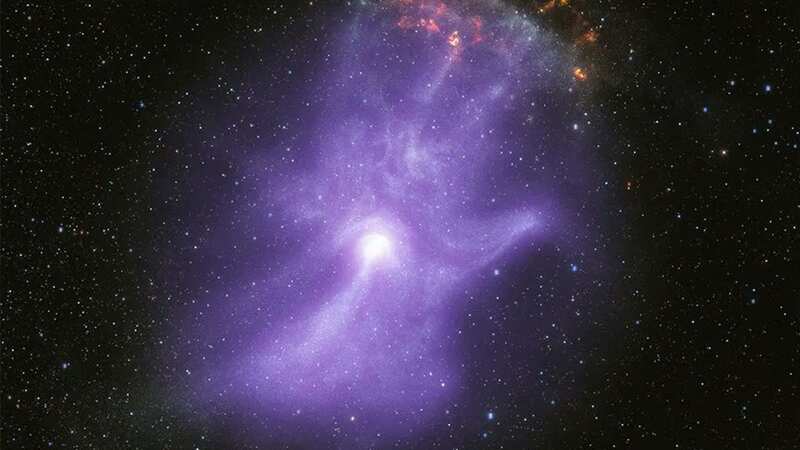
It seems that even the in space there's spooky goings on as NASA has revealed “bones of a ghostly cosmic hand” about to grab the galaxy.
The US space agency ghosted in with these stunning images at the right time, with Halloween still fresh in the memory and bonfire night just around the corner. The images are of a giant star that died 1,500 years ago and resemble a skeletal figure of a four-fingered outstretched hand swirling around the Milky Way in purple plumes.
The breathtaking images captured by a telescope are actually the spectral phalanges of pulsar wind nebula — known as MSH 15-52 — and are the remnants of the star that collapsed in on itself after running out of nuclear fuel more than 15 centuries ago, forming an extremely dense object called a neutron star.
 The ghostly hand was captured on a NASA telescope (NASA)
However, as with most things in space, it lingers on, in this case “through plumes of particles of energised matter and anti-matter” that fluctuates in an intense wind — 16,000 light-years from Earth.
According to the New York Post, Roger Romani of Stanford University, who led the study, said: “The IXPE data gives us the first map of the magnetic field in the hand. The charged particles producing the X-rays travel along the magnetic field, determining the basic shape of the nebula, like the bones do in a person’s hand.”
 'Weird' comet heading towards the sun could be from another solar system
The space agency's scientists have known about the pulsar since 2001, when they discovered it swirling at the base of the “palm” of the nebula and they aim to better understand how pulsars behave — that they work as particle accelerators – through studying the images.
The spooky pictures were captured by two of NASA’s telescopes — including the new Imaging X-ray Polarimetry Explorer (IXPE), which viewed the structure for 17 days, the longest it has looked at any object since it launched in December 2021.
Researchers said that in the nebula, there is a “remarkably high” amount of polarisation, which points to the magnetic field being “very straight and uniform", with little turbulence in much of the nebula.
Particles located in turbulent areas of the nebula are instead given an “energy boost,” causing them to flow to the “wrist, fingers and thumb” parts of the nebula. The images were released just days after NASA shared eerie pictures of what appeared to be a Picasso-esque face on Jupiter.