Thousands stumped by riddle that challenges you to count clocks, tables and mugs
Riddles are sometimes tricky enough that they make you want to scream, and this one is absolutely no different, so why don't you send it to some family and friends and see who can work it out first?
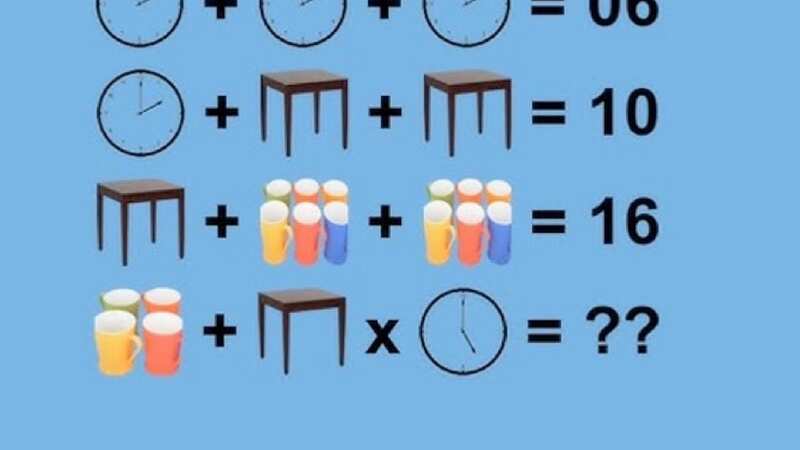
At the bottom of the riddle image, players are asked to try and work out what a group of random objects is worth numerically, based on a formula listed for each object above. The puzzling list of items includdes cups, tables and clocks.
In the list, there's three clocks which equate to six, a clock and two tables which equate to 10, and then a table and two sets of cups which equate to 16. Baffled already? Us too. The riddle, originally posted on X, formally known as Twitter, asks you to work out is what one set of cups plus a table times by a clock is. No biggie.
 Think a little deeper about this one... (@NoContextHumans/Twitter)
If you're confused, you're not the only one as many people in the comments were debating what the answer was. One person responded with confidence, but they were bluntly told that they were wrong when someone else posted a seriously long response explaining why the actual answer was different to what they thought.
Of course, we shouldn't have assumed that a riddle would be that straightforward and easy - many people thought hat the answer was 6 + 4 x 2 - but if you look at the question again, you'll realise that the variables are a little bit different than in the previous picture.
 'I don't want children staying up late at weekends - I really need adult time'
Daily Quiz and Riddles posted the explanation to debunk all the other confused users, writing: "Answer: 19. Explanation: Clock + Clock + Clock = 6; This means Clock = 2 Clock + Table + Table = 10; This means 2 + (2*Table) = 10. Table = 8/2; Table = 4. Table + 6Cups + 6Cups = 16; This means 4 + 12Cups = 16; 1Cup = 1. 4Cups + Table*Clock =? = 4+ 4*2 = 4+8 = 12 But is the answer truly 12? No. This is where you need to watch more clearly. The last Table has 3 legs, and the clock is on 5. That means the last Table = 3 (not 4); and the clock = 5 (not 2) Answer is 4 + 3*5 = 19."
Did you spot the fact that the table had only three legs and the clock was at 5pm? No? This riddle is far sneakier than you first expect, and it's caught many brainy players out.
Responding to a confused commenter, they said: "In actual mathematics, they are indeed different variables, so there wouldn't be answers. But in the context of riddles/brain teasers, it's just testing the 'number of cups', 'hand of the clock' and the 'legs of the table'." "The explanation explains it all", someone joked.
Did you manage to work it out? Let us know in the comments.
Read more similar news:
Comments:
comments powered by Disqus