Waves from the 'Cosmic Dark Ages' to be detected from moon's dark side
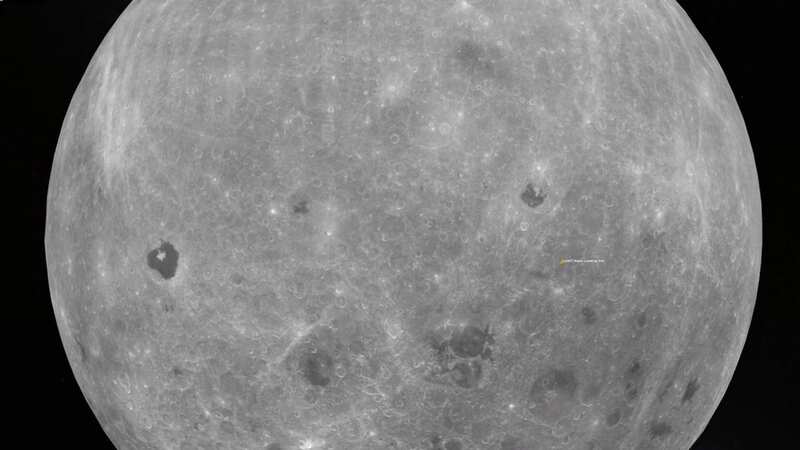
A mission to detect radio waves from an era known as the 'Cosmic Dark Ages' from the dark side of the moon is now planned with a small telescope expected to rocket to space.
A NASA-funded small radio telescope is set to blast off to the moon's far side in 2025 to track waves from 13.4 million years ago. The project involves scientists from the University of California, Berkeley, the University of Minnesota, the Lawrence Berkeley National Laboratory and the Brookhaven National Laboratory and is also being funded by the US Department of Energy.
The project will study the existence of the universe sometime after the Big Bang and will use the far side of the moon because it is far away from the noisy Earth bustling with radio waves of its own in an atmosphere that blocks out some signals.
For all the latest news, politics, sports, and showbiz from the USA, go to The Mirror US
 Kaja Rotermund making adjustments to the LuSEE-Night antenna (Marilyn Sargent, Multimedia Producer)
The moon also acts as a shield to the Earth, blocking signals and diverting them away from the Earth, so the team of scientists plans to put the machinery in a place where signals can be picked up before this happens. The team will use the complicated Lunar Surface Electromagnetics Experiment-Night (LuSEE-Night) pathfinder.
 'Weird' comet heading towards the sun could be from another solar system
Kaja Rotermund, a postdoctoral researcher at Berkeley Lab, said: "If you’re on the far side of the moon, you have a pristine, radio-quiet environment from which you can try to detect this signal from the Dark Ages.
"LuSEE-Night is a mission showing whether we can make these kinds of observations from a location that we’ve never been in, and also for a frequency range that we’ve never been able to observe."
 The LuSEE-Night will have to operate in extreme temperatures (Marilyn Sargent, Multimedia Producer)
Rotermund added: "We’re looking for this very tiny dip that is potentially the Dark Ages signal... We can learn a lot about the cosmology that’s being governed during this time period in a way that is unaffected by stars and other objects that grow very differently, compared to the universe in general."
Measuring the signal remains extremely complicated. The machinery must first operate in extreme temperatures and can only send its data back to Earth by contacting a passing satellite.
"The engineering to land a scientific instrument on the far side of the moon alone is a huge accomplishment,” said Aritoki Suzuki, who leads the antenna project for Berkeley Lab. “If we can demonstrate that this is possible – that we can get there, deploy, and survive the night – that can open up the field for the community and future experiments."
The LuSEE-Night will look for energy absorbed by hydrogen particles known as cosmic microwave background (CMB), which may now be able to be picked up as radio waves.
“With the CMB, we have this snapshot of the early universe. And we also have images from the more recent universe, once the stars are born,” Suzuki said. “We want to study the Dark Ages period because it connects how the early universe evolved into the universe we see today.”
Read more similar news:
Comments:
comments powered by Disqus