Stunning new detailed NASA photograph of Moon's south pole taken by space probe
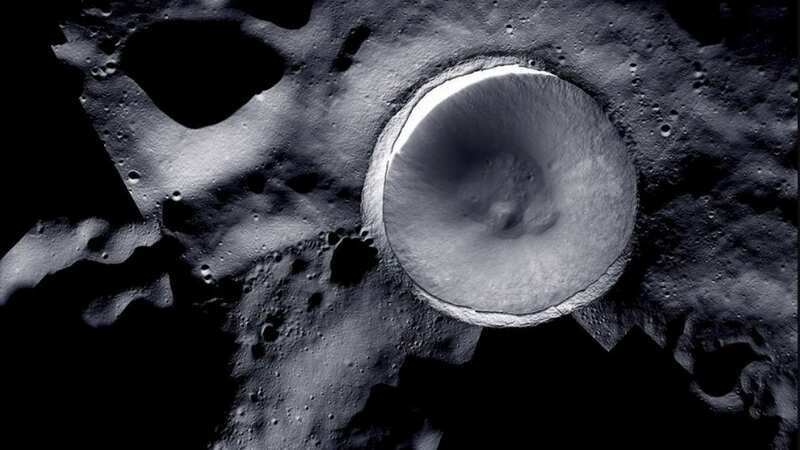
Stunning images from NASA show the Moon's south pole in incredible detail.
The Lunar Reconnaissance Orbiter Camera (LROC) used a 'ShadowCam' to try and capture high-resolution pictures of "features and terrain details that are not visible to LROC". Experts at the space organisation were interested in the area around the Shackleton Crater because of suspected ice deposits.
"Scientists believe layers of the ice deposits have existed on the Moon for millions or billions of years," NASA said. "the ability to study samples could further our understanding of how the Moon and our solar system evolved."
The experts added: "The ice deposits could also serve as an important resource for exploration because they are comprised of hydrogen and oxygen that can be used for rocket fuel or life support systems."
For all the latest news, politics, sports, and showbiz from the USA, go to The Mirror US
 Green comet last seen by Neanderthals 50,000 years ago to fly past earth tonight
 Parts of the Moon's south pole are never immersed in sunlight (Getty Images)
Areas like the Shackleton Crater are at an angle so parts of it are never immersed in sunlight. It means that if a person was to stand at the moon's south pole, the Sun would never rise or set and stay low on the horizon all of the time.
NASA said previously: "Future Artemis missions to the Moon’s South Pole may use these highly illuminated regions to make use of solar energy and support a base camp with trips into shadowed regions to determine what the low-temperature crater holds. The South Pole also provides near constant communication with Earth."
It comes as a NASA spacecraft will fly by Earth on Sunday and drop off what is expected to be at least a cupful of rubble it grabbed from the asteroid Bennu.
 NASA's Lunar Reconnaissance Orbiter (NASA)
The sample capsule will parachute into the Utah desert as its mothership, the Osiris-Rex spacecraft, zooms off for an encounter with another asteroid. Sunday's landing concludes a 4 billion-mile journey highlighted by the rendezvous with the carbon-rich Bennu, a unique pogo stick-style touchdown and sample grab, a jammed lid that sent some of the stash spilling into space, and now the return of NASA’s first asteroid samples.
“I ask myself how many heart-pounding moments can you have in one lifetime because I feel like I might be hitting my limit,” said the University of Arizona’s Dante Lauretta, the mission’s lead scientist.
It is hoped that one of the findings from the study will help scientists figure out how to deflect Bennu, set to come dangerously close and strike Earth with the force of 24 atom bombs on September 24, 2182.
The space rock - which is the same size as the Empire State Building - swings close to our planet every six years. However, the agency says there is a 1 in 2,700 chance it could strike Earth, with catastrophic results.
Read more similar news:
Comments:
comments powered by Disqus